16MnCr5 Steel Properties: What Buyers Should Check Before Purchasing
📑 Table of Contents
- 🔍 1. What Are the Key 16MnCr5 Steel Properties?
- 🧪 2. 16MnCr5 Chemical Composition and Its Effect on Properties
- ⚙️ 3. 16MnCr5 Mechanical Properties in Different Conditions
- 🔥 4. 16MnCr5 Hardness and Case-Hardening Performance
- 🌡️ 5. How Heat Treatment Changes 16MnCr5 Properties
- 🏭 6. 16MnCr5 Properties for Gears, Shafts and Mechanical Parts
- 📏 7. 16MnCr5 Steel Plate Size, Machining and Supply Condition
- 📋 8. What Buyers Should Confirm Before Purchasing 16MnCr5
- 🔬 9. MTC, Inspection and Quality Requirements
- 🏢 Otai Special Steel Advantages
- ❓ FAQ About 16MnCr5 Steel Properties
🔍 1. What Are the Key 16MnCr5 Steel Properties?
16MnCr5 steel properties make this grade suitable for components that need a hard, wear-resistant surface while retaining a relatively tough core. The material is identified as 16MnCr5 and material number 1.7131, and it belongs to the case-hardening steel family covered by EN 10084.
Unlike a conventional through-hardening alloy steel, 16MnCr5 is designed primarily for carburizing. Its relatively low carbon content allows the core to retain useful toughness, while carburizing enriches the surface with carbon before hardening. After the specified treatment, the surface can reach approximately 58–62 HRC, while the core retains substantially different mechanical properties.
That distinction is important when you are buying the material. The hardness of 16MnCr5 in its delivery condition is not the same as the surface hardness of a finished carburized component. A supplier quotation should therefore identify the material condition rather than simply state a single hardness number.
| Property | What It Means | Why Buyers Should Check It |
|---|---|---|
| Chemical composition | Defines the grade and its heat-treatment response | Confirms compliance with the specified standard |
| Delivery hardness | Indicates machinability and supply condition | Helps determine the machining route |
| Case hardness | Surface hardness after carburizing and hardening | Important for wear and contact performance |
| Core strength | Mechanical performance beneath the hardened case | Important for impact and load-bearing components |
| Hardenability | Ability to develop the required hardened structure | Becomes more important as section size increases |
For procurement, this means that the “best” property depends on the finished component. A gear may prioritize case hardness and fatigue resistance, while a machined blank may first require controlled delivery hardness and good machinability.
🧪 2. 16MnCr5 Chemical Composition and Its Effect on Properties
The chemical composition explains much of the material’s behavior during carburizing and hardening. Under EN 10084, 16MnCr5 contains approximately 0.14–0.19% carbon, 1.00–1.30% manganese and 0.80–1.10% chromium, with silicon, phosphorus and sulfur controlled within specified limits.
The following table presents the standard-specified composition range or limit. These figures should not be confused with a steel mill’s Typical Analysis or the actual chemistry of an individual heat.
| Element | EN 10084 Reference Range / Limit, wt.% | Procurement Relevance |
|---|---|---|
| Carbon (C) | 0.14–0.19 | Supports the low-carbon core and carburizing response |
| Silicon (Si) | ≤0.40 | Controlled alloying element affecting processing and properties |
| Manganese (Mn) | 1.00–1.30 | Contributes to hardenability and strength |
| Phosphorus (P) | ≤0.025 | Controlled residual element |
| Sulfur (S) | ≤0.035 | Controlled for material quality and machinability balance |
| Chromium (Cr) | 0.80–1.10 | Supports hardenability and case-hardening performance |
Carbon deserves particular attention. 16MnCr5 starts with a relatively low carbon level, but carburizing increases carbon concentration near the surface. The treatment therefore creates a useful difference between the surface and the core.
Manganese and chromium also matter because they contribute to hardenability. However, buyers should not assume that the presence of these alloying elements guarantees identical performance at every thickness. Section size, heat-treatment parameters and the specified hardenability band all influence the final result.
When purchasing, ask for the actual heat analysis shown on the MTC. The standard tells you what composition is permitted; the MTC tells you what the supplied heat actually contains.
If you are comparing related grades, do not rely on the grade name alone. AISI 5115, JIS SCr415/SCr420 and other grades may appear in cross-reference tables, but their standards and requirements can differ. Treat equivalence as a technical comparison that still requires verification against the drawing and purchasing specification.
⚙️ 3. 16MnCr5 Mechanical Properties in Different Conditions
One of the most important points about 16MnCr5 mechanical properties is that there is no single universal hardness or tensile-strength value for every condition. The material behaves differently when supplied soft annealed, normalized, carburized, quenched and tempered, or processed under a specific hardenability requirement.
For example, EN 10084 reference information gives a maximum hardness of about 207 HB for the soft-annealed (+A) delivery condition. After carburizing and hardening, the surface hardness can reach approximately 58–62 HRC. These two values describe completely different stages of the material’s manufacturing route.
| Condition | Reference Property | Procurement Meaning |
|---|---|---|
| Soft annealed (+A) | Hardness ≤207 HBW | Suitable starting condition where machining is required |
| Ferrite-pearlite (+FP) | Approximately 140–187 HB in referenced data | Controlled structure and hardness for processing |
| Carburized and hardened surface | Approximately 58–62 HRC in referenced data | Finished surface requirement for wear-resistant parts |
| Carburized core, 11 mm reference section | Rm approximately 780–1080 MPa; Re ≥590 MPa | Useful reference for core performance after treatment |
The core strength figures require careful interpretation. The referenced EN 10084 data gives different values according to ruling section. For an 11 mm reference bar, the core tensile-strength range is approximately 780–1080 MPa with a minimum yield strength of 590 MPa; larger reference sections have lower specified ranges.
Therefore, if your component uses thick plate, do not copy the mechanical values of a small reference bar directly into the purchase specification. Ask the supplier to confirm the applicable section-size requirements.
This is particularly important for industrial buyers purchasing large blanks. The final properties depend on the heat-treatment route and the material section, not simply on the 16MnCr5 designation.
🔥 4. 16MnCr5 Hardness and Case-Hardening Performance
Hardness is one of the most frequently searched 16MnCr5 steel properties, but buyers need to specify where and when the hardness is measured. Delivery hardness, core hardness and carburized surface hardness are not interchangeable.
In its soft-annealed delivery condition, 16MnCr5 is intentionally much softer than the final carburized component. This allows manufacturers to machine the blank before carburizing and hardening.
During carburizing, carbon diffuses into the surface. Subsequent hardening transforms the carbon-enriched surface into a high-hardness structure. Referenced technical data commonly gives approximately 58–62 HRC for the carburized surface.
The core remains lower in carbon than the enriched case. As a result, it retains a different microstructure and mechanical response. This combination is one of the main reasons engineers use 16MnCr5 for gears, pinions, shafts, pins and similar components subjected to surface wear and repeated loading.
For procurement, a request such as “16MnCr5, 60 HRC” can be ambiguous. You should specify whether 60 HRC refers to the finished surface, a particular depth, or another measurement location.
If the drawing specifies case depth, include that requirement as well. Surface hardness alone does not fully describe the performance of a carburized component. Case depth, hardness profile, core properties and dimensional distortion can all affect the finished part.
For demanding applications, the supplier and heat-treatment provider should also confirm how the hardness test will be performed. A surface hardness test and a core hardness test answer different questions and should not be treated as equivalent acceptance criteria.
🌡️ 5. How Heat Treatment Changes 16MnCr5 Properties
The heat-treatment route determines how the chemical composition translates into final performance. 16MnCr5 is normally selected for carburizing rather than simply through-hardening the entire section.
Published technical data gives approximate process ranges including carburizing around 880–980°C, core hardening around 860–900°C, surface hardening around 780–820°C, and tempering around 150–200°C. These figures are process references, not universal instructions for every component. Actual cycles depend on equipment, section size, required case depth, cooling method and the applicable specification.
| Treatment Stage | Referenced Temperature Range | Main Purpose |
|---|---|---|
| Carburizing | Approx. 880–980°C | Enrich the surface with carbon |
| Core hardening | Approx. 860–900°C | Develop the required core structure |
| Surface hardening | Approx. 780–820°C | Harden the carburized surface |
| Tempering | Approx. 150–200°C | Reduce stresses and stabilize the hardened structure |
These temperatures should be treated as qualified technical references rather than a recipe to apply blindly. A gear, shaft and thick plate blank can require different processing parameters.
Heat treatment also affects dimensional stability. Carburizing and quenching can introduce distortion, especially in components with complex geometry or tight tolerances. Consequently, manufacturers often leave appropriate machining allowance and perform finishing operations after heat treatment.
When buying raw 16MnCr5 steel, ask whether the material will be carburized after machining or whether you are purchasing a finished heat-treated component. The answer changes the relevant acceptance criteria.
For more detailed material and supply information, buyers can review Otai’s 16MnCr5 steel supply information and confirm the current material condition for the specific order.
🏭 6. 16MnCr5 Steel Properties for Gears, Shafts and Mechanical Parts
The practical value of 16MnCr5 becomes clearer when you consider how the finished component is loaded. The grade is commonly used where a component needs surface wear resistance but cannot sacrifice core toughness.
| Application | Important Property | Purchasing Focus |
|---|---|---|
| Gears | Hard case and tough core | Case depth, surface hardness and distortion |
| Pinions | Wear resistance and fatigue performance | Material chemistry and carburizing response |
| Shaft-related parts | Core strength and surface durability | Section size and final heat treatment |
| Pins and bushes | Surface wear resistance | Final hardness and dimensional control |
| Transmission components | Combination of surface and core performance | Traceability and heat-treatment documentation |
For gears, the surface must resist contact stress and wear, while the core must withstand the loads transmitted through the gear tooth. That is why a case-hardening steel can offer a different performance profile from a steel designed for uniform through-hardening.
For shafts and pins, the selection depends more strongly on geometry, loading mode and required surface treatment. If the component mainly requires through-hardening rather than carburizing, another alloy grade may be more appropriate.
Therefore, buyers should provide the supplier with the intended application whenever possible. The application does not replace the engineering specification, but it helps the supplier understand why you are requesting a particular delivery condition or processing route.
Before purchasing, also confirm whether the steel will be machined before or after carburizing. This determines the required allowance and can affect the final dimensional tolerance.
📏 7. 16MnCr5 Steel Plate Size, Machining and Supply Condition
Material properties are only useful if the supplier can provide the required product form and dimensions. For an industrial buyer, availability can directly affect production planning.
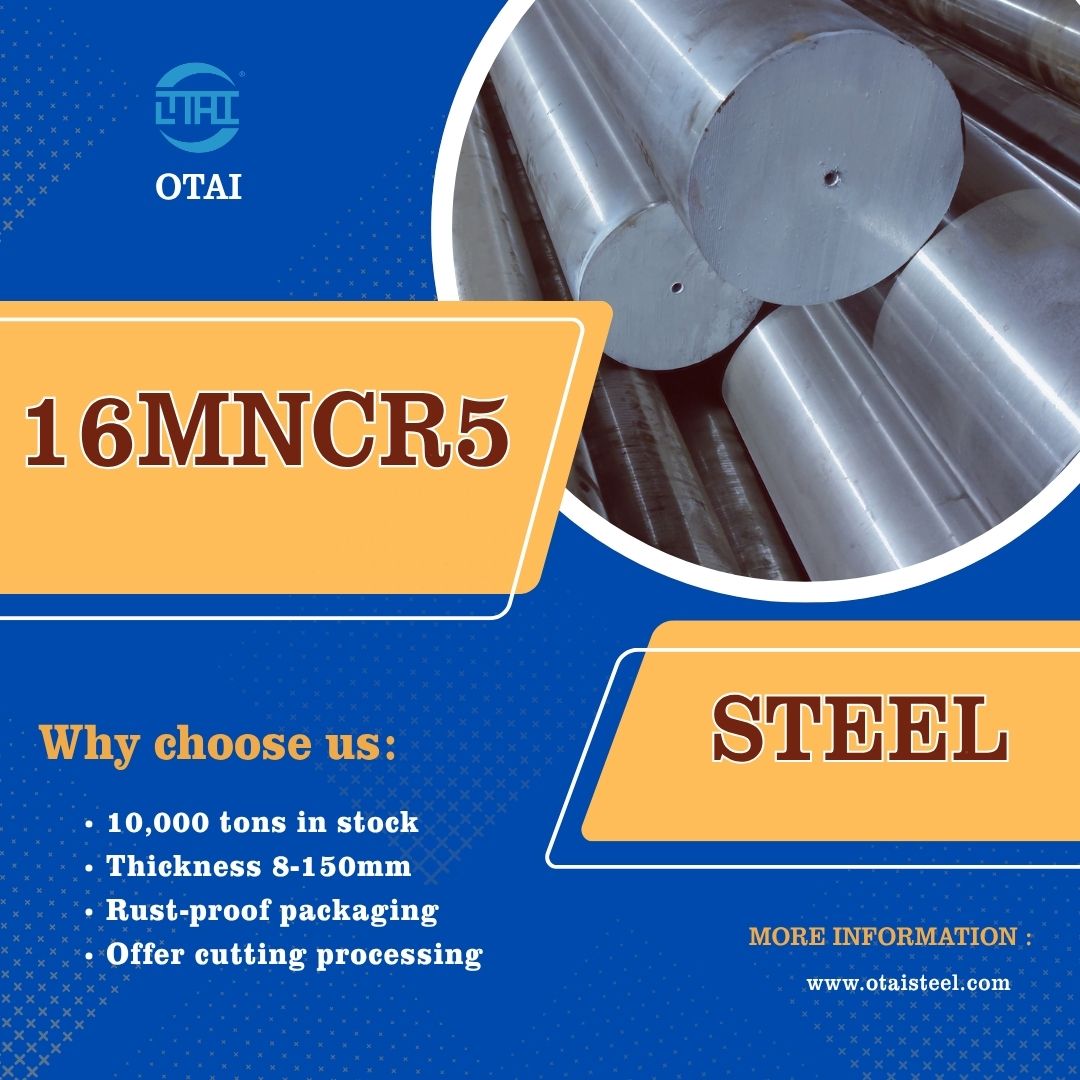
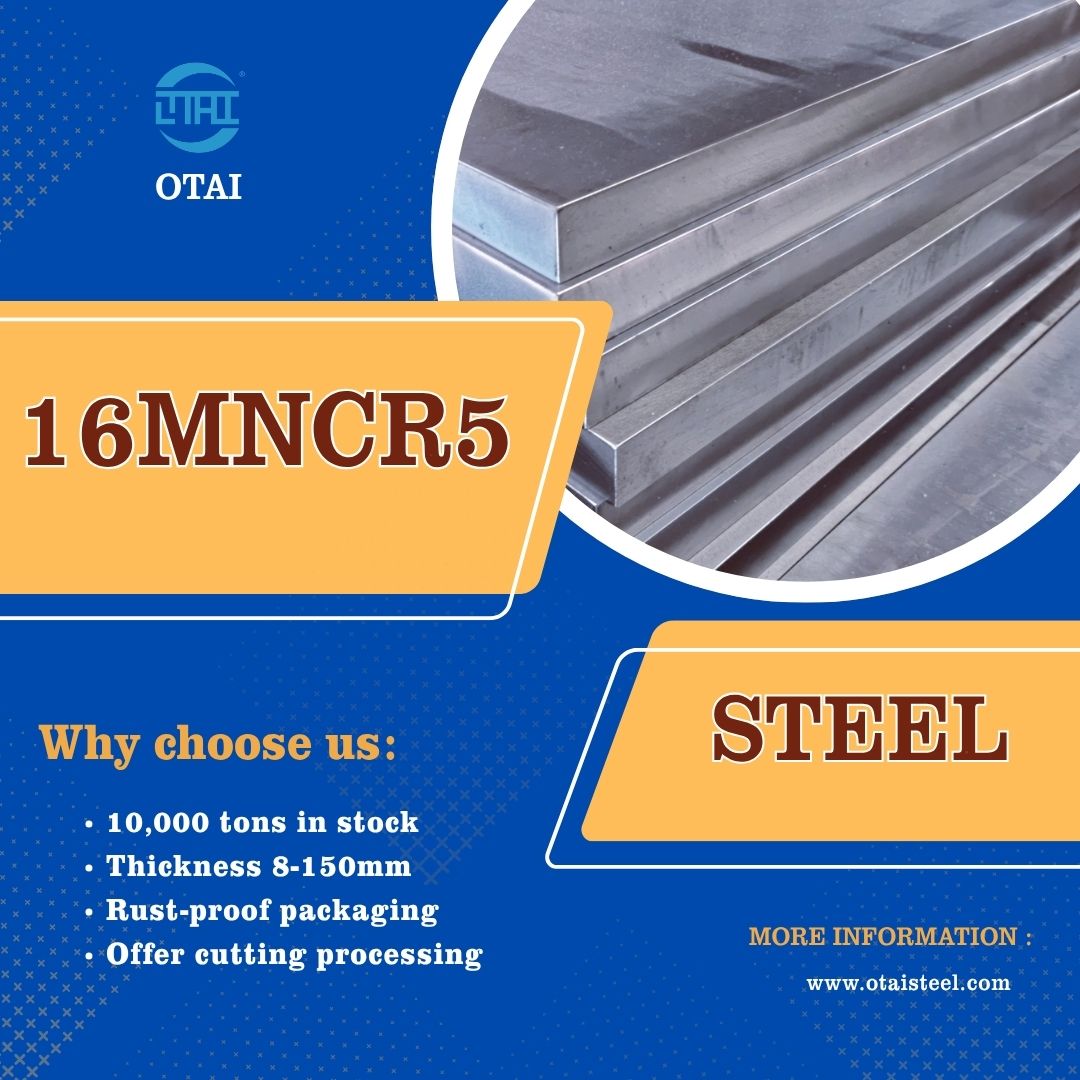
Otai currently has 16MnCr5 steel plate in 8–150 mm thickness available in stock. This is the current stock information provided for this grade and should be distinguished from historical or general published supply ranges.
For buyers purchasing plate, the key dimensions normally include thickness, width and length. Cutting requirements should also be confirmed because the most economical stock size is not always the same as the final blank size.
| Purchase Item | What to Confirm | Procurement Impact |
|---|---|---|
| Grade | 16MnCr5 / 1.7131 | Prevents unintended grade substitution |
| Thickness | 8–150 mm current Otai plate stock | Determines whether existing stock fits the project |
| Width and length | Required finished or stock dimensions | Affects cutting yield and freight |
| Delivery condition | +A, +FP or other specified condition | Affects machining and downstream treatment |
| Cutting tolerance | Required blank dimensions and tolerance | Reduces material preparation work |
If your project requires 16MnCr5 plate blanks, provide the finished blank dimensions to the supplier. Precision cutting can reduce internal handling and help you plan machining allowances more accurately.
However, current stock should always be reconfirmed for the exact width, length and quantity. The 8–150 mm figure describes the confirmed current thickness stock; it does not mean that every possible width and length within that range is continuously available.
📋 8. What Buyers Should Confirm Before Purchasing 16MnCr5
A quotation for 16MnCr5 should contain enough information for your engineering and quality teams to verify the material. A grade name and quantity alone are rarely enough for a demanding industrial order.
Start with the standard. If the drawing specifies EN 10084 or another particular standard, use that exact designation in the RFQ. This gives the supplier a clear technical reference and reduces confusion when the MTC is reviewed.
Next, specify the delivery condition. If you intend to machine the material before carburizing, the required hardness and structural condition may differ from a finished heat-treated component.
Then confirm the final heat-treatment requirements. For example, if your drawing specifies a surface hardness, effective case depth or core mechanical property, include those requirements in the inquiry. Do not assume that “16MnCr5” automatically defines the finished component’s heat-treatment result.
| Requirement | Buyer Should Specify |
|---|---|
| Material grade | 16MnCr5 / 1.7131 |
| Standard | Applicable EN or customer specification |
| Product form | Plate or other required form |
| Dimensions | Thickness × width × length |
| Delivery condition | Annealed, normalized or other specified condition |
| Final treatment | Carburizing, quenching, tempering and relevant targets |
| Inspection | MTC, UT, third-party inspection where required |
| Packaging | Bundling, wooden case, anti-rust protection or customer specification |
Also ask whether the quoted price includes cutting, testing and export packaging. These services can change the delivered cost significantly compared with a material-only quotation.
For overseas procurement, provide the destination country and preferred shipping terms at the quotation stage. That allows the supplier to evaluate the complete delivery requirement instead of quoting only the ex-stock material.
🔬 9. MTC, Inspection and Quality Requirements
For industrial purchasing, documentation is part of the material specification. A supplier’s webpage can explain the general properties of 16MnCr5, but the actual heat supplied to your project needs traceable documentation.
The Mill Test Certificate should normally allow the buyer to verify the actual heat chemistry against the specified standard. This distinction matters because a standard composition range defines what is permitted, while the MTC records the actual analysis of the supplied heat.
If your project requires additional testing, specify it before production or shipment. Depending on the application, buyers may request ultrasonic testing, third-party inspection, dimensional inspection, hardness verification or other quality-control measures.
For carburizing applications, the material certificate and final component inspection should be considered separately. The incoming steel MTC confirms the raw material, while final inspection after carburizing and hardening verifies the properties of the finished component.
Traceability also matters when several heats are used in one project. Make sure the heat number remains identifiable through cutting and packaging if your quality system requires full material traceability.
A clear inspection plan can therefore prevent disputes after delivery. Before placing the order, agree on the applicable standard, inspection documents, acceptance criteria and responsibility for third-party testing.
For buyers who need additional technical processing, Otai can support cutting, machining, inspection and export preparation alongside material supply. The exact scope should be confirmed against the individual purchase specification.
🏢 Otai Special Steel Advantages
- 16MnCr5 steel plate in current stock: Otai currently has 16MnCr5 steel plate in 8–150 mm thickness available in stock.
- 10,000+ tons of steel stock: Large inventory supports regular industrial purchasing and project requirements.
- 20 saw cutting machines: Cutting services can support customized blank sizes and production requirements.
- CNC and grinding: Additional machining and finishing services can be arranged according to project requirements.
- Custom size and tolerance: Buyers can discuss dimensional requirements before cutting or processing.
- One-stop service: Material supply, cutting, machining, heat treatment, inspection support and export packaging can be coordinated.
- International export experience: Otai has supplied steel to customers in more than 54 countries since 1999.
- Inspection support: Ultrasonic testing and third-party inspection can be arranged when required by the purchase specification.
- Export packaging: Steel can be protected with strapping, bundling, wooden cases and anti-rust packaging according to shipping requirements.
❓ FAQ About 16MnCr5 Steel Properties
1. What are the main properties of 16MnCr5 steel?
The main properties include good carburizing response, a hard surface after carburizing and hardening, and a tougher core. The exact hardness and mechanical properties depend on delivery condition, section size and heat-treatment process.
2. What hardness can 16MnCr5 reach?
After carburizing and hardening, the surface can typically reach around 58–62 HRC in referenced technical data. In the soft-annealed delivery condition, the reference maximum hardness is approximately 207 HBW. These values describe different material conditions and should not be compared as though they were the same test state.
3. Is 16MnCr5 suitable for gears?
Yes. Its case-hardening behavior makes it suitable for gears, pinions and other components that need a wear-resistant surface with a tougher core. The required case depth, surface hardness, core properties and distortion limits should be specified for the finished component.
4. What is the material number of 16MnCr5?
16MnCr5 is identified by the European material number 1.7131. It is associated with EN 10084 and related European standards for case-hardening steels. Buyers should still confirm the exact standard required by their drawing or purchase specification.
5. What 16MnCr5 steel plate thickness does Otai currently have in stock?
Otai currently has 16MnCr5 steel plate in 8–150 mm thickness in stock. Exact width, length, quantity and current availability should be confirmed for the specific order because stock dimensions can vary.