Skip to Content

About: Jack Otai

Recent Posts by Jack Otai

41Cr4 Equivalent: Which Steel Grades Can Replace It in Industrial Applications?

41Cr4 Equivalent: Which Steel Grades Can Replace It in Industrial Applications?

🔍 1. What Is the 41Cr4 Equivalent?

When you search for a 41Cr4 equivalent, the most commonly referenced grades are AISI 5140, JIS SCr440 and GB 40Cr. These steels belong to the same general family of medium-carbon chromium alloy steels, so they can show similar behavior in shafts, gears, pins, axles, machine components and other parts that require strength and surface hardening.

However, an equivalent grade does not automatically mean an identical grade. The designation 41Cr4 refers to the European grade 1.7035, while 5140, SCr440 and 40Cr come from different standards. Their carbon, manganese, chromium, phosphorus and sulfur limits can differ.

For procurement, that distinction matters. If a drawing specifically calls for EN 10083-3 41Cr4, replacing it with 5140 or 40Cr should not be treated as a simple name conversion. The chemical composition, mechanical requirements, heat-treatment condition and applicable standard should all be checked before substitution.

Grade Main Standard Material Number Relationship to 41Cr4
41Cr4 EN 10083-3 1.7035 Reference grade
5140 ASTM/AISI G51400 Common US equivalent / alternative
SCr440 JIS G4053 — Close Japanese equivalent
40Cr GB/T 3077 A20402 Common Chinese equivalent

⬆️ Back to Table of Contents

🧪 2. 41Cr4 Chemical Composition and Why It Matters

The first step in evaluating a 41Cr4 equivalent is to compare the chemistry. Under EN 10083-3, 41Cr4 contains approximately 0.38–0.45% carbon and 0.90–1.20% chromium, with manganese controlled around 0.60–0.90%. Silicon has a maximum limit of about 0.40%, while phosphorus and sulfur have relatively low maximum limits.

Element 41Cr4 EN 10083-3 Why It Matters
C 0.38–0.45% Supports strength and hardenability
Si ≤ 0.40% Contributes to strength and deoxidation
Mn 0.60–0.90% Improves hardenability and strength
P ≤ 0.025% Controlled because excessive phosphorus can reduce toughness
S ≤ 0.035% Affects machinability and cleanliness
Cr 0.90–1.20% Improves hardenability, wear resistance and surface-hardening response

These figures represent the standard composition range or limit, not the chemistry of every production heat. A steel mill may publish a Typical Analysis that sits near the middle of these limits, while your actual material certificate can show a different chemistry within the permitted range.

That distinction becomes important when you are buying an equivalent grade. A supplier may tell you that 5140 or SCr440 is “equivalent,” but you still need the actual MTC if your component has controlled chemistry requirements.

For example, chromium is particularly important when you compare 41Cr4 with AISI 5140. 41Cr4 generally specifies approximately 0.90–1.20% Cr, while 5140 commonly specifies a lower chromium range of around 0.70–0.90%. Therefore, 5140 is widely treated as a corresponding or alternative grade, but its chemistry is **not an exact copy of 41Cr4**.

⬆️ Back to Table of Contents

⚖️ 3. 41Cr4 vs 5140, SCr440 and 40Cr

Among international grades, three names appear frequently when buyers search for a 41Cr4 equivalent: AISI 5140, JIS SCr440 and GB 40Cr. They share a similar medium-carbon chromium-alloy concept, but each standard defines its own chemistry and delivery requirements.

41Cr4 vs AISI 5140

AISI 5140 is one of the most frequently quoted US equivalents for 41Cr4. Both contain roughly 0.38–0.43% carbon in their commonly specified ranges. The main difference appears in chromium: 5140 generally falls around 0.70–0.90%, while 41Cr4 specifies approximately 0.90–1.20%.

For many machine components, this difference does not prevent the grades from serving similar functions. Nevertheless, if your design depends on a particular hardenability level, section size or heat-treatment result, you should compare the actual specification rather than relying only on the grade name.

41Cr4 vs JIS SCr440

SCr440 is another close match. Its carbon range is commonly around 0.38–0.43%, while chromium is approximately 0.90–1.20%. That chromium range aligns closely with 41Cr4.

For Japanese-origin drawings, equipment or components, SCr440 can therefore be a practical material reference. Even so, the JIS standard has its own limits for elements such as manganese, phosphorus and sulfur, so the purchasing specification should identify the required standard.

41Cr4 vs GB 40Cr

GB 40Cr is widely used in China and is frequently listed alongside 41Cr4 and SCr440 in international cross-reference tables. Its carbon range is generally around 0.37–0.44%, while chromium is approximately 0.80–1.10%.

Its composition sits close to 41Cr4, but manganese and chromium limits differ. Consequently, 40Cr can often serve as a practical alternative for general engineering applications, while a formal substitution still requires engineering approval when the original drawing specifies EN 41Cr4.

⬆️ Back to Table of Contents

📊 4. Comparing the Chemical Composition

The following comparison helps you see why these grades are considered related without treating them as chemically identical.

Grade C % Si % Mn % Cr % P max % S max %
41Cr4 0.38–0.45 ≤0.40 0.60–0.90 0.90–1.20 0.025 0.035
AISI 5140 0.38–0.43 0.15–0.35 0.70–0.90 0.70–0.90 0.035 0.040
JIS SCr440 0.38–0.43 0.15–0.35 0.60–0.90 0.90–1.20 0.030 0.030
GB 40Cr 0.37–0.44 0.17–0.37 0.50–0.80 0.80–1.10 0.030 0.030

The table illustrates an important purchasing principle: chemical similarity is evidence for comparison, not automatic approval for substitution. Standards also control mechanical properties, testing, dimensional tolerances, delivery conditions and heat-treatment requirements.

If your customer specification simply asks for a chromium alloy steel with comparable hardening behavior, several alternatives may work. On the other hand, aerospace, automotive, pressure-related or safety-critical components may require the exact grade and standard stated on the drawing.

⬆️ Back to Table of Contents

⚙️ 5. How Equivalent Grades Perform in Practice

41Cr4 is a medium-carbon chromium steel designed for components that need a useful combination of strength, toughness and hardenability. It can also respond well to induction surface hardening. Typical applications include shafts, axles, gears, pins, studs, bushings and machine components.

The carbon content provides the foundation for achieving useful hardness after quenching. Chromium and manganese then contribute to hardenability, allowing the material to develop suitable mechanical properties beyond the immediate surface.

Strength and hardenability

For a buyer, hardenability matters because the same nominal grade can behave differently when component dimensions increase. A small shaft and a thick section do not necessarily achieve the same hardness distribution after the same heat treatment.

Published producer information for 41Cr4 indicates that it can through-harden in oil to approximately 40 mm diameter under suitable conditions. This figure should be treated as a practical reference rather than a universal guarantee for every production route.

Surface hardening

41Cr4 also suits induction hardening. Producer data commonly indicates a minimum surface hardness around 52 HRC after suitable induction hardening.

This characteristic can be valuable when a component needs a harder working surface while retaining a tougher core. Before purchasing, therefore, do not ask only for “41Cr4 hardness.” Confirm whether the requirement applies to the supplied material, the quenched-and-tempered condition or the finished surface after induction hardening.

Machinability

In annealed or soft-annealed conditions, 41Cr4 can be machined before final heat treatment. That makes it practical for shafts, gears and other parts where the supplier provides oversized material for subsequent turning, milling or grinding.

If you are replacing 41Cr4 with 5140, SCr440 or 40Cr, the machinability may be broadly comparable, but your machining parameters should still follow the actual material condition rather than the grade name alone.

⬆️ Back to Table of Contents

🔥 6. Heat Treatment and Hardening Considerations

Heat treatment is one of the most important areas to check when evaluating an equivalent grade. Even when two materials have similar chemical compositions, their standard heat-treatment recommendations and achieved properties may differ.

For 41Cr4, commonly published processing routes include annealing, normalizing, quenching and tempering. Exact temperatures depend on section size, equipment, starting condition and the final mechanical-property requirement.

Process Typical Consideration Buyer Concern
Annealing Used to obtain a softer, more machinable structure Confirm supplied condition and hardness
Quenching Develops a hard martensitic structure Check section size and quenching medium
Tempering Balances hardness, strength and toughness Confirm target hardness and mechanical properties
Induction hardening Creates a hardened surface with a tougher core Confirm surface hardness and effective case depth

For this reason, an equivalent-grade purchase should include the intended heat-treatment route. If the original component specification was developed around 41Cr4, provide the supplier with the required hardness, tensile strength, yield strength, case depth or other relevant target instead of asking for an equivalent grade based only on the name.

The closer the substitution is to the finished component rather than just the raw material, the more important this verification becomes.

⬆️ Back to Table of Contents

🏭 7. Which 41Cr4 Equivalent Should You Choose?

There is no single equivalent grade that fits every purchasing situation. The practical choice depends on the standard required by your customer, the country of manufacture, the component design and the availability of material.

Your Requirement Grade to Investigate What to Confirm
European specification 41Cr4 / 1.7035 EN standard, delivery condition and MTC
US procurement AISI 5140 ASTM/AISI specification and chemistry
Japanese specification SCr440 JIS standard and mechanical requirements
Chinese supply 40Cr GB/T 3077 and actual MTC values

If your customer has already approved 41Cr4, the simplest route is usually to purchase 41Cr4 rather than introduce an unapproved substitute. Conversely, if your project allows alternative grades, comparing 5140, SCr440 and 40Cr can expand sourcing options.

When price, lead time or local availability becomes a concern, an equivalent-grade review can be especially useful. However, the substitution should remain technically controlled. A lower purchase price does not compensate for an incorrect hardness profile, dimensional instability or failure to meet the drawing specification.

⬆️ Back to Table of Contents

📏 8. 41Cr4 Steel Plate for Industrial Purchasing

For buyers who need 41Cr4 in plate form, product dimensions can be just as important as grade equivalence. A technically suitable grade does not help if the available thickness, width, length or cutting tolerance does not fit your manufacturing process.

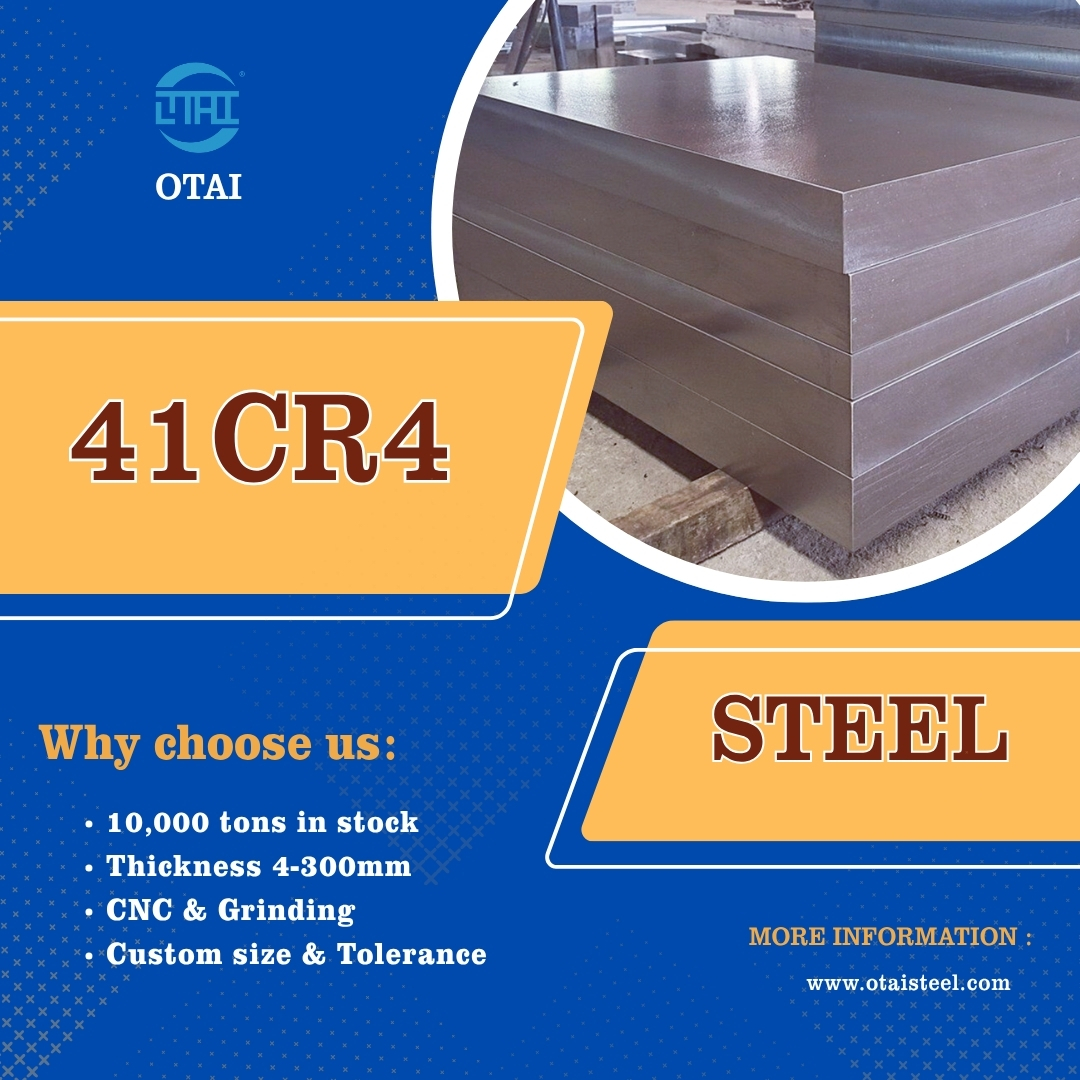
Otai Special Steel keeps 41Cr4 steel plate in thicknesses from 4–300 mm. This range covers relatively thin plate as well as heavy sections for machining-intensive industrial components.

Before placing an order, you may want to confirm several details:

  • Required 41Cr4 standard and material number.
  • Plate thickness, width and length.
  • Required supply condition, such as annealed or quenched and tempered.
  • Surface condition and machining allowance.
  • Dimensional tolerance requirements.
  • Ultrasonic testing requirements, if applicable.
  • Required chemical composition and mechanical properties.
  • Whether the material requires third-party inspection.
  • Cutting dimensions for your machining process.

For large or irregular components, buying cut-to-size material can also reduce machining waste. Saw cutting, CNC machining and grinding can help move the material closer to the dimensions required for production.

That is where the difference between simply finding a 41Cr4 equivalent and sourcing the correct industrial material becomes clear. The grade, size, condition, inspection and processing requirements should work together.

⬆️ Back to Table of Contents

📋 9. What to Confirm Before Ordering an Equivalent Grade

A useful equivalent-grade inquiry should contain more information than “Please quote 41Cr4 equivalent.” Give the supplier enough technical information to determine whether the proposed material actually meets your application.

1. Identify the original standard

State whether your drawing specifies EN 10083-3 41Cr4, 1.7035 or another standard. This prevents a supplier from treating every grade listed under the 41Cr4 cross-reference as identical.

2. Specify the final application

A shaft, gear, pin and structural machine component can have very different requirements. The application helps the supplier understand whether strength, machinability, induction hardening or toughness deserves priority.

3. Provide the heat-treatment target

Tell the supplier whether you require annealed material for machining, quenched-and-tempered material for direct use, or material intended for later induction hardening.

4. Request the actual MTC

The material certificate should provide the actual heat chemistry and applicable mechanical or inspection results where required. This is more useful for verification than a generic statement that two grades are “equivalent.”

5. Confirm inspection requirements

For demanding applications, you may require ultrasonic testing, dimensional inspection, mechanical testing or third-party inspection. Agree on these requirements before production or shipment.

6. Confirm processing requirements

If you need the plate cut to specific sizes or require CNC machining and grinding, include those requirements in the quotation. This allows the supplier to quote the complete material solution rather than only the raw steel price.

⬆️ Back to Table of Contents

🏢 10. Otai Special Steel Supply Advantages

  • 41Cr4 steel plate in stock: 4–300 mm thickness range available for industrial purchasing requirements.
  • 10,000+ tons of steel stock: Supports stable supply for regular and project-based orders.
  • 20 saw cutting machines: Supports efficient cutting to customer-required dimensions.
  • CNC machining and grinding: Suitable when buyers need more than standard raw plate supply.
  • Custom sizes and tolerances: Material can be prepared according to agreed dimensional requirements.
  • Quality inspection support: Ultrasonic testing and third-party inspection can be arranged according to project requirements.
  • Export experience since 1999: Otai has supplied steel to customers in 54+ countries.
  • One-stop service: Cutting, machining, heat treatment, inspection and export packaging can be coordinated according to the order.
  • Export packaging: Steel can be strapped or bundled and protected with wooden boxes and anti-rust packaging where required.

⬆️ Back to Table of Contents

❓ FAQ About 41Cr4 Equivalent

Is AISI 5140 an equivalent of 41Cr4?

AISI 5140 is widely referenced as a corresponding grade for 41Cr4, particularly in international steel cross-reference tables. However, it is not chemically identical. The chromium range of 5140 is generally lower than that of EN 41Cr4, so the applicable specification and required properties should be checked before substitution.

Is SCr440 the same as 41Cr4?

JIS SCr440 is a close equivalent to 41Cr4 and has a similar carbon and chromium range. Nevertheless, SCr440 belongs to the JIS system and 41Cr4 belongs to the EN system. For controlled engineering applications, use the standard specified by the drawing or obtain approval for the substitution.

What is the Chinese equivalent of 41Cr4?

GB 40Cr is commonly used as the Chinese equivalent or alternative to 41Cr4. Its composition is similar, but its specified manganese and chromium ranges differ from EN 41Cr4. The actual application and mechanical requirements should therefore determine whether substitution is acceptable.

What is 41Cr4 used for?

41Cr4 is commonly used for shafts, axles, gears, pins, studs, bushings and other machine components that require a combination of strength, toughness and hardenability. It also works well for induction surface hardening when the process and component geometry are suitable.

What should I ask a supplier when buying 41Cr4 equivalent steel?

Ask for the exact standard, material number, chemical composition, delivery condition, mechanical properties, dimensions, tolerances, MTC and inspection requirements. If you plan to substitute 5140, SCr440 or 40Cr for 41Cr4, also confirm that the proposed grade meets your component’s heat-treatment and performance requirements.
⬆️ Back to Table of Contents

0 0 Continue Reading →

16MnCr5 Sheet Metal for Industrial Components: Is It Right for Your Application?

16MnCr5 Sheet Metal for Industrial Components: Is It Right for Your Application?

🔍 1. What Is 16MnCr5 Sheet Metal?

If you are searching for 16MnCr5 sheet metal, the first point to clarify is what you actually need to buy. 16MnCr5, material number 1.7131, is an alloy case-hardening steel specified under EN 10084. It is designed for components that need a hard, wear-resistant surface after carburizing while retaining a comparatively tougher core.

That makes the grade particularly relevant when your finished component faces repeated contact, friction or surface wear. Gears are a typical example. The working surface needs high hardness, but the whole component does not necessarily need to become uniformly hard and brittle.

For procurement, this distinction is important. You are not simply buying steel with a particular hardness value. You are buying a material that will become part of a larger manufacturing process involving machining, carburizing, quenching, tempering and final inspection.

So, when you evaluate 16MnCr5 sheet or plate, look at three stages:

Stage What matters Why it matters to the buyer
Raw material Chemical composition, supply condition, dimensions Determines whether the material fits your machining process
Heat treatment Carburizing, quenching, tempering and case depth Creates the required surface and core properties
Finished component Surface hardness, core performance and dimensional accuracy Determines whether the component actually meets the drawing

The important point is that raw-material hardness alone does not describe the final performance of a carburized 16MnCr5 component.

⬆️ Back to Table of Contents

🧪 2. 16MnCr5 Chemical Composition

The chemistry explains why 16MnCr5 behaves differently from ordinary carbon steel. Under EN 10084, the principal composition limits include carbon at 0.14–0.19%, manganese at 1.00–1.30% and chromium at 0.80–1.10%. Silicon has a maximum of 0.40%, phosphorus a maximum of 0.025%, and sulfur a maximum of 0.035%.

EN 10084 chemical composition of 16MnCr5

Element EN 10084 range / limit Procurement significance
C 0.14–0.19% Supports carburizing behavior while maintaining a relatively low-carbon core before treatment
Si ≤ 0.40% Controlled alloying element; the actual heat chemistry should be checked on the MTC
Mn 1.00–1.30% Contributes to hardenability and strength
P ≤ 0.025% A controlled residual element; important for specification compliance
S ≤ 0.035% Influences machinability and must remain within the agreed specification
Cr 0.80–1.10% Supports hardenability and the response of the steel during case hardening

These figures represent the EN 10084 composition limits commonly cited for 16MnCr5. They should not be confused with a particular steel mill’s Typical Analysis.

Standard range versus Typical Analysis

This distinction becomes important when you compare supplier datasheets. For example, Ovako publishes a Typical Analysis for one 16MnCr5 variant of approximately 0.16% C, 0.20% Si, 1.20% Mn and 1.00% Cr. Those values illustrate one producer’s typical chemistry; they do not replace the standard composition limits or the chemistry of your actual heat.

Your MTC should show the actual chemical analysis of the heat supplied to your order. Therefore, if your customer has tight chemistry requirements, ask for the actual MTC instead of using a website’s typical analysis as the acceptance value.

⬆️ Back to Table of Contents

⚙️ 3. How Chemical Composition Affects Performance

The numbers in the chemistry table are not just certification data. They explain why engineers choose this grade for specific components.

Carbon: 0.14–0.19%

The relatively low carbon level is central to the case-hardening concept. Before carburizing, the base material does not contain the same carbon level that a high-carbon tool steel would contain. During carburizing, the surface absorbs additional carbon, allowing the outer layer to develop high hardness after quenching.

For you as a buyer, this means you should not reject 16MnCr5 simply because its raw-material carbon percentage looks low. That low carbon content is part of the reason the grade works for a hard-surface/tough-core design.

Manganese: 1.00–1.30%

Manganese contributes to hardenability and strength. The relatively high manganese range compared with plain carbon steel helps the material respond to hardening more effectively.

If you are purchasing larger or more complex components, the heat-treatment response becomes particularly relevant. The final result depends not only on chemistry but also on section size, quenching conditions and the actual process used.

Chromium: 0.80–1.10%

Chromium supports hardenability and contributes to the performance of this case-hardening steel. That makes the Cr content worth checking when you receive the MTC.

In other words, if your specification calls for 16MnCr5, do not treat the grade name as enough evidence. Check the actual heat chemistry against the agreed standard.

Phosphorus and sulfur

The standard limits phosphorus to 0.025% maximum and sulfur to 0.035% maximum in the EN 10084 chemistry commonly listed for 16MnCr5.

These values matter because residual elements form part of the material specification. For normal procurement, you may not need to analyze the metallurgical effect of every hundredth of a percent. You do, however, need the actual certificate when your customer requires documented compliance.

⬆️ Back to Table of Contents

📊 4. 16MnCr5 Mechanical Properties and Hardness

This is where the previous “sheet metal” question needs more precision. 16MnCr5 does not have one universal hardness value that applies to every delivery condition.

The mechanical properties depend on the supply condition, product form and thickness. For example, published EN 10084 data summarized by SteelNumber lists, for nominal thickness up to 16 mm in the +A condition, a tensile strength of about 550 MPa, 0.2% proof strength of about 420 MPa, minimum elongation of 21% and Brinell hardness around 207 HBW.

Property Published value / range Condition / note
Tensile strength, Rm ≥ 550 MPa +A, nominal thickness up to 16 mm
0.2% proof strength, Rp0.2 ≥ 420 MPa +A, nominal thickness up to 16 mm
Elongation, A ≥ 21% +A, L0 = 80 mm
Brinell hardness 140–207 HBW depending on condition Published ranges vary with delivery condition
Hardness, +FP 140–187 HBW Ferrite-pearlite treated condition

Ovako’s current 16MnCr5 material data gives a similar picture: +A material is listed at about 207 HB typical, while +FP material is listed at 140–187 HB.

For procurement, the lesson is simple: always specify the delivery condition when hardness matters. Otherwise, two suppliers can quote the same grade while offering material in different conditions.

Raw-material hardness is not case hardness

This distinction is especially important for 16MnCr5. A raw plate or blank may have a hardness suitable for machining, while the finished component can achieve a much harder carburized surface after heat treatment.

Therefore, if your drawing requires a surface hardness such as a specified HRC range, do not ask the raw-material supplier to guarantee that value unless the supplier is also performing the complete heat-treatment process. Instead, confirm the raw-material condition and separately define the final heat-treatment specification.

⬆️ Back to Table of Contents

🔥 5. 16MnCr5 Heat Treatment and Carburizing

Heat treatment is where the low-carbon chemistry of 16MnCr5 becomes commercially useful.

Ovako lists a carburizing range of 880–980°C, a quenching range of 860–900°C, and a tempering range of 150–200°C for its 16MnCr5 material data. The same source lists AC1 at about 734°C, AC3 at about 827°C, and an Ms temperature around 430°C.

Process Published temperature range Purpose
Carburizing 880–980°C Adds carbon to the surface
Quenching 860–900°C Hardens the carburized layer
Tempering 150–200°C Adjusts the hardened structure and reduces excessive stresses
Normalizing 860–890°C Used as a preparation or conditioning treatment where specified

These are published heat-treatment recommendations, not universal production recipes. Actual parameters depend on component size, furnace atmosphere, carburizing equipment, quenching medium, required case depth and distortion control. Ovako also notes that case-hardening steels are typically carburized at high temperatures and then quenched to harden the carburized layer.

What this means when you are buying the raw steel

Suppose your customer requires a specific effective case depth. The carburizing time and process will influence how much carbon enters the surface. Therefore, the heat-treatment requirement can affect your production cycle and finishing allowance.

Before ordering, give your supplier the final component requirements whenever possible:

  • Target surface hardness
  • Effective case depth
  • Core hardness or core mechanical requirement
  • Final component dimensions
  • Machining allowance
  • Heat-treatment route

This information gives the supplier context that a simple grade name cannot provide.

Typical case depth

Ovako explains that carburized layers are typically around 0.5–1.0 mm, although deeper cases are possible depending on the application and process.

Do not treat 0.5–1.0 mm as a mandatory 16MnCr5 specification. It is a general typical range for carburizing steels. Your drawing may require a different effective case depth, and the heat-treatment supplier should establish the appropriate process.

⬆️ Back to Table of Contents

🏭 6. 16MnCr5 Applications and Material Selection

16MnCr5 is commonly associated with mechanical engineering components that need case hardening. The grade’s combination of low carbon, manganese and chromium makes it suitable for components where surface wear resistance and core toughness need to work together.

Application Why 16MnCr5 may fit What to confirm before purchase
Gears Hard surface for repeated contact and wear Case depth, surface hardness, distortion control
Shafts Wear-resistant working areas with a tougher core Final dimensions and machining allowance
Pins Useful surface hardness after case hardening Contact load and required case depth
Bushings Supports wear resistance at contacting surfaces Machining condition and final hardness
Transmission components Case hardening suits repeated mechanical loading Heat-treatment process and dimensional stability

If your application does not require a carburized surface, however, 16MnCr5 may not automatically be the logical choice. The material should match the actual failure mode of the component: wear, contact fatigue, impact, bending fatigue, machining requirements or a combination of these factors.

That is why procurement should start with the component requirement and then work backward toward the steel grade.

⬆️ Back to Table of Contents

📏 7. 16MnCr5 Sheet Metal Thickness, Cutting & Machining

“Sheet metal” is a broad commercial term. For industrial steel purchasing, the actual thickness matters much more than the word “sheet.” If your requirement is for thicker flat stock, specify the exact thickness and dimensions in the RFQ so the supplier can quote the correct plate or flat product.

For buyers sourcing 16MnCr5 flat steel from Otai, the current stock range is:

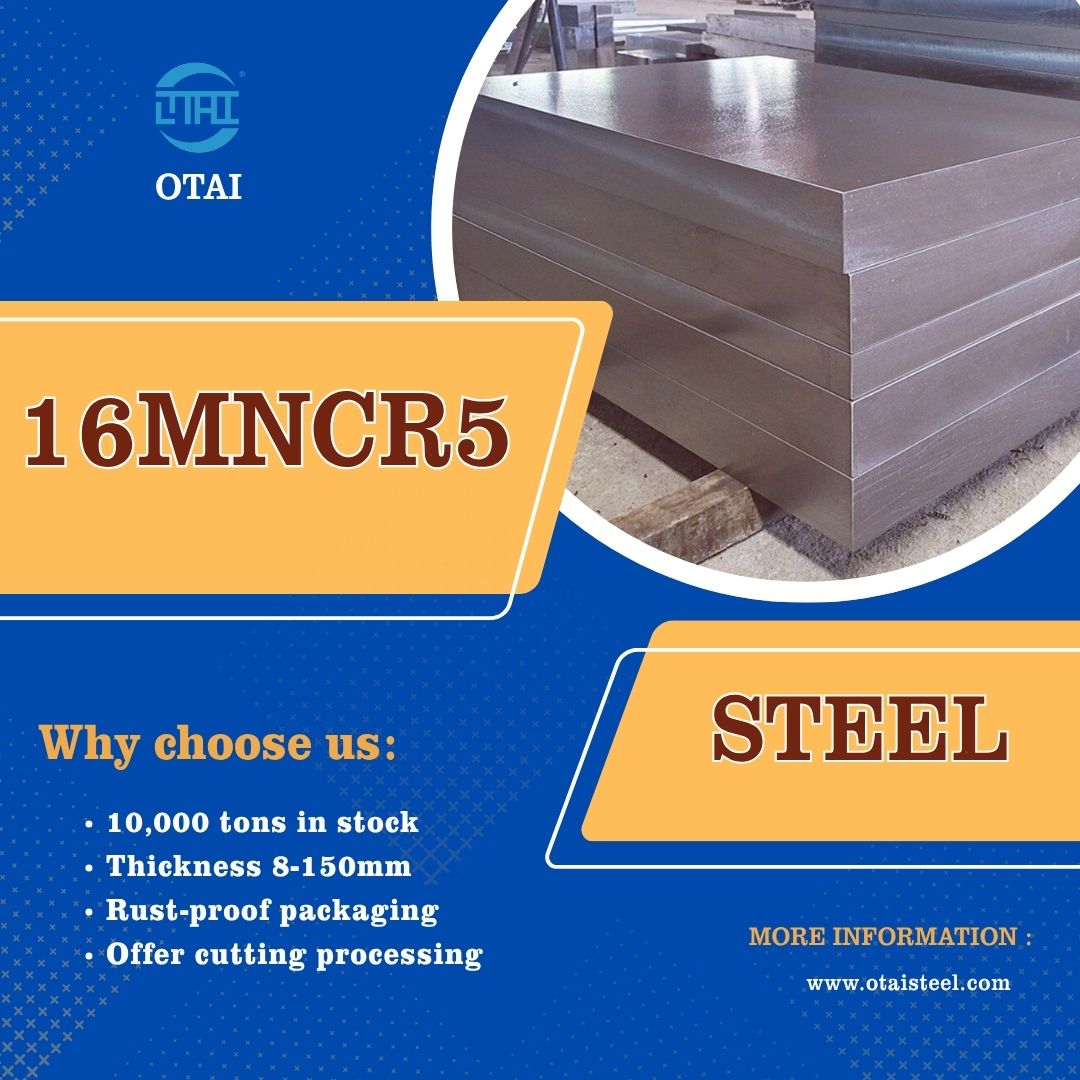
📏 16MnCr5 steel plate thickness range: 8–150mm in stock.

This range is more relevant to industrial machined components than to thin sheet-metal fabrication. If your finished component starts from a thick blank, the supplier can discuss cutting dimensions and machining allowance before shipment.

Why starting thickness matters

Imagine your finished component requires a 45 mm section, but your machining process needs additional material for rough machining and finishing. Buying material too close to the final dimension may leave insufficient allowance. Buying substantially thicker stock, on the other hand, can increase machining time and material waste.

For that reason, provide both the finished dimension and the required blank dimension whenever possible.

Requirement Information to provide
Thickness Required plate thickness or blank thickness
Width Finished or cutting width
Length Finished or cutting length
Tolerance Required dimensional tolerance
Machining Saw cutting, CNC machining or grinding if required

Otai operates 20 saw cutting machines and can provide customized cutting according to agreed dimensions and tolerances. CNC machining and grinding can also support buyers who want to reduce the number of separate suppliers involved in the project.

⬆️ Back to Table of Contents

📋 8. What Should You Confirm Before Buying 16MnCr5?

A technically correct grade can still become the wrong purchase if the commercial specification is incomplete. Before you send an RFQ for 16MnCr5 sheet or plate, prepare the following information.

Grade and standard

Specify 16MnCr5, material number 1.7131 where applicable, and the required standard. EN 10084 identifies 16MnCr5 as a case-hardening steel.

Chemical composition

Ask whether the quotation and MTC will comply with the agreed chemistry. If your customer requires heat-specific chemistry, request the MTC rather than accepting a generic datasheet.

Supply condition and hardness

State the required delivery condition. Published data show different hardness ranges for +A and +FP conditions, so simply writing “16MnCr5, HB” can leave too much room for interpretation.

Dimensions and cutting

Specify thickness, width, length, quantity and cutting tolerance. If you need blanks rather than full plates, give the blank dimensions directly.

Heat-treatment target

If the material will become a carburized component, tell the supplier the target case depth and final surface hardness whenever those values are already defined by your engineering department.

Inspection documents

Confirm MTC requirements, EN 10204 certification if applicable, ultrasonic testing, third-party inspection and any customer-specific inspection requirements before production.

A clear RFQ should therefore answer at least these questions:

  • What exact grade and standard do you need?
  • What thickness and cutting dimensions do you need?
  • What delivery condition do you require?
  • What hardness range applies to the supplied material?
  • Will the finished component undergo carburizing?
  • What case depth and surface hardness does the drawing require?
  • What certificate and inspection documents must accompany the shipment?

⬆️ Back to Table of Contents

🔬 9. MTC, Inspection and Quality Requirements

For international steel procurement, the difference between “the material should be 16MnCr5” and “the shipment is documented as compliant 16MnCr5” matters.

The first statement describes your purchasing intention. The second requires evidence from the actual material.

What the MTC should tell you

A heat-specific MTC can document the actual chemical analysis of the material supplied. Depending on the agreed specification and delivery condition, it can also include mechanical test results and other relevant information.

For example, if the specification calls for carbon between 0.14% and 0.19%, the actual MTC value should fall within the applicable requirement. The same principle applies to manganese, chromium, silicon, phosphorus and sulfur.

Do not use a Typical Analysis as a substitute for the actual MTC.

Ultrasonic testing

For thicker plate and critical machined components, buyers may also request ultrasonic testing to assess internal quality. The required acceptance level should come from the applicable project or customer specification.

Third-party inspection

When your customer requires independent verification, third-party inspection can be arranged before shipment. Discuss the inspection scope early so the supplier can coordinate the inspection with production and delivery.

For overseas orders, packaging also matters. Anti-rust protection, strapping or bundling and wooden cases can help protect the steel during international transportation and storage.

⬆️ Back to Table of Contents

🏢 10. 16MnCr5 Supply from Otai Special Steel

  • 📏 16MnCr5 steel plate thickness range: 8–150mm in stock.
  • 📦 More than 10,000 tons of steel inventory supports regular industrial orders.
  • ✂️ 20 saw cutting machines support customized cutting sizes.
  • ⚙️ CNC machining and grinding are available for projects requiring additional processing.
  • 📐 Custom dimensions and tolerances can be discussed according to project requirements.
  • 🔬 Ultrasonic testing and third-party inspection support are available when required.
  • 📋 Material testing and certification can be arranged according to the agreed specification.
  • 📦 Export packaging can include strapping/bundling, wooden cases and anti-rust protection.
  • 🌍 Otai has exported tool steel and alloy steel to customers in more than 54 countries since 1999.
  • 🤝 Cutting, machining, inspection, packaging and export support can be coordinated as a one-stop service.

If your requirement is for 16MnCr5 sheet or plate for a specific machining and heat-treatment process, send the grade, thickness, dimensions, quantity, supply condition and inspection requirements together. That gives the supplier enough information to check the available material and prepare a practical quotation.

⬆️ Back to Table of Contents

❓ 11. FAQ About 16MnCr5 Sheet Metal

What is the chemical composition of 16MnCr5?

Under EN 10084, 16MnCr5 contains 0.14–0.19% carbon, 1.00–1.30% manganese and 0.80–1.10% chromium. Silicon is limited to 0.40% maximum, phosphorus to 0.025% maximum and sulfur to 0.035% maximum. These are standard composition limits; the actual heat chemistry should be confirmed on the MTC.

What is the hardness of 16MnCr5?

There is no single hardness value for every supply condition. Published data list approximately 207 HBW for +A material and 140–187 HBW for +FP material. The applicable value depends on the delivery condition and product specification.

What temperature is used for 16MnCr5 carburizing?

Ovako lists 880–980°C as a carburizing range for 16MnCr5. It also lists 860–900°C for quenching and 150–200°C for tempering. Actual production parameters should match the component geometry, furnace process, case-depth requirement and quenching system.

What is 16MnCr5 mainly used for?

16MnCr5 is a case-hardening steel used for mechanical engineering components that need a hard surface and comparatively tougher core. Typical applications include gears and other transmission or mechanical components exposed to wear and repeated contact.

What 16MnCr5 plate thickness is available from Otai?

Otai Special Steel keeps 16MnCr5 steel plate in 8–150 mm thicknesses in stock. Customized cutting, machining, grinding and inspection support can be discussed according to the project requirements.

⬆️ Back to Table of Contents

0 0 Continue Reading →

42CrMo4 Chemical Composition: What Buyers Should Check Before Purchasing

42CrMo4 Chemical Composition: What Buyers Should Check Before Purchasing

🔎 1. What Is 42CrMo4?

42CrMo4 is a chromium-molybdenum alloy steel commonly supplied for quenched-and-tempered engineering components. The grade belongs to the European steel system and carries the material number 1.7225.

For buyers researching 42CrMo4 chemical composition, the most important point is that the grade relies on carbon, chromium, and molybdenum to achieve a useful combination of strength, hardenability, toughness, and fatigue resistance.

EN 10083-3 specifies the chemical composition of 42CrMo4. Under the commonly referenced EN 10083-3:2006 specification, the principal elements include carbon at 0.38–0.45%, manganese at 0.60–0.90%, chromium at 0.90–1.20%, and molybdenum at 0.15–0.30%. Silicon, phosphorus, and sulfur also have specified limits.

Although 42CrMo4 often appears in equivalent-grade charts alongside AISI 4140 and JIS SCM440, buyers should not treat the three designations as identical specifications. Different standards can define different chemistry limits and mechanical requirements.

42CrMo4 material number

The material number for 42CrMo4 is 1.7225. You may therefore see the material listed as “42CrMo4,” “42CrMo4 1.7225,” or simply “1.7225” in international steel quotations and technical documents.

When requesting a quotation, include both the grade and material number where possible. This helps the supplier identify the requested material more precisely.

⬆️ Back to Table of Contents

🧪 2. 42CrMo4 Chemical Composition

The following table presents the chemical composition limits commonly specified for 42CrMo4 under EN 10083-3. These values represent standard requirements, not the actual chemistry of every production heat.

Element Chemical Composition, wt.% Requirement Type
Carbon (C) 0.38–0.45 Specified range
Silicon (Si) ≤ 0.40 Maximum limit
Manganese (Mn) 0.60–0.90 Specified range
Phosphorus (P) ≤ 0.025 Maximum limit
Sulfur (S) ≤ 0.035 Maximum limit
Chromium (Cr) 0.90–1.20 Specified range
Molybdenum (Mo) 0.15–0.30 Specified range

These composition limits are reported for 42CrMo4 under EN 10083-3.

42CrMo4 chemical composition at a glance

The name itself gives a useful indication of the alloy design. “42” refers approximately to the nominal carbon level of 0.42%, while “CrMo” indicates chromium and molybdenum as the key alloying elements.

The actual standard range is broader than the nominal value represented by the designation. For example, carbon does not remain fixed at exactly 0.42%; EN 10083-3 specifies a range of 0.38–0.45%.

This distinction becomes important when buyers compare a mill certificate with a material datasheet.

Standard composition is not the same as MTC chemistry

A steel standard defines an acceptable chemical range or limit. A steel mill then produces a particular heat within those requirements. The MTC records the measured chemistry of that actual heat.

Therefore, an MTC might show carbon below or above the nominal 0.42% value while still meeting the applicable standard. Buyers should compare the measured value with the standard limit rather than expect every MTC to show identical numbers.

⬆️ Back to Table of Contents

⚙️ 3. What Does Each Element Do in 42CrMo4?

Understanding the role of each element helps buyers connect 42CrMo4 chemical composition with actual steel performance.

Carbon (C)

Carbon provides the basic hardening potential of the steel. The 0.38–0.45% carbon range allows 42CrMo4 to develop substantial hardness and strength after suitable quenching and tempering.

At the same time, higher carbon content generally makes welding more demanding. Therefore, fabrication engineers should consider the complete composition rather than looking at carbon alone.

Chromium (Cr)

Chromium improves hardenability and contributes to strength and wear resistance. The specified 0.90–1.20% chromium range gives 42CrMo4 its characteristic Cr-Mo alloy-steel behavior.

Chromium also supports the material’s response during heat treatment, helping thicker sections achieve useful mechanical properties.

Molybdenum (Mo)

Molybdenum plays an important role in hardenability and high-temperature strength. The 0.15–0.30% Mo range also helps the alloy maintain useful mechanical performance after tempering.

Because chromium and molybdenum work together, 42CrMo4 can provide a stronger hardening response than a comparable plain carbon steel.

Manganese (Mn)

Manganese contributes to hardenability and strength. The 0.60–0.90% range forms part of the balanced alloy design used in 42CrMo4.

Silicon (Si)

Silicon supports deoxidation during steelmaking and contributes to strength. EN 10083-3 limits silicon to a maximum of 0.40% for the commonly referenced 42CrMo4 composition.

Phosphorus and sulfur (P and S)

Phosphorus and sulfur require tighter control because excessive levels can negatively affect certain mechanical and processing characteristics. For 42CrMo4, EN 10083-3 specifies maximum limits of 0.025% phosphorus and 0.035% sulfur.

Do not confuse standard 42CrMo4 with 42CrMoS4. The “S” designation indicates a modified sulfur range intended to improve machinability under the relevant specification.

⬆️ Back to Table of Contents

📊 4. 42CrMo4 Composition vs 4140 and SCM440

Buyers frequently compare 42CrMo4 with AISI 4140 and JIS SCM440 because all three belong to the Cr-Mo alloy steel family. However, their chemical requirements are not identical.

Element 42CrMo4, EN 10083-3 4140, common SAE/AISI specification SCM440, JIS G4053
C 0.38–0.45% About 0.38–0.43% About 0.38–0.43%
Si ≤ 0.40% About 0.15–0.35% About 0.15–0.35%
Mn 0.60–0.90% About 0.75–1.00% 0.60–0.90%
Cr 0.90–1.20% About 0.80–1.10% 0.90–1.20%
Mo 0.15–0.30% About 0.15–0.25% 0.15–0.30%

The comparison above illustrates why equivalent-grade charts require caution. The alloy concepts are similar, but the numerical limits can differ between standards. The 42CrMo4 values come from EN 10083-3, while the 4140 and SCM440 values depend on their respective specifications.

Is 42CrMo4 the same as 4140?

42CrMo4 and AISI 4140 are commonly treated as equivalent or closely corresponding grades for many engineering applications. However, they are not literally one universal specification. A buyer should compare the applicable standards before approving substitution.

Is 42CrMo4 the same as SCM440?

SCM440 also has a very similar alloy concept and commonly appears in international equivalent-grade tables. Nevertheless, JIS G4053 and EN 10083-3 define their own chemical requirements.

For normal procurement, a supplier can use the comparison as a starting point. For controlled engineering applications, the customer should approve the substitution based on the actual specification and MTC.

⬆️ Back to Table of Contents

🔥 5. How Chemical Composition Affects 42CrMo4 Properties

The composition of 42CrMo4 directly influences its response to heat treatment and its final mechanical properties. However, chemistry alone does not determine the final hardness or strength.

Hardenability

Chromium, molybdenum, manganese, and carbon work together to improve hardenability. As a result, 42CrMo4 can develop useful strength through a significant section thickness when the supplier applies an appropriate heat-treatment process.

This characteristic makes the grade suitable for heavily loaded engineering components where a combination of core strength and toughness matters.

Strength and hardness

Carbon establishes much of the steel’s hardening potential, while Cr-Mo alloying supports the hardening response. After quenching and tempering, 42CrMo4 can achieve high strength with a controlled balance of toughness.

Actual mechanical properties depend on section size, heat-treatment parameters, cooling conditions, and the final tempering temperature. Therefore, buyers should never calculate final hardness from the chemical composition alone.

Machinability

42CrMo4 can offer reasonable machinability in suitable delivery conditions. Soft-annealed material generally machines more easily than hardened and tempered material.

If a project requires extensive machining, specify the delivery condition when requesting a quotation. The supplier can then recommend a suitable condition rather than supplying only the nominal grade.

⬆️ Back to Table of Contents

📏 6. 42CrMo4 Steel Plate and Material Selection

When buyers search for 42CrMo4 steel plate, chemical composition represents only one part of the purchasing specification. Plate thickness, delivery condition, dimensional tolerance, surface condition, and testing requirements can also affect suitability.

Why thickness matters

Thicker sections cool more slowly during quenching than thin sections. This difference can influence the final microstructure and mechanical properties through the section.

Consequently, buyers should provide the actual plate thickness when asking a supplier about 42CrMo4 mechanical properties. A chemistry comparison without the product dimensions cannot fully determine performance.

Common procurement requirements

  • 42CrMo4 / 1.7225 grade
  • EN standard and applicable edition
  • Plate thickness and dimensions
  • Annealed or quenched-and-tempered condition
  • Hardness requirement
  • Tensile and yield strength requirements
  • Ultrasonic testing, when required
  • Mill Test Certificate
  • Third-party inspection, when required
  • Cutting and dimensional tolerance

For international purchasing, giving the supplier these details at the quotation stage reduces uncertainty and helps the buyer compare offers on the same technical basis.

42CrMo4 and cut-to-size supply

Some projects require standard plate dimensions, while others need material cut to a specified size. A supplier with saw cutting and machining capability can combine material supply with processing, reducing the number of external operations required after delivery.

⬆️ Back to Table of Contents

🏭 7. 42CrMo4 Heat Treatment and Composition

The chemical composition establishes the hardening potential of 42CrMo4, but the heat-treatment process determines how the steel develops its final structure and mechanical properties.

Quenching

Industrial heat-treatment procedures commonly austenitize 42CrMo4 at a temperature appropriate to the material specification and section size, followed by controlled cooling. Published technical data commonly lists quenching temperatures around 820–850°C, depending on the specific procedure.

Because different product forms and standards can use different procedures, buyers should follow the applicable mill datasheet or heat-treatment specification rather than copy a single temperature into every application.

Tempering

After quenching, tempering reduces brittleness and allows engineers to establish the required balance between strength and toughness. Published 42CrMo4 data commonly gives tempering ranges around 540–680°C, although the final temperature should match the required mechanical properties and applicable specification.

Composition and heat-treatment response

A steel with the correct nominal grade but an incorrect delivery condition may not meet the customer’s requirements. For this reason, purchasing teams should treat chemical composition and heat treatment as two connected but separate specification checks.

The MTC should confirm the actual heat chemistry, while the inspection and mechanical-property data should confirm whether the supplied material meets the requested condition.

⬆️ Back to Table of Contents

📋 8. How to Check 42CrMo4 Chemical Composition on an MTC

For procurement, the most reliable way to confirm 42CrMo4 chemical composition is to check the actual Mill Test Certificate supplied with the material.

Step 1: Confirm the grade

Check that the certificate identifies the material as 42CrMo4 and, where applicable, material number 1.7225.

Step 2: Check each element

Compare the reported C, Si, Mn, P, S, Cr, and Mo values with the applicable standard limits. Do not compare the certificate only with a generic website table if the purchase order specifies a particular standard edition.

Step 3: Check the product information

Verify the heat number, dimensions, delivery condition, and other identifying information. The chemical analysis should correspond to the supplied heat and product.

Step 4: Check mechanical requirements

Correct chemistry does not automatically prove that the material meets the required mechanical condition. Review hardness, tensile strength, yield strength, elongation, impact properties, or other requirements listed in the purchase specification.

For buyers comparing several suppliers, this process provides a much stronger basis for evaluation than comparing only the advertised grade name.

⬆️ Back to Table of Contents

💰 9. Buying 42CrMo4 from a Steel Supplier

When purchasing 42CrMo4 internationally, buyers often focus first on price. However, the technical specification can significantly affect the final quotation.

For example, two suppliers may quote the same nominal grade but offer different thicknesses, delivery conditions, tolerances, testing levels, or processing services. These differences make a direct price comparison misleading.

What should a 42CrMo4 RFQ include?

  • Grade: 42CrMo4 / 1.7225
  • Applicable standard
  • Product form
  • Thickness, width, and length
  • Quantity
  • Delivery condition
  • Hardness or mechanical requirements
  • Ultrasonic testing requirements
  • MTC requirements
  • Cutting or machining requirements
  • Destination and shipping terms

A clear RFQ allows the supplier to quote the correct material instead of offering a generic “42CrMo4 equivalent.”

42CrMo4 supplier selection

A reliable supplier should be able to explain the difference between the standard chemical composition, its own typical analysis, and the actual MTC chemistry. This distinction becomes particularly important when customers compare 42CrMo4 with 4140, SCM440, or other Cr-Mo grades.

For customized orders, the supplier should also confirm cutting tolerance, inspection requirements, packaging, and delivery schedule before production or shipment.

⬆️ Back to Table of Contents

🏢 Otai Special Steel Advantages

  • 10,000+ tons of steel stock supports international alloy steel supply.
  • 42CrMo4 / SCM440 / 4140-related sourcing supports customers comparing international Cr-Mo grades.
  • 20 saw cutting machines support fast and customized cutting services.
  • CNC machining and grinding are available for customers requiring additional processing.
  • Custom sizes and tolerances can be arranged according to project requirements.
  • One-stop service covers cutting, machining, heat treatment, inspection, and export packaging.
  • Ultrasonic testing and third-party inspection support are available for applicable orders.
  • Export packaging can include bundled, wooden-box, and anti-rust protection according to order requirements.
  • Otai has supplied tool steel and alloy steel to customers in 54+ countries since 1999.

⬆️ Back to Table of Contents

❓ FAQ About 42CrMo4 Chemical Composition

1. What is the chemical composition of 42CrMo4?

Under the commonly referenced EN 10083-3 specification, 42CrMo4 contains C 0.38–0.45%, Si up to 0.40%, Mn 0.60–0.90%, P up to 0.025%, S up to 0.035%, Cr 0.90–1.20%, and Mo 0.15–0.30%.

2. What is the carbon content of 42CrMo4?

The specified carbon range for 42CrMo4 under EN 10083-3 is 0.38–0.45 wt.%. The nominal carbon level represented by the grade name is approximately 0.42%, but the actual standard allows a range.

3. How much chromium is in 42CrMo4?

42CrMo4 contains 0.90–1.20 wt.% chromium under the commonly referenced EN 10083-3 composition. Chromium contributes to hardenability and strength.

4. How much molybdenum is in 42CrMo4?

The molybdenum range is 0.15–0.30 wt.% under EN 10083-3. Molybdenum contributes to hardenability and supports the steel’s performance after heat treatment.

5. Is 42CrMo4 chemical composition the same as 4140?

No. 42CrMo4 and 4140 have similar Cr-Mo alloy designs and often appear as equivalent grades, but their standard composition limits are not identical. Buyers should compare the applicable specifications and actual MTC chemistry before approving substitution.

⬆️ Back to Table of Contents

0 0 Continue Reading →

SCM440 Equivalent: How to Choose 4140 or 42CrMo4 for Industrial Applications

SCM440 Equivalent: How to Choose 4140 or 42CrMo4 for Industrial Applications

🔎 1. What Is the SCM440 Equivalent?

When buyers search for SCM440 equivalent, they usually want to identify a steel grade with similar chemical composition, hardenability, strength, and application performance. The most frequently discussed equivalents include AISI 4140 and 42CrMo4.

However, an equivalent grade does not automatically mean an identical grade. SCM440 belongs to the Japanese JIS alloy structural steel system, while AISI 4140 follows the SAE/AISI system and 42CrMo4 belongs to the European EN system. Each standard defines its own chemical composition, mechanical requirements, delivery conditions, testing rules, and dimensional requirements.

For this reason, buyers should treat SCM440 equivalent grades as technical alternatives rather than automatically interchangeable materials. The correct choice depends on the drawing, applicable standard, heat-treatment condition, required mechanical properties, and customer approval.

In practical international purchasing, AISI 4140 and 42CrMo4 are commonly considered close alternatives to SCM440. Nevertheless, the supplier should compare the requested specification with the actual mill certificate before confirming substitution.

SCM440 in the JIS system

SCM440 is a chromium-molybdenum alloy structural steel covered by JIS G4053. Its Cr-Mo alloy design gives the material a useful combination of strength, toughness, hardenability, and wear resistance after suitable heat treatment.

For international procurement, buyers may encounter several designations for steels with similar metallurgical characteristics. The designation alone, however, cannot replace a specification check.

⬆️ Back to Table of Contents

🌍 2. SCM440 Equivalent Grades by Standard

The following table provides a practical comparison for buyers looking for SCM440 equivalent grades.

Standard Grade Typical Relationship to SCM440 Main Market
JIS SCM440 Reference grade Japan / Asia
SAE / AISI 4140 Common close equivalent USA / international
EN 42CrMo4 Common close equivalent Europe / international
EN 1.7225 Material number associated with 42CrMo4 Europe

Among these grades, AISI 4140 and 42CrMo4 are the two names buyers most often encounter when looking for SCM440 alternatives. International steel references also commonly group 42CrMo4 and 4140 as similar Cr-Mo alloy steels.

Is 4140 exactly the same as SCM440?

No. Although the two grades have very similar alloy concepts and often serve similar engineering applications, they belong to different standards. A purchasing department should not replace SCM440 with 4140 solely because a comparison chart lists them together.

Instead, compare the required chemistry, delivery condition, hardness, tensile strength, yield strength, impact requirements, size, and inspection requirements.

Is 42CrMo4 the same as SCM440?

42CrMo4 is another commonly cited SCM440 equivalent. Its designation comes from the European standard system, and its material number is commonly listed as 1.7225. Industrial steel references identify 42CrMo4 alongside AISI 4140 as a similar designation.

Still, buyers should confirm the exact standard edition and product specification before placing a substitution order.

⬆️ Back to Table of Contents

🧪 3. SCM440 Chemical Composition Comparison

Chemical composition provides one of the first technical checks when evaluating an SCM440 equivalent. SCM440, 4140, and 42CrMo4 all use chromium and molybdenum as important alloying elements, with carbon providing the basis for strength and hardening response.

However, the exact limits depend on the applicable standard and product specification. Therefore, a general comparison should not replace the chemical analysis on the actual mill test certificate.

Grade C Cr Mo General Alloy Concept
SCM440 Cr-Mo alloy steel Cr-bearing Mo-bearing JIS alloy structural steel
AISI 4140 Approx. 0.40% C class Approx. 1% Cr class Approx. 0.20% Mo class SAE/AISI Cr-Mo steel
42CrMo4 Approx. 0.42% C class Approx. 1% Cr class Approx. 0.20% Mo class EN Cr-Mo steel

Important: the table above describes the general alloy design rather than a universal chemical specification. For a purchasing decision, use the limits from the requested standard and then compare them with the actual MTC chemistry.

Standard range vs typical analysis vs MTC

Steel buyers should separate three different types of chemistry data:

  • Standard chemical range or limit: the specification requirement for the grade.
  • Mill Typical Analysis: a representative chemistry from a steel producer.
  • Actual MTC chemistry: the measured chemistry for the specific production heat or supplied material.

This distinction matters when a customer asks whether a particular 4140 or 42CrMo4 product can replace SCM440. The safest method is to compare the actual certificate with the customer’s required standard.

⬆️ Back to Table of Contents

⚙️ 4. SCM440 vs 4140 vs 42CrMo4

SCM440, 4140, and 42CrMo4 occupy a similar position in alloy steel applications. They support components that require a combination of strength, toughness, hardenability, and fatigue resistance.

Factor SCM440 AISI 4140 42CrMo4
Primary standard JIS SAE/AISI EN
Steel family Cr-Mo alloy steel Cr-Mo alloy steel Cr-Mo alloy steel
Heat treatment Quenching & tempering Quenching & tempering Quenching & tempering
Typical applications Machinery, shafts, gears Automotive, machinery, fasteners Machinery, shafts, high-strength components
Substitution check Reference requirement Verify specification Verify specification

SCM440 vs 4140

SCM440 and 4140 are probably the most frequently compared grades in international procurement. Both belong to the chromium-molybdenum alloy steel family and can achieve high strength after appropriate heat treatment.

For buyers in North America, 4140 may appear more frequently on engineering drawings, specifications, and stock lists. A Chinese supplier may instead quote SCM440 or another regional designation depending on the requested standard.

Before substituting one for the other, confirm the product form, heat-treatment condition, mechanical requirements, and certificate requirements.

SCM440 vs 42CrMo4

42CrMo4 provides another common international comparison. European buyers often specify 42CrMo4 or material number 1.7225, while Japanese or Asian drawings may specify SCM440.

The two grades share a similar Cr-Mo alloy concept, but buyers should still check the relevant EN and JIS requirements. A supplier should not rely only on a generic equivalent-grade chart when the component carries a safety-critical or tightly controlled specification.

⬆️ Back to Table of Contents

🔥 5. Heat Treatment and Mechanical Properties

One reason SCM440 and its equivalent grades receive extensive industrial use is their response to heat treatment. Quenching and tempering can produce a useful balance between strength and toughness.

Quenching and tempering

During heat treatment, the steel first reaches an austenitizing temperature suitable for the specific product size and supplier procedure. The material then undergoes controlled cooling followed by tempering.

The exact temperature should come from the applicable material standard, steel mill datasheet, product thickness, and required mechanical properties. Do not copy one heat-treatment schedule across all SCM440, 4140, and 42CrMo4 products without checking the applicable specification.

For many industrial applications, suppliers provide SCM440 in annealed, normalized, pre-hardened, or quenched-and-tempered conditions. The required delivery condition can significantly affect machining and final performance.

Hardness and strength

SCM440 can achieve high hardness and strength after quenching and tempering. The final values depend strongly on section size, heat-treatment parameters, tempering temperature, cooling method, and test location.

Therefore, a buyer should specify whether the project requires a hardness range, tensile strength, yield strength, impact value, or another mechanical requirement. The supplier can then select the appropriate delivery condition.

For an equivalent-grade purchase, matching the required mechanical condition is often more important than simply matching the grade name.

⬆️ Back to Table of Contents

📏 6. SCM440 Equivalent for Steel Plate Procurement

When purchasing SCM440 steel plate, buyers often search for an equivalent because their local market does not stock the exact JIS designation. In that situation, the procurement process should focus on technical compatibility rather than the name alone.

Check the steel grade first

Ask the supplier which standard the quoted material follows. A quotation may say “SCM440 equivalent,” but that phrase alone does not tell you whether the material is 4140, 42CrMo4, or another Cr-Mo grade.

The quotation should identify the actual grade, standard, product form, dimensions, delivery condition, and inspection documents.

Check thickness and delivery condition

Large-section steel can behave differently during heat treatment because cooling rates vary through the thickness. Consequently, two materials with similar chemistry may not deliver identical mechanical properties in thick sections.

For steel plate procurement, confirm:

  • Plate thickness and width
  • Length or cut-to-size requirement
  • Heat-treatment condition
  • Hardness requirement
  • Tensile and yield strength requirements
  • Ultrasonic testing requirements
  • Surface condition
  • Dimensional tolerance
  • Mill Test Certificate requirements

These details allow the supplier to determine whether a proposed SCM440 equivalent can meet the actual engineering requirement.

SCM440 plate stock availability

For buyers who need SCM440 rather than a substitute, Otai Special Steel keeps SCM440 steel plate in a broad thickness range. Current stock includes SCM440 steel plate from 4–380 mm.

This range allows buyers to discuss both standard-size material and cut-to-size requirements with the supplier before selecting an alternative grade.

⬆️ Back to Table of Contents

🏭 7. Choosing the Right Equivalent for Your Application

The best SCM440 equivalent depends on the application and the specification behind the purchase. A buyer should first determine why the original design specifies SCM440.

Application Requirement What to Confirm
High strength Tensile strength, yield strength, hardness
Heavy section Hardenability and through-thickness properties
Machining before heat treatment Annealed or suitable pre-machining condition
Finished high-strength component Quenching, tempering, hardness and final mechanical properties
Safety-critical component Applicable standard, MTC, testing and customer approval

For general machinery

SCM440 and its common equivalents can support shafts, gears, bolts, couplings, machine components, and other parts that require a combination of strength and toughness.

The supplier should still match the material condition to the machining and heat-treatment process. For example, a buyer planning extensive machining may require a softer delivery condition than a buyer purchasing material for final assembly.

For engineering drawings

If the drawing specifically calls for JIS SCM440, do not replace it automatically. Ask the engineering or quality department whether 4140 or 42CrMo4 is an approved alternative.

This approach prevents a common procurement problem: receiving a material that looks equivalent on a commercial quotation but does not satisfy the project’s formal specification.

⬆️ Back to Table of Contents

💰 8. SCM440 Equivalent Price and Purchasing Factors

Searching for SCM440 equivalent price does not always produce a meaningful comparison because suppliers may quote different grades, dimensions, delivery conditions, and processing services.

A 42CrMo4 quotation, for example, may include a different heat-treatment condition from an SCM440 quotation. Similarly, a 4140 plate may come from a different mill, thickness range, or quality level.

What affects the final price?

  • Steel grade and applicable standard
  • Plate thickness and dimensions
  • Total order weight
  • Heat-treatment condition
  • Ultrasonic testing
  • Cutting and machining requirements
  • Surface and dimensional tolerance
  • Packaging requirements
  • Inspection and certification
  • Shipping destination and delivery terms

For this reason, buyers should compare quotations on the same technical basis. A lower material price does not necessarily represent a lower total procurement cost if the quotation excludes cutting, inspection, certification, packaging, or other required services.

Ask for a technical comparison before substitution

If SCM440 is unavailable in the buyer’s local market, provide the supplier with the original specification and ask for a formal comparison with the proposed 4140 or 42CrMo4.

The most useful document is a side-by-side comparison of the requested specification and the actual MTC. This gives purchasing and engineering teams a clear basis for approval.

⬆️ Back to Table of Contents

📦 9. Buying SCM440 from a Steel Supplier

When buying SCM440 or an equivalent grade internationally, the supplier should provide more than a grade name. A professional quotation should identify the material standard and clearly describe the supplied condition.

Information to include in an RFQ

  • SCM440 or requested equivalent grade
  • Applicable standard
  • Plate thickness, width, and length
  • Required quantity
  • Delivery condition
  • Hardness or mechanical-property requirements
  • Ultrasonic testing requirements, if applicable
  • Inspection certificate requirements
  • Cutting or machining dimensions
  • Destination and shipping requirements

For overseas buyers, this information helps the supplier provide a more accurate quotation and reduces repeated clarification during order processing.

SCM440 supplier or equivalent supplier?

If the original drawing requires SCM440, sourcing the exact grade can simplify approval. When the market cannot provide SCM440, a supplier with experience in 4140, 42CrMo4, and other Cr-Mo alloy steels can help compare the alternatives.

However, the supplier should present the substitution as a technical comparison rather than simply claiming that every grade is “the same.” The final acceptance should follow the customer’s engineering and purchasing requirements.

⬆️ Back to Table of Contents

🏢 Otai Special Steel Advantages

  • 10,000+ tons of steel stock supports fast material selection and international supply.
  • SCM440 steel plate in 4–380 mm thickness is available from current stock.
  • 20 saw cutting machines support efficient cutting and customized dimensions.
  • CNC machining and grinding support customers who need additional processing.
  • Custom sizes and tolerances can be arranged according to project requirements.
  • One-stop service covers cutting, machining, heat treatment, inspection, and export packaging.
  • Ultrasonic testing and third-party inspection support are available for applicable orders.
  • Professional export packaging includes bundled, wooden-box, and anti-rust packaging options.
  • Otai has supplied tool steel and alloy steel to customers in 54+ countries since 1999.

⬆️ Back to Table of Contents

❓ FAQ About SCM440 Equivalent

1. What is the most common SCM440 equivalent?

AISI 4140 and EN 42CrMo4 are the two most commonly discussed SCM440 equivalents. Both belong to the Cr-Mo alloy steel family, but buyers should verify the exact standard and material condition before substitution.

2. Is SCM440 equivalent to AISI 4140?

SCM440 and AISI 4140 are widely treated as close equivalent grades for many engineering applications. However, they follow different standards, so the actual chemical composition, mechanical requirements, and delivery condition should be checked before replacement.

3. Is SCM440 equivalent to 42CrMo4?

42CrMo4 is commonly listed as a close equivalent to SCM440 because both are chromium-molybdenum alloy structural steels with similar application areas. The buyer should still compare the applicable JIS and EN requirements before approving substitution.

4. Can I replace SCM440 with 4140 without approval?

Not when the drawing or purchasing specification explicitly requires SCM440. Ask the customer or engineering department to approve the alternative after comparing chemistry, mechanical properties, heat-treatment condition, dimensions, and inspection requirements.

5. What should I check when buying SCM440 equivalent steel?

Check the actual grade, applicable standard, chemical composition, product form, dimensions, delivery condition, hardness, mechanical properties, MTC, testing requirements, and quantity. For a substitution order, request a technical comparison before purchase.

⬆️ Back to Table of Contents

0 0 Continue Reading →

A2 Steel Plate: Properties, Heat Treatment and Key Buying Considerations

A2 Steel Plate: Properties, Heat Treatment and Key Buying Considerations

🔎 1. What Is A2 Steel Plate?

A2 steel plate is a cold work tool steel plate that combines wear resistance, toughness, dimensional stability, and good machinability. AISI A2 belongs to the air-hardening tool steel family and serves many applications in dies, punches, forming tools, shear blades, and precision tooling.

The grade contains chromium together with molybdenum and vanadium. This alloy combination improves hardenability and helps A2 develop useful wear resistance after hardening and tempering. At the same time, A2 maintains a practical toughness level for many cold work applications.

Why do toolmakers choose A2?

Toolmakers often need more than maximum hardness. A die must resist wear, while a punch may also need enough toughness to reduce chipping. A precision component may require dimensional stability during heat treatment. A2 addresses these requirements with a balanced alloy design.

Buyers usually purchase A2 plate in an annealed or machinable condition, then machine the required tool geometry before final heat treatment. The exact delivery condition depends on the supplier’s product specification and the customer’s purchase requirements.

A2 as an air-hardening tool steel

A2 develops high hardness during controlled cooling after austenitizing. Its air-hardening behavior can reduce distortion compared with some oil-hardening tool steels, although the actual dimensional change still depends on geometry, section thickness, heating practice, cooling conditions, and heat-treatment equipment.

For procurement, customers should specify the applicable standard, thickness, dimensions, delivery condition, tolerance, and inspection requirements instead of ordering only by the name “A2 steel plate.”

⬆️ Back to Table of Contents

🧪 2. A2 Steel Chemical Composition

A2 relies on several alloying elements to achieve its balance of hardness, wear resistance, toughness, and hardenability. However, buyers should distinguish the standard composition from a steel mill’s typical analysis and the actual chemistry shown on the material test certificate.

Typical chemical composition reference

The following values provide a general reference for A2 tool steel. They do not represent the actual chemistry of every A2 heat or every steel mill.

Element Typical Reference, wt.% Main Function
C About 0.95–1.05 Supports hardness and wear resistance
Si About 0.10–0.40 Supports strength and deoxidation
Mn About 0.40–0.60 Improves hardenability and strength
Cr About 4.75–5.50 Improves hardenability and wear resistance
Mo About 0.90–1.20 Supports hardenability and temper resistance
V About 0.15–0.35 Forms carbides and improves wear resistance

Three types of chemistry information

When you compare A2 steel suppliers, keep these three categories separate:

  • Standard composition: the applicable standard defines the permitted range or limits.
  • Mill typical analysis: the producer publishes representative chemistry for its own grade.
  • Actual MTC chemistry: the supplier provides measured results for the specific material or heat.

A typical analysis does not replace an actual MTC. If your project requires strict chemical control, ask the supplier to provide the certificate for the material quoted and confirm the applicable standard before purchase.

⬆️ Back to Table of Contents

⚙️ 3. A2 Steel Properties

A2 steel plate offers a balanced combination of wear resistance, toughness, hardness, and dimensional stability. This balance makes the grade useful when a tool requires more than simple high-carbon hardness.

Wear resistance

Chromium, molybdenum, and vanadium contribute to the carbide structure that A2 develops during heat treatment. As a result, hardened A2 can resist repeated contact and abrasive wear in many cold work applications.

Toughness and chipping resistance

A2 does not focus solely on maximum wear resistance. Its alloy design provides a useful toughness level for many punches, dies, and forming tools. The final performance still depends on hardness, heat treatment, geometry, loading, and service conditions.

Dimensional stability

A2 generally offers good dimensional stability during hardening when the heat-treatment process matches the material and component geometry. Toolmakers still need to account for dimensional movement, especially with large sections, sharp corners, and complex shapes.

Hardenability

The chromium, molybdenum, and other alloying elements give A2 strong hardenability. This characteristic allows thicker sections to develop useful hardness during controlled air cooling. The actual result depends on section size and the complete heat-treatment process.

Property A2 Characteristics Procurement Relevance
Wear resistance Good Useful for dies, punches, and wear components
Toughness Good balance for many cold work tools Helps reduce chipping risk
Dimensional stability Good with controlled heat treatment Important for precision tooling
Machinability Good in annealed condition Supports pre-hardening machining

How the properties work together

In practical tooling, these properties work as a system. Increasing hardness can improve wear resistance, but excessive hardness may reduce toughness. Therefore, toolmakers should select the final hardness according to the application rather than simply choosing the highest available value.

⬆️ Back to Table of Contents

🔥 4. A2 Steel Heat Treatment

Heat treatment determines much of the final performance of A2 tool steel. Customers normally machine the material before hardening, then apply a controlled hardening and tempering cycle to achieve the required working properties.

Annealing condition

Annealed A2 offers better machinability than hardened A2. The soft condition allows manufacturers to saw, mill, drill, and rough-machine components before final hardening.

The supplier should provide the recommended annealing procedure for the specific material because different producers may specify slightly different cycles.

Preheating

Controlled preheating helps reduce thermal gradients before the material reaches its austenitizing temperature. This step becomes particularly important when the component has a large cross-section or a complex shape.

Austenitizing

Typical industrial recommendations place the A2 austenitizing temperature roughly around 940–980°C. However, customers should follow the actual steel mill’s technical datasheet or qualified heat-treatment procedure because section thickness, furnace type, and material condition affect the optimum cycle.

Air cooling and tempering

After austenitizing, controlled air cooling allows A2 to develop high hardness. The operator should begin tempering promptly after hardening and follow the selected heat-treatment specification.

Double tempering commonly provides a practical route for hardened A2 tooling. The correct tempering temperature depends on the required hardness, toughness, dimensional stability, and service conditions.

Why should buyers confirm the heat-treatment cycle?

Heat treatment affects hardness, distortion, retained austenite, toughness, and dimensional stability. Therefore, buyers should not rely on a generic temperature table when they need production-grade tooling. Ask the steel supplier or qualified heat-treatment provider for the recommended cycle for the actual A2 material.

⬆️ Back to Table of Contents

📊 5. A2 Steel Plate Hardness

A2 hardness changes significantly with the delivery condition and heat-treatment process. Buyers therefore need to specify whether they require annealed A2 plate for machining or hardened material for direct tooling use.

Annealed A2

Annealed A2 has a much lower hardness than finished tooling. This condition makes machining more practical and allows manufacturers to produce the required geometry before hardening.

Hardened and tempered A2

After suitable hardening and tempering, A2 commonly reaches approximately 58–62 HRC. The final target depends on the heat-treatment route and the application’s requirements.

Condition Purpose Hardness Consideration
Annealed Machining and fabrication Lower hardness supports easier machining
Hardened Tool production High hardness after controlled cooling
Tempered Final working condition Final hardness balances wear and toughness

Hardness and application requirements

Higher hardness does not automatically produce better tool performance. A stamping punch that experiences impact may require a different hardness target from a component that mainly faces abrasive wear.

For this reason, customers should discuss the working conditions with the heat-treatment provider and specify the required hardness range rather than requesting maximum HRC without further context.

⬆️ Back to Table of Contents

🛠️ 6. A2 Steel Machining and Fabrication

Manufacturers generally machine A2 plate before final hardening because the annealed condition provides better machinability. The machining plan should account for the required dimensions, heat-treatment allowance, final grinding, and tolerance.

Cutting and rough machining

Manufacturers can saw A2 plate into smaller blanks before CNC machining. Milling and drilling operations can then establish the basic tool geometry.

Stable cutting conditions, suitable tooling, and effective coolant management help control heat generation during machining. The exact cutting parameters depend on the machine, tooling, plate thickness, and material condition.

Machining allowance

Toolmakers should leave an appropriate finishing allowance before hardening. A2 offers good dimensional stability, but heat treatment can still cause dimensional movement. Finishing operations can then bring the hardened component to the required tolerance.

Grinding after hardening

Grinding often provides the final dimensional accuracy and surface finish for hardened A2 components. Controlled grinding prevents excessive heat from damaging the hardened surface.

Precision processing requirements

If the customer needs cut-to-size blanks, CNC machining, or grinding, the supplier should receive those requirements at the quotation stage. This approach allows the supplier to calculate material usage, processing costs, tolerance, and delivery time more accurately.

⬆️ Back to Table of Contents

🏭 7. A2 Steel Plate Applications

A2 steel plate supports many cold work applications that require a combination of wear resistance, toughness, and dimensional stability. The correct application depends on the operating conditions and the final heat treatment.

Stamping dies

Manufacturers use A2 for various stamping and forming dies because hardened A2 can resist repeated mechanical contact and wear. The tool designer should still evaluate impact, load, geometry, and expected production volume.

Punches and inserts

A2 works well for many punches and inserts that require high hardness together with useful toughness. The final hardness should match the punch design and working conditions.

Shear blades

A2 can serve industrial shear applications that require edge retention and dimensional stability. Blade designers should consider the material being cut, cutting geometry, impact level, and maintenance schedule when selecting the final hardness.

Forming tools and gauges

Manufacturers also use A2 for forming tools, gauges, wear components, and precision tooling. These applications benefit from the grade’s balanced performance rather than from maximum wear resistance alone.

Application Relevant A2 Property Key Consideration
Stamping dies Wear resistance and stability Heat-treatment control
Punches Hardness and toughness Impact level
Shear blades Edge retention Grinding and hardness control
Forming tools Wear resistance and toughness Working load and geometry

⬆️ Back to Table of Contents

📐 8. A2 Steel Plate Size and Stock

For international buyers, stock availability can affect both lead time and purchasing cost. A supplier with ready A2 plate can respond faster when the required thickness already exists in inventory.

A2 steel plate thickness range

Otai Special Steel currently has A2 steel plate in stock from 8–200 mm thickness. This range covers many tooling blocks, dies, inserts, machine components, and other applications that require thicker cold work tool steel.

Dimensions and cutting

Customers should confirm the available width, length, quantity, surface condition, and tolerance for the specific stock item. When the customer needs smaller blanks, Otai can provide saw cutting according to the requested dimensions.

Cut-to-size supply can also reduce material waste and simplify transportation. Customers should provide the finished blank dimensions together with the required tolerance so the supplier can recommend a suitable cutting allowance.

What information should buyers provide?

A detailed inquiry should include:

  • AISI A2 or the required equivalent grade
  • Applicable standard
  • Plate thickness, width, and length
  • Required quantity
  • Delivery condition
  • Dimensional and thickness tolerance
  • Surface requirements
  • MTC and inspection requirements
  • Cutting or machining requirements

Clear specifications help the supplier match the inquiry with actual stock and reduce unnecessary quotation revisions.

⬆️ Back to Table of Contents

💰 9. Buying A2 Steel Plate from a Supplier

International buyers should evaluate more than the quoted material price when sourcing A2 steel plate. Stock availability, processing, inspection, documentation, packaging, and delivery all affect the final purchasing result.

Confirm physical stock

Ask the supplier whether the required thickness currently sits in warehouse inventory or requires new production. Ready stock can shorten the procurement cycle for urgent tooling projects.

Check the material certificate

Ask for an MTC that corresponds to the supplied material. The certificate should contain the relevant chemical analysis and other required information according to the purchase specification.

Discuss processing requirements

If you need cut-to-size blanks, CNC machining, grinding, or heat treatment, include those requirements in the initial inquiry. The supplier can then quote the complete service instead of pricing only the raw plate.

Confirm inspection and packaging

Critical tooling projects may require ultrasonic testing, dimensional inspection, third-party inspection, or special packaging. Buyers should communicate these requirements before order confirmation.

For export shipments, suitable packaging also protects the steel during transportation and storage. Anti-rust protection, strapping, bundled packaging, and wooden cases can support safer international delivery.

Compare equivalent quotations

Buyers should compare quotations on the same technical basis. A quotation for untreated full-size plate does not have the same scope as a quotation that includes cutting, inspection, special tolerance, machining, packaging, and delivery.

⬆️ Back to Table of Contents

🏢 Otai Special Steel Advantages

  • A2 steel plate stock: Otai currently has A2 steel plate in thicknesses from 8–200 mm in stock.
  • 10,000+ tons of inventory: Large stock supports faster sourcing for international buyers.
  • 20 saw cutting machines: Otai can cut A2 plate according to customer requirements.
  • CNC and grinding: Additional machining services support customers who need processed steel.
  • Custom size and tolerance: Customers can discuss required dimensions and tolerances before cutting or machining.
  • One-stop service: Otai supports sourcing, cutting, machining, heat treatment, inspection, packaging, and export delivery.
  • Global export experience: Otai Special Steel has exported steel to 54+ countries since 1999.
  • Inspection support: Otai can arrange ultrasonic testing and support third-party inspection when customers require it.
  • Export packaging: Otai can use strapping, bundled packaging, wooden cases, and anti-rust protection according to shipment requirements.

⬆️ Back to Table of Contents

❓ FAQ

1. What is A2 steel plate used for?

A2 steel plate serves many cold work tooling applications, including stamping dies, punches, forming tools, shear blades, inserts, gauges, and wear components.

2. Is A2 steel air hardening?

Yes. A2 belongs to the air-hardening cold work tool steel group. Controlled cooling after austenitizing allows the steel to develop high hardness.

3. What hardness can A2 steel reach?

After appropriate hardening and tempering, A2 commonly reaches approximately 58–62 HRC. The correct target depends on the application and heat-treatment procedure.

4. How does A2 compare with D2 steel?

A2 and D2 both serve cold work tooling, but their alloy designs produce different performance balances. D2 generally emphasizes higher wear resistance, while A2 provides a useful combination of wear resistance, toughness, and dimensional stability.

5. What A2 steel plate thickness does Otai have in stock?

Otai Special Steel currently has A2 steel plate from 8–200 mm thickness in stock. Buyers should confirm current dimensions, quantity, surface condition, and delivery requirements before ordering.

⬆️ Back to Table of Contents

0 0 Continue Reading →

4130 Steel Plate: How to Select the Right Grade, Condition and Supplier

4130 Steel Plate: How to Select the Right Grade, Condition and Supplier

🔍 1. What Is 4130 Steel?

4130 steel plate is a chromium-molybdenum alloy steel plate widely used in engineering applications that require high strength, toughness, and good weldability. It is commonly known as AISI 4130, SAE 4130, or 4130 Chromoly steel in international markets.

For buyers searching for a reliable 4130 steel plate supplier, this grade is often selected because it provides an excellent balance between mechanical performance and manufacturing flexibility. Compared with plain carbon steel, 4130 steel offers improved hardenability and strength due to the addition of chromium and molybdenum.

What is 4130 steel plate used for?

4130 steel plate is commonly used for structural and mechanical components where engineers need high strength-to-weight performance, good fatigue resistance, and reliable welding characteristics. Typical applications include aerospace components, motorsport parts, pressure equipment, machinery structures, and industrial components.

The main alloying elements of 4130 steel are chromium and molybdenum. Chromium improves hardenability and wear resistance, while molybdenum increases strength at elevated temperatures and improves toughness after heat treatment.

When purchasing from a 4130 steel plate manufacturer or exporter, customers should confirm the material standard, thickness range, delivery condition, mechanical requirements, and inspection documents before placing an order.

Item Description
Steel Grade AISI 4130 / SAE 4130
Steel Type Chromium-molybdenum alloy steel
Main Alloy Elements Chromium (Cr) and Molybdenum (Mo)
Carbon Level Low-to-medium carbon alloy steel
Main Characteristics High strength, toughness, weldability, and fatigue resistance
Common Supply Condition Hot rolled, normalized, annealed, or heat treated

4130 steel plate is especially popular among manufacturers that need a material with both strength and fabrication advantages. Its weldability is one of the reasons why many engineers choose it instead of higher carbon alloy steels for welded structures.

However, the final performance of 4130 steel depends on factors such as plate thickness, heat treatment process, manufacturing method, and application requirements. Professional buyers normally review the 4130 steel datasheet and material certificate before confirming the purchase.

⬆️ Back to Table of Contents

⚙️ 2. 4130 Steel Chemical Composition and Classification

The chemical composition of 4130 steel plate determines its strength, hardenability, weldability, and heat treatment response. When reviewing material data, buyers should distinguish between the standard composition range, steel mill Typical Analysis, and the actual chemistry shown on the Material Test Certificate (MTC).

The following table shows the general composition range for AISI 4130 steel according to common specifications. The exact chemistry of supplied material should always be confirmed through the supplier’s MTC.

Element Standard Composition Range (wt.%) Function in Steel
Carbon (C) 0.28–0.33% Provides strength and hardness after heat treatment
Silicon (Si) 0.15–0.35% Improves deoxidation and contributes to strength
Manganese (Mn) 0.40–0.60% Improves strength and hardenability
Chromium (Cr) 0.80–1.10% Improves hardenability and wear resistance
Molybdenum (Mo) 0.15–0.25% Improves toughness and high-temperature strength
Phosphorus (P) ≤0.035% Controlled impurity element
Sulfur (S) ≤0.040% Controlled according to specification

The combination of chromium and molybdenum gives 4130 steel better performance than many carbon steels. At the same time, its carbon content remains moderate, which helps maintain good weldability when manufacturers follow suitable welding procedures.

Some steel mills may publish a Typical Analysis based on their own production heats. This information can help customers understand normal production characteristics, but it should not be treated as a universal chemical composition for all 4130 steel plates.

For international purchasing, buyers should request:

  • 4130 steel plate chemical composition report
  • Material Test Certificate (MTC)
  • Applicable specification information
  • Thickness and tolerance details
  • Inspection requirements if necessary

These documents help confirm that the supplied material matches the customer’s technical requirements.

⬆️ Back to Table of Contents

📊 3. 4130 Steel Mechanical Properties and Datasheet Information

The mechanical properties of 4130 steel plate vary according to delivery condition, thickness, and heat treatment process. Therefore, suppliers normally provide mechanical data together with the material condition stated in the datasheet or MTC.

What are the mechanical properties of 4130 steel plate?
4130 steel plate generally provides high tensile strength, good yield strength, and excellent toughness compared with many conventional carbon steels.

Property Typical Reference Value
Tensile Strength Approximately 560–850 MPa depending on condition
Yield Strength Approximately 460–700 MPa depending on heat treatment
Elongation Approximately 15–25%
Impact Toughness Depends on testing temperature and delivery condition
Hardness Depends on heat treatment condition

For engineers selecting 4130 steel plate, mechanical properties are only one part of the evaluation process. They should also consider welding requirements, machining performance, operating environment, and final component design.

A professional 4130 steel plate supplier should provide complete technical information, including:

  • Steel grade and standard
  • Chemical composition
  • Mechanical properties
  • Dimensions and tolerance
  • Heat treatment condition
  • Material certificate

This information allows purchasing teams to compare suppliers accurately and select suitable material for their applications.

⬆️ Back to Table of Contents

🔥 4. 4130 Steel Heat Treatment Process and Temperature

Heat treatment plays an important role in improving the mechanical performance of 4130 steel plate. Through controlled heating, cooling, and tempering processes, manufacturers can adjust the balance between strength, hardness, and toughness according to different application requirements.

How is 4130 steel plate heat treated?
Manufacturers commonly use normalizing, hardening, and tempering processes to achieve the required mechanical properties. The exact parameters depend on plate thickness, furnace conditions, and final performance requirements.

Heat Treatment Process Typical Temperature Purpose
Normalizing Approximately 870–900°C Refines grain structure and improves mechanical consistency
Austenitizing / Hardening Approximately 830–870°C Creates suitable austenite structure before quenching
Quenching After heating process Oil quenching is commonly selected to achieve higher hardness
Tempering Approximately 400–650°C Improves toughness and reduces internal stress

The holding time depends on plate thickness, furnace loading, and required metallurgical transformation. Therefore, suppliers normally adjust the heat treatment cycle according to actual dimensions instead of applying one fixed processing time for every order.

For critical applications, buyers should confirm whether the supplier can provide heat treatment records, mechanical testing results, and inspection documentation together with the material certificate.

A reliable 4130 steel plate supplier should understand not only the steel grade but also how heat treatment influences final component performance.

⬆️ Back to Table of Contents

📏 5. 4130 Steel Plate Hardness in Different Conditions

Hardness is an important factor when selecting 4130 steel plate for engineering applications. However, hardness values depend on delivery condition, heat treatment process, plate thickness, and testing method.

What hardness can 4130 steel plate reach?
The hardness of 4130 steel plate changes significantly between annealed, normalized, and quenched and tempered conditions.

Condition Typical Hardness Reference Application Characteristics
Annealed Approximately 156–217 HB Better machinability before final processing
Normalized Approximately 200–250 HB Balanced strength and toughness
Quenched and Tempered Approximately 25–40 HRC Higher strength mechanical applications
Surface Hardened Depends on surface treatment method Improved wear resistance at the surface

Engineers usually select the required hardness according to operating conditions. For example, welded structures may prioritize toughness and weldability, while rotating components may require higher hardness and fatigue resistance.

When requesting a quotation from a 4130 steel plate stockist, customers should specify the required hardness range, delivery condition, and inspection standard to avoid receiving unsuitable material.

⬆️ Back to Table of Contents

🔄 6. 4130 Steel Equivalent Grades Comparison

Because different countries use different steel standards, buyers often compare 4130 steel with similar chromium-molybdenum alloy steels from Europe, China, and other regions.

What is the equivalent grade of 4130 steel?
Common comparable grades include EN 25CrMo4, DIN 1.7218, and China 30CrMo. However, equivalent grades should be confirmed according to chemical composition, mechanical requirements, and applicable standards.

Standard System Grade Region
AISI / SAE 4130 USA
EN 25CrMo4 Europe
DIN 1.7218 Germany
GB 30CrMo China

Although these grades have similar alloy systems, they may differ in chemical limits, manufacturing specifications, and certification requirements.

For international purchasing, buyers should avoid replacing one grade with another based only on the name. A professional supplier should compare:

  • Chemical composition requirements
  • Mechanical properties
  • Heat treatment condition
  • Dimensions and tolerance
  • Required certification

This approach helps manufacturers avoid unexpected differences during machining, welding, and final assembly.

⬆️ Back to Table of Contents

⚖️ 7. 4130 vs 4140 Steel : Key Differences

4130 and 4140 steel plate are frequently compared because both belong to chromium-molybdenum alloy steel families. However, differences in carbon content and alloy composition influence their strength, hardenability, and application range.

Comparison Item 4130 Steel Plate 4140 Steel Plate
Carbon Content Approximately 0.28–0.33% Approximately 0.38–0.43%
Main Alloy Elements Chromium + Molybdenum Higher carbon with Chromium + Molybdenum
Strength Level High strength with good weldability Higher strength after heat treatment
Weldability Generally easier to weld Requires more welding consideration
Typical Applications Aerospace parts, welded structures, machinery Heavy-duty shafts, gears, high-stress components

Should you choose 4130 or 4140 steel plate?
The choice depends on application requirements. When weldability and balanced mechanical performance are important, many engineers select 4130. When higher strength and hardness are the priority, 4140 may be considered.

Therefore, buyers should evaluate operating conditions, fabrication methods, and final performance requirements instead of selecting material only by price.

⬆️ Back to Table of Contents

🏭 8. 4130 Steel Plate Applications

4130 steel plate is widely used in industries that require high strength, good toughness, and reliable fabrication performance. Its chromium-molybdenum alloy design allows manufacturers to produce components that can withstand repeated loads, impact stress, and demanding operating conditions.

Where is 4130 steel plate used?
Engineers commonly select 4130 steel plate for aerospace structures, motorsport components, pressure-related equipment, machinery parts, and welded structural applications.

Industry Typical Components Why Choose 4130 Steel Plate
Aerospace Aircraft components, structural parts, landing gear components High strength-to-weight ratio and good fatigue resistance
Motorsport Roll cages, chassis components, suspension parts Good strength with excellent weldability
Machinery Manufacturing Machine frames, shafts, mechanical structures Balanced strength and toughness after heat treatment
Industrial Equipment Pressure-related components and heavy-duty parts Reliable mechanical performance
Energy Industry Special structural components Suitable for demanding service environments

One important advantage of 4130 steel plate is its combination of strength and weldability. Compared with many higher carbon alloy steels, 4130 provides easier fabrication when manufacturers apply suitable welding procedures and post-weld treatment.

However, engineers should consider the complete working environment before selecting the material. Factors such as temperature, loading condition, corrosion exposure, machining method, and required service life all influence the final material choice.

For this reason, experienced 4130 steel plate suppliers usually help customers evaluate not only the steel grade but also thickness, delivery condition, processing requirements, and inspection needs.

⬆️ Back to Table of Contents

🚢 9. How to Choose a Reliable 4130 Steel Plate Supplier?

Selecting a reliable 4130 steel plate supplier is an important step for manufacturers and distributors purchasing alloy steel internationally. A suitable supplier should provide stable material quality, accurate documentation, flexible processing options, and dependable delivery.

What should buyers check before purchasing 4130 steel plate?

  • Stock availability: Confirm whether the supplier maintains regular inventory and can support urgent production requirements.
  • Material certification: Request MTC documents showing chemical composition, mechanical properties, and heat treatment condition.
  • Dimensions and tolerance: Confirm plate thickness, width, length, and machining allowance requirements before ordering.
  • Processing capability: Cutting, machining, and grinding services can reduce additional production steps.
  • Quality inspection: For critical applications, buyers may require ultrasonic testing or third-party inspection.
  • Export experience: International suppliers should understand export documentation, packaging requirements, and logistics procedures.

When comparing 4130 steel plate price between suppliers, buyers should evaluate the total purchasing value instead of focusing only on the material cost. Factors such as stock availability, processing service, quality stability, and delivery time can significantly influence the final project cost.

A professional 4130 steel plate manufacturer, stockist, or exporter should provide clear technical communication and help customers select suitable material according to application requirements.

Before placing an order, buyers normally prepare the following information:

  • Steel grade and applicable standard
  • Plate dimensions and quantity
  • Delivery condition
  • Mechanical property requirements
  • Inspection and certification requirements
  • Shipping destination

Providing complete purchasing information allows suppliers to prepare accurate quotations and avoid delays caused by specification misunderstandings.

⬆️ Back to Table of Contents

🏢 10. Otai Special Steel Supply Capability

Otai Special Steel is a China-based special steel supplier specializing in alloy steel and tool steel products for global customers. Since 1999, Otai has supplied steel materials to international buyers and provides solutions for manufacturers, distributors, and engineering companies.

For customers looking for a reliable 4130 steel plate supplier, Otai provides stock availability, customized processing, inspection support, and export services to simplify international purchasing.

  • Large inventory: More than 10,000 tons of steel stock available to support different project requirements.
  • 4130 steel plate stock: 4130 steel plate thickness range from 10–70mm in stock.
  • Professional cutting capability: Equipped with 20 saw cutting machines for customized size processing.
  • Machining support: CNC machining and grinding services are available for customers requiring additional processing.
  • Customized solutions: Support custom dimensions, tolerances, and project-based requirements.
  • International export experience: Exporting steel products to 54+ countries since 1999.
  • Quality support: Provide MTC documents, quality testing, ultrasonic testing options, third-party inspection support, and export anti-rust packaging.

For international steel procurement, reliable supply capability is as important as material quality. Otai helps customers reduce purchasing complexity by combining inventory, processing services, quality documentation, and export experience.

Whether customers require standard 4130 steel plate sizes or customized processing solutions, Otai can support different project requirements with professional steel supply services.

⬆️ Back to Table of Contents

❓ FAQ

1. What is 4130 steel plate?

4130 steel plate is a chromium-molybdenum alloy steel plate under the AISI/SAE standard system. It provides a combination of high strength, toughness, fatigue resistance, and good weldability.

Manufacturers commonly use this material for aerospace parts, motorsport structures, machinery components, and industrial applications requiring reliable mechanical performance.

2. What is the equivalent grade of 4130 steel?

Common comparable grades include EN 25CrMo4, DIN 1.7218, and China 30CrMo. However, buyers should confirm chemical composition, mechanical properties, and certification requirements before replacing one grade with another.

3. What hardness can 4130 steel plate reach?

The hardness of 4130 steel plate depends on delivery condition and heat treatment. Typical hardness ranges include approximately 156–217 HB in annealed condition and around 25–40 HRC after suitable quenching and tempering.

The final hardness value should be confirmed according to actual plate thickness, heat treatment parameters, and testing requirements.

4. Is 4130 steel plate easy to weld?

4130 steel plate generally provides good weldability compared with many higher carbon alloy steels. However, proper welding procedures, preheating, and post-weld treatment may be required depending on thickness and application requirements.

5. How can I buy 4130 steel plate from a supplier?

To purchase 4130 steel plate, buyers should provide the required grade, dimensions, quantity, delivery condition, tolerance, inspection requirements, and destination information.

A professional supplier can then confirm availability, processing options, certification documents, and delivery arrangements.

⬆️ Back to Table of Contents

0 0 Continue Reading →

5140 Supplier: How to Select the Right Grade, Condition and Steel Source

5140 Supplier: How to Select the Right Grade, Condition and Steel Source

🔍 1. What Is 5140 Steel?

5140 steel is a medium carbon chromium alloy steel. Manufacturers widely use 5140 steel for mechanical components that require a combination of strength, toughness, wear resistance, and reliable heat treatment performance. International steel markets commonly identify this grade as AISI 5140, SAE 5140, or UNS G51400.

For buyers searching for a reliable 5140 supplier, this grade is usually selected when ordinary carbon steel cannot provide enough strength after manufacturing. The chromium addition improves hardenability, allowing 5140 alloy steel to achieve better mechanical properties after quenching and tempering.

In practice, AISI 5140 is frequently used for shafts, gears, axles, transmission components, and other engineering parts exposed to repeated loads. Its balanced alloy design makes it a practical choice between plain carbon steels and higher alloy grades with increased material costs.

What is 5140 steel used for?
Engineers mainly select 5140 alloy steel for heat-treated mechanical parts requiring moderate-to-high strength, good fatigue resistance, and improved wear performance. The final application suitability depends on component size, heat treatment condition, and required mechanical properties.

Item Description
Steel Grade AISI 5140 / SAE 5140
Steel Type Chromium alloy engineering steel
Carbon Level Medium carbon alloy steel
Main Alloy Element Chromium (Cr)
Common Delivery Condition Hot rolled, annealed, normalized, quenched and tempered
Main Industry Automotive, machinery, and industrial manufacturing

When purchasing from a 5140 steel manufacturer or exporter, customers should confirm the exact standard, dimensions, tolerance, delivery condition, and inspection requirements instead of relying only on the grade designation.

⬆️ Back to Table of Contents

⚙️ 2. AISI 5140 Chemical Composition and Steel Classification

The chemical composition of AISI 5140 steel determines its hardenability, strength potential, and processing characteristics. However, buyers should understand the difference between a standard specification range, a steel mill’s typical analysis, and the actual chemistry shown on the Material Test Certificate (MTC).

The following values represent the general specification range for 5140 alloy steel. The actual chemical composition of supplied material should always be confirmed through the MTC provided for each production heat.

Element Standard Composition Range (wt.%) Main Function
Carbon (C) 0.38–0.43% Provides strength and hardness after heat treatment
Silicon (Si) 0.15–0.35% Improves deoxidation and strength
Manganese (Mn) 0.70–0.90% Improves strength and hardenability
Chromium (Cr) 0.70–0.90% Improves hardenability and wear resistance
Phosphorus (P) ≤0.035% Controlled impurity element
Sulfur (S) ≤0.040% Controlled according to specification

Chromium is the key alloying element that separates 5140 from standard carbon steels. It allows deeper hardening during heat treatment and improves performance in components with larger cross sections.

Some suppliers publish a Typical Analysis from a specific steel production heat. Although this information helps customers understand the material trend, it should not be considered a universal composition for every 5140 steel product. The actual MTC chemistry remains the final reference for each shipment.

For international purchasing, buyers commonly request a 5140 steel datasheet together with chemical composition, mechanical properties, dimensions, and tolerance information before placing an order.

⬆️ Back to Table of Contents

📊 3. 5140 Steel Mechanical Properties and Datasheet Information

The mechanical properties of 5140 steel depend on delivery condition, product size, and heat treatment process. Therefore, suppliers usually provide mechanical data together with the delivery condition stated in the material certificate.

What are the mechanical properties of 5140 steel?
The typical mechanical properties include tensile strength, yield strength, elongation, and hardness. The exact values vary according to heat treatment and section thickness.

Property Typical Reference Value
Tensile Strength Approximately 800–1100 MPa after suitable heat treatment
Yield Strength Approximately 600–900 MPa depending on condition
Elongation Approximately 10–15%
Impact Performance Depends on heat treatment and testing requirements
Hardness Depends on delivery condition

For engineering applications, the same 5140 steel grade can provide different performance levels. For example, annealed material offers better machinability, while quenched and tempered material provides higher strength and hardness.

A professional 5140 steel supplier should be able to provide:

  • Material Test Certificate (MTC)
  • Chemical composition report
  • Mechanical properties
  • Dimensions and tolerance information
  • Inspection documents if required

This documentation helps procurement teams confirm that the purchased material matches the requirements of their manufacturing process.

⬆️ Back to Table of Contents

🔥 4. 5140 Steel Heat Treatment Process and Temperature

Heat treatment plays an important role in developing the final properties of 5140 alloy steel. Through controlled heating, quenching, and tempering, manufacturers can adjust the balance between hardness, strength, and toughness.

What temperature is used for 5140 steel heat treatment?
5140 steel is commonly austenitized at approximately 830–860°C before quenching. The final treatment parameters depend on material thickness, furnace conditions, and required mechanical properties.

Heat Treatment Step Typical Temperature Cooling / Purpose
Austenitizing 830–860°C Heat to form suitable austenite structure before quenching
Quenching After austenitizing Oil quenching is commonly used; cooling method depends on size and requirement
Tempering 500–650°C Improve toughness and reduce brittleness

Holding time depends on section thickness, furnace loading, and required transformation. Therefore, suppliers normally adjust the heat treatment cycle according to the actual product dimensions rather than applying one fixed time for every order.

For critical engineering applications, buyers should confirm whether the supplier can provide heat treatment records and inspection support.

⬆️ Back to Table of Contents

📏 5. 5140 Steel Hardness in Different Conditions

Hardness is one of the most important parameters when selecting 5140 steel for engineering applications. However, the hardness value does not depend only on the steel grade. Delivery condition, heat treatment process, cooling method, and material size all influence the final result.

What is the hardness of 5140 steel?
The typical hardness of 5140 steel varies according to its processing condition. Annealed material usually provides better machinability, while quenched and tempered material achieves higher hardness and strength.

Delivery Condition Typical Hardness Reference Application Consideration
Annealed Approximately 200–230 HB Suitable for machining before final heat treatment
Normalized Approximately 220–260 HB Improved strength and structure uniformity
Quenched and Tempered Approximately 28–45 HRC Used for higher strength mechanical components
Surface Hardened Depends on hardening process Used when higher surface wear resistance is required

In practice, manufacturers may use induction hardening or other surface treatment methods when components require a hard wear-resistant surface while maintaining a tougher core structure.

When purchasing from a 5140 steel stockist, buyers should specify the required hardness range, testing method, and delivery condition. This information allows the supplier to recommend the correct production route.

⬆️ Back to Table of Contents

🔄 6. 5140 Equivalent Grades: 41Cr4, SCr440 and 40Cr

Because alloy steel standards vary between countries, buyers often compare 5140 steel with similar grades from Europe, Japan, and China. These grades may have similar applications, but they should not be treated as completely identical without checking the applicable specification.

What is the equivalent grade of 5140 steel?
The commonly compared grades include EN 41Cr4, JIS SCr440, and GB 40Cr. The actual substitution should be confirmed according to chemical composition, mechanical requirements, and customer standards.

Standard System Equivalent / Comparable Grade Region
AISI / SAE 5140 USA
EN 41Cr4 / 1.7035 Europe
JIS SCr440 Japan
GB 40Cr China

For example, 5140 and 41Cr4 are frequently compared because both are chromium alloy steels with similar engineering applications. However, differences may exist in chemical limits, manufacturing standards, and certification requirements.

Therefore, professional buyers should confirm:

  • Applicable steel standard
  • Chemical composition requirements
  • Mechanical properties
  • Delivery condition
  • Material certificate requirements

⬆️ Back to Table of Contents

⚖️ 7. 5140 vs 4140 Steel: Key Differences for Selection

5140 and 4140 steel are often compared because both belong to chromium alloy steel families and are used in heat-treated engineering applications. However, the addition of molybdenum in 4140 gives it different performance characteristics.

Comparison Item 5140 Steel 4140 Steel
Main Alloy Elements Carbon + Chromium Carbon + Chromium + Molybdenum
Hardenability Good Higher due to molybdenum addition
Strength Performance Suitable for general heavy-duty components Suitable for higher stress applications
Typical Applications Shafts, gears, axles, machine parts High-strength shafts, pressure components, heavy machinery
Material Cost Generally more economical Usually higher due to alloy content

Should you choose 5140 or 4140 steel?
The answer depends on application requirements. For many mechanical parts requiring reliable strength and cost control, 5140 provides a practical solution. However, when higher hardenability and strength are required for larger or more highly stressed components, 4140 may be considered.

For this reason, buyers should discuss operating conditions with their 5140 steel manufacturer instead of selecting material only by price.

⬆️ Back to Table of Contents

🏭 8. 5140 Steel Applications in Engineering Industries

Manufacturers widely use 5140 alloy steel in mechanical manufacturing because it provides a balanced combination of strength, toughness, and wear resistance after suitable heat treatment.

Where is 5140 steel used?
Typical applications include automotive components, industrial machinery parts, transmission systems, and load-bearing mechanical components.

Industry Typical Parts Material Advantages
Automotive Axles, shafts, gears, transmission parts Good fatigue resistance and strength
Machinery Manufacturing Drive shafts, pins, connecting parts Reliable mechanical performance
Agricultural Equipment Rotating components and heavy-duty parts Good toughness and wear resistance
Industrial Equipment Fasteners and structural mechanical parts Suitable for heat-treated applications

In practical manufacturing, engineers consider not only steel grade but also machining requirements, component size, operating environment, and final surface treatment.

For large-scale production, a supplier that can provide cutting, machining, inspection, and documentation support can help reduce purchasing complexity.

⬆️ Back to Table of Contents

🚢 9. How to Choose a Reliable 5140 Supplier?

Selecting a reliable 5140 supplier requires more than comparing steel prices. International buyers should evaluate inventory capability, technical support, processing services, and export experience.

What should buyers check before purchasing 5140 steel?

  • Stock availability: Confirm whether the supplier keeps regular inventory and can provide stable delivery.
  • Material documentation: Request MTC, chemical composition, mechanical properties, and inspection records.
  • Dimensions and tolerance: Confirm thickness range, cutting tolerance, and final size requirements.
  • Processing capability: Cutting, machining, grinding, and other services can reduce additional production steps.
  • Quality inspection: For critical projects, ultrasonic testing and third-party inspection may be required.
  • Export capability: Experienced exporters can provide suitable packaging, documents, and international logistics support.

A professional 5140 steel distributor or exporter should provide a complete purchasing solution, from material selection to shipment preparation.

⬆️ Back to Table of Contents

🏢 10. Otai Special Steel 5140 Supply Capability

Otai Special Steel is a China-based special steel supplier providing alloy steel and tool steel solutions for international industrial customers. With experience in global steel supply since 1999, Otai supports manufacturers, distributors, and engineering companies that require stable quality, flexible processing, and reliable delivery.

For customers looking for a professional 5140 supplier, Otai provides not only steel materials but also customized services that help simplify the purchasing process. From stock availability and cutting service to inspection support and export packaging, customers can receive a complete supply solution.

  • Large inventory: More than 10,000 tons of steel stock available to support different project requirements.
  • 5140 / 41Cr4 stock availability: 5140 alloy steel plate thickness range from 4–300mm in stock.
  • Professional processing capability: Equipped with 20 saw cutting machines, CNC machining, and grinding equipment.
  • Customized dimensions: Support custom sizes, tolerances, and project-based requirements according to customer drawings and specifications.
  • Complete service: Provide one-stop service including cutting, machining support, inspection coordination, and export preparation.
  • Global export experience: Supplying customers in 54+ countries since 1999 with international B2B steel supply experience.
  • Quality support: Provide MTC documents, quality testing, ultrasonic testing options, third-party inspection support, and export standard anti-rust packaging.

When purchasing 5140 steel internationally, stable supply and technical communication are important factors beyond the material price. A supplier with inventory, processing capability, and export experience can help customers reduce purchasing risks and improve production efficiency.

Otai works with customers to provide suitable 5140 steel solutions according to grade requirements, dimensions, tolerance, delivery condition, and application needs.

⬆️ Back to Table of Contents

❓ FAQ About 5140 Steel

1. What is 5140 steel?

5140 steel is a medium carbon chromium alloy steel under the AISI/SAE standard system. It is mainly used for mechanical components requiring good strength, toughness, wear resistance, and heat treatment performance.

The chromium content improves hardenability, while the carbon content allows the material to achieve higher strength after quenching and tempering.

2. What is the equivalent grade of 5140 steel?

Common comparable grades of 5140 steel include EN 41Cr4, JIS SCr440, and China 40Cr. However, you should not consider these grades completely identical because chemical composition limits and technical standards may differ.

Before substitution, buyers should confirm the required specification, mechanical properties, and Material Test Certificate requirements.

3. What hardness can 5140 steel reach?

The hardness of 5140 steel depends on the delivery condition and heat treatment process. Typical values are approximately 200–230 HB in annealed condition and around 28–45 HRC after quenching and tempering.

You should confirm the final hardness according to the actual product size, heat treatment parameters, and inspection requirements.

4. What temperature is used for 5140 steel heat treatment?

Manufacturers commonly austenitize 5140 steel at approximately 830–860°C before quenching. They generally perform tempering at approximately 500–650°C to improve toughness and reduce brittleness.

The exact process depends on section thickness, furnace conditions, cooling method, and required mechanical properties.

5. How can I buy 5140 steel from a supplier?

To request a quotation from a 5140 steel supplier, buyers should provide the steel grade, dimensions, quantity, delivery condition, tolerance requirements, inspection requirements, and destination information.

A professional supplier can then confirm material availability, processing options, documentation requirements, and delivery arrangements.

⬆️ Back to Table of Contents

0 0 Continue Reading →

41Cr4 Grade: Properties, Heat Treatment and Key Buying Considerations

41Cr4 Grade: Properties, Heat Treatment and Key Buying Considerations

🔍 1. What Is 41Cr4 Grade?

41Cr4 grade is a chromium alloy engineering steel designed for quenching and tempering applications. It belongs to the EN alloy steel family and is widely used when manufacturers need a combination of strength, toughness, wear resistance, and good machinability.

According to EN standards, 41Cr4 is identified as material number 1.7035. It is mainly supplied as a heat-treatable steel for mechanical components that require reliable performance under repeated loads. The grade is commonly selected for shafts, gears, axles, connecting parts, and other industrial components. :contentReference[oaicite:0]{index=0}

For international buyers, understanding the characteristics of 41Cr4 grade helps determine whether this alloy steel is suitable for machining, forging, heat treatment, or final component production. As a chromium alloy steel, 41Cr4 provides a practical balance between tensile strength and impact resistance without the higher alloy cost associated with some chromium-molybdenum steels.

Item Description
Steel Grade 41Cr4
Material Number 1.7035
Steel Type Alloy engineering steel
Standard Reference EN 10083 series
Main Alloy Element Chromium (Cr)
Main Treatment Quenching and tempering

⬆️ Back to Table of Contents

⚙️ 2. 41Cr4 Steel Chemical Composition and Grade Classification

The chemical composition of 41Cr4 steel is controlled according to applicable standards. Buyers should distinguish between the official standard composition range, a steel mill’s typical analysis, and the actual chemical composition shown on the Material Test Certificate (MTC).

The following table shows the standard composition range generally specified for 41Cr4 according to EN 10083 requirements. The exact values for supplied material should always be confirmed through the manufacturer’s MTC.

Element Standard Range / Limit (wt.%)
Carbon (C) 0.38–0.45%
Silicon (Si) ≤0.40%
Manganese (Mn) 0.60–0.90%
Phosphorus (P) ≤0.025%
Sulfur (S) ≤0.035%
Chromium (Cr) 0.90–1.20%

Chromium improves hardenability and wear resistance, while carbon provides the foundation for strength after heat treatment. Because 41Cr4 contains chromium but does not include molybdenum as a standard alloying element, engineers often consider it a cost-effective alternative for applications that do not require extreme hardenability.

Some steel suppliers publish typical analysis values from individual production heats. These values can be useful for reference, but they should not replace the actual MTC chemistry provided for a specific order.

⬆️ Back to Table of Contents

📊 3. 41Cr4 Steel Mechanical Properties and Hardness

The mechanical properties of 41Cr4 grade depend strongly on product size, delivery condition, and heat treatment process. In the quenched and tempered condition, 41Cr4 can achieve a strong combination of tensile strength and toughness.

For engineering applications, buyers normally check tensile strength, yield strength, elongation, impact performance, and hardness before selecting this material.

Property Typical Reference Range (+QT Condition)
Tensile Strength Approximately 800–1200 MPa depending on section size
Yield Strength Approximately 560–800 MPa depending on size
Elongation Generally around 10–14%
Hardness Depends on heat treatment condition

The final hardness of 41Cr4 grade is not determined only by chemical composition. Cooling method, tempering temperature, material thickness, and production route all influence the final result.

For customers purchasing 41Cr4 steel plate or machined components, specifying the required delivery condition, such as annealed, normalized, or quenched and tempered, helps suppliers provide suitable material.

⬆️ Back to Table of Contents

🔥 4. 41Cr4 Heat Treatment Process

Heat treatment is one of the most important steps for achieving the expected performance of 41Cr4 steel. The process changes the microstructure and allows manufacturers to adjust strength, hardness, and toughness according to the application.

Process Typical Temperature Range Purpose
Normalizing Approx. 850–880°C Refine grain structure and improve uniformity
Hardening Approx. 820–860°C Increase hardness through quenching
Tempering Approx. 540–680°C Improve toughness and reduce brittleness

Actual heat treatment parameters should be adjusted according to steel thickness, equipment conditions, and required mechanical properties. Different manufacturers may use different processes while still meeting the same technical requirements.

For international procurement, customers should confirm whether the supplier can provide heat treatment records and MTC documentation when ordering critical components.

⬆️ Back to Table of Contents

🔄 5. 41Cr4 Equivalent Grades Comparison

Many buyers compare 41Cr4 grade with similar alloy steels from different countries. Although equivalent grades may have similar chemical compositions, they are not always identical in every specification. Buyers should confirm the required standard before purchasing.

Standard Equivalent Grade Region
EN 41Cr4 / 1.7035 Europe
SAE/AISI 5140 USA
JIS SCr440 Japan
BS 530M40 United Kingdom

For example, AISI 5140 is commonly listed as a comparable grade to 41Cr4, but chemical requirements and delivery standards can differ between specifications. Procurement teams should always check the applicable standard and MTC before confirming substitution.

⬆️ Back to Table of Contents

🏭 6. 41Cr4 Steel Applications in Engineering Industries

Due to its balanced strength, toughness, and wear resistance, 41Cr4 grade is widely used in mechanical engineering applications where components must withstand repeated stress and dynamic loads. Compared with plain carbon steel, 41Cr4 provides better hardenability because of its chromium content.

Manufacturers usually select 41Cr4 steel for parts that require reliable mechanical performance after machining and heat treatment. Typical applications include automotive components, industrial machinery parts, power transmission components, and general engineering products.

Application Area Typical Components Reason for Selection
Automotive Industry Axles, shafts, gears, transmission parts Good strength and fatigue resistance
Mechanical Equipment Drive shafts, connecting parts, machine components Suitable for quenched and tempered conditions
Industrial Manufacturing Bolts, fasteners, structural mechanical parts Good balance of toughness and hardness
Power Transmission Rotating components and load-bearing parts Reliable under cyclic loading

When selecting 41Cr4 for industrial projects, engineers normally consider working conditions, required hardness, component size, and heat treatment capability. For high-load applications, the final performance depends not only on the steel grade but also on manufacturing quality and processing control.

For this reason, many international buyers prefer working with experienced alloy steel suppliers who can provide material traceability, cutting service, and technical documentation together with the steel.

⬆️ Back to Table of Contents

📏 7. 41Cr4 Steel Plate Supply and Machining Services

For overseas customers, purchasing the correct 41Cr4 steel plate is not only about the grade itself. Dimensions, delivery condition, surface quality, inspection requirements, and processing capability are also important factors during procurement.

Otai Special Steel supplies 41Cr4 steel plate with thickness from 4–300mm in stock to support different engineering requirements. Customers can request customized sizes according to project drawings and machining needs.

Supply Service Details
Stock Availability 41Cr4 steel plate 4–300mm thickness available
Cutting Service Saw cutting and customized dimension cutting
Machining Support CNC machining and grinding service
Quality Documents MTC, inspection support, and technical documents
Packaging Export suitable packing and anti-rust protection

A professional 41Cr4 steel supplier should help customers reduce unnecessary processing costs by providing suitable dimensions and stable material quality. Instead of purchasing oversized raw material and spending additional time on machining, buyers can choose customized cutting services based on their production requirements.

For international shipments, suppliers should also provide proper marking, packaging, and documentation to ensure smooth customs clearance and project management.

⬆️ Back to Table of Contents

💰 8. How to Choose a Reliable 41Cr4 Supplier

Choosing the right 41Cr4 supplier is an important step for manufacturers that depend on stable alloy steel quality. A qualified supplier should provide not only competitive pricing but also technical support and reliable delivery capability.

Before placing an order, buyers should evaluate several key points:

  • Material availability: Confirm whether the supplier has regular stock or needs long production lead times.
  • Quality certification: Check whether the supplier can provide MTC documents and inspection records.
  • Processing capability: Cutting, machining, and surface treatment services can reduce additional production steps.
  • Export experience: International experience helps ensure proper documentation and transportation handling.
  • Technical communication: Professional suppliers should understand standards, equivalents, and application requirements.

For companies importing alloy steel from overseas, price is only one part of the purchasing decision. Material consistency, delivery reliability, and after-sales communication also influence the total purchasing cost.

A dependable 41Cr4 steel stockist and exporter can provide a complete supply solution from raw material selection to final shipment preparation.

⬆️ Back to Table of Contents

🏢 9. Why Choose Otai Special Steel for 41Cr4 Grade?

Otai Special Steel is a China-based special steel supplier focusing on alloy steel and tool steel supply for global industrial customers. With long-term experience in international steel trading, Otai provides 41Cr4 grade solutions for customers requiring stable quality, customized dimensions, and efficient delivery.

  • Large inventory: More than 10,000 tons of steel stock available for different customer requirements.
  • 41Cr4 stock availability: 41Cr4 steel plate thickness range from 4–300mm in stock.
  • Professional processing: Equipped with 20 saw cutting machines, CNC machining, and grinding capabilities.
  • Customized service: Support for custom sizes, tolerances, and project-based requirements.
  • Global export experience: Supplying customers in 54+ countries since 1999.
  • Quality support: Provide MTC documents, inspection support, ultrasonic testing options, and export packaging solutions.

By combining inventory, processing capability, and export experience, Otai helps customers purchase 41Cr4 steel more efficiently for engineering and manufacturing applications.

⬆️ Back to Table of Contents

❓ 10. Frequently Asked Questions About 41Cr4 Grade

Q1: What does 41Cr4 grade mean?

41Cr4 grade is a chromium alloy engineering steel under the EN standard system. It is mainly used for quenched and tempered components requiring strength, toughness, and improved hardenability.

Q2: What is the equivalent grade of 41Cr4 steel?

The commonly compared equivalent grade is AISI 5140 in the USA system. However, buyers should confirm the exact standard requirements and chemical composition before substitution.

Q3: Is 41Cr4 suitable for heat treatment?

Yes. 41Cr4 is specifically developed for heat treatment processes such as hardening and tempering. The final mechanical properties depend on heat treatment parameters and material size.

Q4: What products can be supplied as 41Cr4 steel?

41Cr4 can be supplied in different product forms depending on supplier capability and customer requirements. Otai Special Steel provides 41Cr4 steel plate with thickness from 4–300mm in stock, together with cutting and machining support.

Q5: How can I get a quotation for 41Cr4 steel?

To receive a quotation, customers should provide steel grade, dimensions, quantity, delivery condition, inspection requirements, and destination information. These details help suppliers calculate accurate material and processing costs.

⬆️ Back to Table of Contents

0 0 Continue Reading →

16MnCr5 Steel Stockist: Reliable Case Hardening Steel Plate Supply for Global Buyers

16MnCr5 Steel Stockist: Reliable Case Hardening Steel Plate Supply for Global Buyers

🔍 1. What Is 16MnCr5 Steel?

16MnCr5 steel is a low-carbon alloy case hardening steel widely used for mechanical components that require a hard wear-resistant surface and a tough internal core.

According to the EN standard system, 16MnCr5 is commonly identified as 1.7131 and belongs to case-hardening steels specified under EN 10084 / EN ISO 683-3. The material contains manganese and chromium as major alloying elements, which improve hardenability and surface hardening performance. :contentReference[oaicite:0]{index=0}

The main feature of 16MnCr5 is its ability to achieve a high surface hardness through carburizing treatment while maintaining good core toughness. During carburizing, carbon enriches the surface layer, creating a wear-resistant outer layer while the core remains strong enough to absorb impact loads. :contentReference[oaicite:1]{index=1}

This balanced performance makes 16MnCr5 suitable for gears, shafts, pins, bushings, and other mechanical parts exposed to friction and repeated loading.

Feature 16MnCr5 Steel
Material Number 1.7131
Steel Type Low-carbon alloy case hardening steel
Main Alloy Elements Manganese and Chromium
Main Treatment Carburizing and hardening
Main Advantage Hard surface with tough core

For international buyers, choosing the correct 16MnCr5 steel stockist is important because material availability, dimensional accuracy, certification, and processing capability directly affect production efficiency.

The steel grade specification alone is not enough; the delivery condition and actual application requirements determine the final performance.

⬆️ Back to Table of Contents

🏭 2. Why Choose a 16MnCr5 Steel Stockist?

A reliable 16MnCr5 steel stockist provides more than material supply. Global buyers usually need stable inventory, accurate documentation, customized processing, and professional technical support.

Compared with purchasing directly from uncertain sources, working with an experienced stockist can simplify international procurement. A qualified supplier understands steel standards, customer specifications, and export requirements.

Supplier Capability Buyer Benefit
Stock Availability Shortens purchasing lead time
Material Certificate Confirms chemical composition and mechanical data
Cutting Service Provides customized dimensions before shipment
Processing Support Reduces additional machining preparation
Export Experience Improves international communication and delivery

For 16MnCr5 steel, buyers often need confirmation of thickness, tolerance, surface condition, heat treatment requirements, and inspection documents.

Especially for case hardening steel, the final performance depends heavily on carburizing quality and heat treatment control. Therefore, suppliers should understand the customer’s production process instead of only providing a material quotation.

⬆️ Back to Table of Contents

🧪 3. 16MnCr5 Chemical Composition and Material Features

The performance of 16MnCr5 steel comes from its carefully balanced alloy composition. As a low-carbon alloy steel, it contains a controlled amount of carbon together with manganese and chromium to provide good carburizing performance.

The relatively low carbon content allows the core of the material to maintain toughness, while the carburized surface can achieve high hardness and wear resistance after heat treatment.

The chemical composition of 16MnCr5 is defined within specific ranges. The exact analysis may vary slightly depending on the steel mill, production standard, and customer requirements.

Element Typical Range Function
Carbon (C) Approx. 0.14–0.19% Provides carburizing response while maintaining core toughness
Silicon (Si) Approx. ≤0.40% Supports deoxidation and strength
Manganese (Mn) Approx. 1.00–1.30% Improves hardenability and toughness
Chromium (Cr) Approx. 0.80–1.10% Improves wear resistance and carburizing performance
Phosphorus (P) Approx. ≤0.025% Controlled to maintain material quality
Sulfur (S) Approx. ≤0.035% Controlled for cleanliness and machinability

The chromium and manganese combination gives 16MnCr5 better hardenability than plain carbon steels. Therefore, the material can achieve a more reliable hardened layer after carburizing.

However, the final performance does not depend only on chemical composition. Factors such as carburizing depth, quenching method, tempering temperature, and component size also influence the finished part.

The actual mill certificate remains the most important reference when confirming 16MnCr5 chemical composition.

⬆️ Back to Table of Contents

🔥 4. 16MnCr5 Heat Treatment and Carburizing Process

Heat treatment is the key process that allows 16MnCr5 steel to achieve its typical combination of a hard surface and tough core.

Unlike through-hardening alloy steels, 16MnCr5 is mainly used after carburizing. During this process, carbon atoms diffuse into the surface layer at high temperature, increasing the carbon concentration near the outside area.

Process Typical Temperature Purpose
Carburizing Approx. 880–950°C Adds carbon to the surface layer
Quenching Usually after carburizing from around 820–860°C Creates a hard martensitic surface structure
Tempering Approx. 150–200°C Reduces stress and improves toughness

The carburizing time depends mainly on the required case depth and component size. For many industrial parts, carburizing may require several hours because carbon diffusion gradually develops from the surface toward the core.

For example, a thin component may require a shorter treatment cycle, while a large gear or shaft needs longer soaking time to achieve the required hardened layer depth.

After carburizing and quenching, 16MnCr5 can achieve a surface hardness of approximately 58–62 HRC, while the core maintains better toughness and impact resistance.

The purpose of carburizing is not to make the entire material extremely hard; it creates a wear-resistant surface while protecting the tougher internal structure.

⬆️ Back to Table of Contents

📏 5. 16MnCr5 Hardness and Mechanical Properties

Hardness requirements for 16MnCr5 depend on whether the material is supplied before or after carburizing treatment.

As a case hardening steel, the most important performance indicator is usually the relationship between surface hardness and core toughness.

Condition Typical Hardness Performance
Soft Annealed Condition Approx. 160–200 HB Suitable for machining preparation
Carburized Surface Approx. 58–62 HRC Excellent wear resistance
Core After Treatment Typically around 30–45 HRC depending on treatment Maintains toughness and impact resistance

Mechanical properties vary according to section size, carburizing depth, and heat treatment parameters. Therefore, customers should define their required hardness range before purchasing.

For gears and transmission parts, excessive hardness without sufficient toughness may increase the risk of cracking under impact loads.

16MnCr5 performs best when the surface hardness and core strength are properly balanced for the working environment.

⬆️ Back to Table of Contents

⚙️ 6. Machining and Processing of 16MnCr5 Steel

Before carburizing treatment, 16MnCr5 steel provides relatively good machinability because of its low carbon content. Manufacturers can perform turning, milling, drilling, and other machining operations more easily compared with fully hardened steels.

After carburizing and quenching, the surface hardness increases significantly. Therefore, finishing processes such as grinding are commonly used when tight dimensional accuracy and surface quality are required.

Processing Method Application Consideration
Cutting Suitable for preparing required dimensions before machining
CNC Machining Supports customized component production
Grinding Improves surface finish and dimensional accuracy
Carburizing Creates wear-resistant hardened surface

Welding 16MnCr5 requires careful control because the carburized surface and alloy composition may affect weld quality. In applications requiring welding, engineers should evaluate preheating, filler material selection, and post-weld treatment requirements.

For many industrial components, manufacturers complete rough machining before carburizing and perform final finishing after heat treatment. This method helps maintain dimensional accuracy after the material develops its hardened surface.

The correct processing sequence improves both production efficiency and final component reliability.

⬆️ Back to Table of Contents

🌍 7. 16MnCr5 Equivalent Grades Worldwide

International buyers often compare 16MnCr5 with similar case hardening steels from different standards. These comparisons help companies identify possible alternatives during global sourcing.

However, equivalent grades should always be verified through chemical composition, mechanical properties, and customer specifications before replacement.

Grade Standard Relationship
16MnCr5 EN / DIN Main European case hardening steel grade
1.7131 Material Number Identification number for 16MnCr5
SAE 5115 USA Similar low-carbon chromium alloy steel
SAE 5117 USA Comparable carburizing steel in some applications

Although these grades share similar purposes, differences may exist in alloy content and performance requirements. For critical components, buyers should request technical confirmation before selecting an alternative material.
The safest approach is to compare actual certificates instead of relying only on grade names.

⬆️ Back to Table of Contents

🏗️ 8. Applications of 16MnCr5 Steel

16MnCr5 steel is widely used in mechanical engineering applications where components need strong wear resistance on the surface and reliable toughness inside.

The carburized layer allows parts to withstand friction and contact stress, while the tougher core helps absorb impact loads during operation.

Industry Typical Components
Automotive Industry Gears, shafts, transmission parts
Mechanical Engineering Bushings, pins, rotating components
Gear Manufacturing Precision gears requiring wear resistance
Industrial Equipment Heavy-duty moving components

Typical applications require a combination of surface hardness, fatigue resistance, and dimensional stability. Therefore, selecting the correct steel condition before manufacturing is important.

Compared with ordinary carbon steel, 16MnCr5 provides improved performance for parts exposed to continuous contact stress and repeated loading.

⬆️ Back to Table of Contents

📦 9. Buying Guide for 16MnCr5 Steel Stock

When purchasing 16MnCr5 steel stock, international buyers should provide detailed technical requirements to ensure the supplier can prepare the correct material and processing solution.

Because 16MnCr5 is mainly used for carburizing applications, buyers should consider not only steel size and quantity but also the final component requirements, heat treatment process, and required surface performance.

Important Information Reason
Steel Grade Confirms the correct material standard and specification
Thickness and Size Determines cutting and processing requirements
Delivery Condition Affects machining performance and production planning
Inspection Requirement Ensures quality confirmation before shipment
Application Helps suppliers recommend suitable solutions

For overseas procurement, buyers usually need information such as chemical composition, mechanical properties, tolerance, surface condition, and inspection documents.

A professional 16MnCr5 steel stockist can also support additional requirements, including cutting service, customized dimensions, and export packaging.

When comparing suppliers, customers should evaluate not only material price but also supply stability, technical communication, processing capability, and delivery reliability.

A complete specification helps avoid incorrect material selection and improves purchasing efficiency.

⬆️ Back to Table of Contents

🏢 10. Why Choose Otai as Your 16MnCr5 Steel Supplier?

  • 16MnCr5 steel plate stock availability: Otai supplies 16MnCr5 steel plate with thickness from 8–150mm in stock to support different industrial purchasing requirements.
  • 10,000+ tons stock: Large inventory capacity helps overseas customers obtain stable material supply and reduces waiting time.
  • 20 saw cutting machines: Multiple cutting machines improve processing efficiency and support customized size requirements.
  • CNC & grinding service: Provides additional processing options for customers requiring closer dimensional accuracy.
  • Custom size & tolerance: Supports different engineering specifications according to customer drawings and requirements.
  • One-stop service: Integrates steel supply, cutting, machining, inspection support, packaging, and export preparation.
  • International export experience: Otai has exported steel products to more than 54 countries since 1999.

For global buyers searching for a reliable 16MnCr5 steel stockist, Otai provides material supply solutions with inventory support, processing capability, and international export experience.

Customers can confirm requirements such as steel grade, thickness, tolerance, inspection documents, and packaging method before shipment.

⬆️ Back to Table of Contents

❓ FAQ About 16MnCr5 Steel Stockist

1. What is 16MnCr5 steel used for?

16MnCr5 is mainly used for carburized mechanical components such as gears, shafts, bushings, pins, and transmission parts. It provides a hard wear-resistant surface with a tougher internal structure.

2. What is the equivalent of 16MnCr5 steel?

16MnCr5 is commonly identified as DIN 1.7131 and EN 10084 case hardening steel. Similar grades may include SAE 5115 or SAE 5117 depending on application requirements, but technical confirmation is recommended before substitution.

3. What hardness can 16MnCr5 achieve?

After carburizing and hardening, the surface hardness of 16MnCr5 can typically reach around 58–62 HRC. The core hardness depends on the heat treatment process and component size.

4. Does Otai stock 16MnCr5 steel?

Yes. Otai supplies 16MnCr5 steel plate with thickness from 8–150mm in stock. Customers can also request customized cutting, tolerance requirements, and processing support according to their projects.

5. What should buyers confirm before ordering 16MnCr5 steel?

Buyers should confirm steel grade, dimensions, quantity, delivery condition, inspection requirements, and final application. These details help suppliers provide accurate quotations and suitable material solutions.

⬆️ Back to Table of Contents

0 0 Continue Reading →

DIN 1.6582 | VCN150: High Strength Alloy Steel for Heavy-Duty Applications

DIN 1.6582 | VCN150: High Strength Alloy Steel for Heavy-Duty Applications

🔍 1. What Is DIN 1.6582 VCN150 Steel?

DIN 1.6582 VCN150 steel is a high-strength nickel-chromium-molybdenum alloy steel designed for components that require excellent toughness, fatigue resistance, and high mechanical strength.

In the DIN standard system, 1.6582 is commonly associated with 34CrNiMo6. VCN150 is a commercial designation widely used for this alloy steel family. The material is known for its ability to maintain good toughness even after achieving high strength through heat treatment.

Unlike medium-carbon alloy steels such as 42CrMo4, DIN 1.6582 contains nickel as an important alloying element. Nickel improves toughness and helps the material perform better under impact loading and heavy stress conditions.

This makes VCN150 suitable for demanding applications including large shafts, gears, aerospace components, heavy machinery parts, and power transmission components.

For international buyers, selecting the correct supplier is important because DIN 1.6582 performance depends not only on chemical composition but also on heat treatment condition, steel cleanliness, size range, and inspection requirements.

Feature DIN 1.6582 VCN150
Steel Type Nickel-Chromium-Molybdenum Alloy Steel
DIN Designation 1.6582
Common Grade 34CrNiMo6
Main Alloy Elements Nickel, Chromium, Molybdenum
Main Advantage High strength combined with excellent toughness

When purchasing this material, buyers should define the required condition clearly. For example, quenched and tempered DIN 1.6582 provides different mechanical properties compared with annealed material.

The steel grade name alone does not define the final performance; the delivery condition and technical requirements are equally important.

⬆️ Back to Table of Contents

🏭 2. Why Choose a DIN 1.6582 VCN150 Steel Supplier?

Choosing a reliable DIN 1.6582 VCN150 steel supplier requires more than checking the material price. Industrial buyers need consistent quality, accurate documentation, and technical support throughout the purchasing process.

A professional supplier should understand international standards and provide clear information about material origin, chemical composition, mechanical properties, and inspection documents.

Supplier Capability Buyer Benefit
Material Traceability Confirms steel origin and quality records
Mill Certificate Provides chemical and mechanical data
Cutting Service Reduces preparation time after delivery
Machining Support Helps achieve customized dimensions
Export Experience Improves international communication

For heavy-duty applications, incorrect material selection can increase production costs and shorten component service life. Therefore, suppliers should review the customer’s working conditions before recommending material solutions.

Important purchasing details include size, quantity, heat treatment condition, hardness requirement, tolerance, testing standard, and final application.

⬆️ Back to Table of Contents

🧪 3. DIN 1.6582 Chemical Composition and Material Characteristics

The performance of DIN 1.6582 VCN150 steel comes from its balanced alloy design. This grade combines nickel, chromium, and molybdenum to achieve high strength while maintaining good toughness after heat treatment.

Unlike plain carbon steels, DIN 1.6582 uses alloying elements to improve hardenability. As a result, larger sections can achieve more uniform mechanical properties from the surface to the core.

The chemical composition is controlled within specified ranges. The exact values may vary slightly depending on the production standard, steel mill, and customer requirements.

Element Typical Range Influence on Performance
Carbon (C) Approx. 0.30–0.38% Provides strength and hardness capability
Silicon (Si) Approx. ≤0.40% Supports deoxidation and strength
Manganese (Mn) Approx. 0.50–0.90% Improves toughness and hardenability
Chromium (Cr) Approx. 1.30–1.70% Improves wear resistance and strength
Nickel (Ni) Approx. 1.30–1.70% Enhances toughness and impact resistance
Molybdenum (Mo) Approx. 0.15–0.30% Improves hardenability and tempering resistance

The combination of nickel and chromium gives DIN 1.6582 an advantage in applications where impact resistance is critical. Meanwhile, molybdenum helps reduce temper brittleness and improves performance after heat treatment.

For international procurement, buyers should always check the actual mill certificate because the delivered chemical analysis is the final reference for material confirmation.

⬆️ Back to Table of Contents

🔥 4. DIN 1.6582 Heat Treatment Process

Heat treatment determines the final mechanical performance of DIN 1.6582 VCN150 steel. Through controlled heating, cooling, and tempering, manufacturers can achieve the required balance between strength, hardness, and toughness.

For most industrial applications, DIN 1.6582 is supplied in quenched and tempered condition. This treatment provides excellent performance for components exposed to heavy loads and repeated stress.

Process Typical Temperature Purpose
Annealing Approx. 650–700°C Improves machinability and reduces internal stress
Hardening Approx. 820–860°C Creates martensitic structure for high strength
Tempering Approx. 540–680°C Balances hardness and toughness

The holding time depends on section thickness, furnace type, and production requirements. A thicker component requires more soaking time to ensure the core reaches the target temperature evenly.

For example, a small section may complete heat treatment faster than a large forged shaft. Therefore, suppliers should consider dimensions before confirming the final heat treatment schedule.

The correct heat treatment condition is essential because DIN 1.6582 performance changes significantly between annealed and quenched and tempered states.

⬆️ Back to Table of Contents

📏 5. DIN 1.6582 Hardness and Mechanical Properties

Hardness is one of the key factors buyers consider when selecting DIN 1.6582 VCN150 steel. However, hardness depends on the supply condition and heat treatment parameters.

Condition Typical Hardness Characteristics
Annealed Approx. 220–260 HB Better machinability before final treatment
Quenched and Tempered Approx. 35–50 HRC High strength and fatigue resistance

After proper heat treatment, DIN 1.6582 can achieve high tensile strength while maintaining good impact toughness. This combination makes it suitable for safety-critical mechanical components.

Typical mechanical properties vary according to section size and tempering condition. Therefore, buyers should specify the required tensile strength, yield strength, hardness, and impact value when ordering.

For heavy-duty applications, a balanced hardness level is usually more valuable than maximum hardness because toughness directly affects service reliability.

⬆️ Back to Table of Contents

⚙️ 6. Machining, Welding and Processing of VCN150 Steel

DIN 1.6582 VCN150 steel provides excellent mechanical performance, but its processing requirements depend on the delivery condition and hardness level. Buyers should consider machining conditions before selecting the final material state.

Annealed DIN 1.6582 offers better machinability because its lower hardness reduces cutting resistance. In contrast, quenched and tempered material provides higher strength but usually requires more suitable tooling and machining parameters.

Processing Method Consideration
Machining Use suitable cutting tools and speeds according to hardness condition
Grinding Suitable for achieving tighter dimensional tolerance and surface finish
CNC Processing Supports customized component preparation
Welding Requires preheating and controlled procedures due to alloy content

Welding DIN 1.6582 requires additional attention compared with low-carbon steel. Because of its alloy elements and strength level, improper welding conditions may create hardness changes or residual stress in the heat-affected zone.

For welded structures, manufacturers usually evaluate preheating temperature, filler material selection, post-weld treatment, and final application requirements.

Professional suppliers can support customers by providing cutting, machining, and surface processing services. These services help reduce preparation time and improve production efficiency.

The best processing solution depends on the final component requirement, not only the steel grade.

⬆️ Back to Table of Contents

🌍 7. DIN 1.6582 Equivalent Grades Worldwide

International buyers often search for equivalent materials because different regions use different steel designation systems. Understanding these comparisons helps suppliers and customers communicate more efficiently.

DIN 1.6582 is commonly associated with EN 34CrNiMo6. Other countries use similar nickel-chromium-molybdenum alloy steels, although the exact chemical composition and mechanical requirements may differ.

Grade Standard Comparison
DIN 1.6582 DIN / EN Reference German alloy steel grade
34CrNiMo6 EN Common designation for 1.6582
AISI 4340 USA Similar nickel-chromium-molybdenum alloy steel
VCN150 Commercial designation Common industrial name for high-strength alloy steel

Although equivalent grades share similar characteristics, buyers should confirm technical details before substitution. Differences in standards may affect chemical limits, mechanical properties, and inspection requirements.

The material certificate should always be the final reference when confirming grade equivalence.

⬆️ Back to Table of Contents

🏗️ 8. Applications of DIN 1.6582 VCN150 Steel

DIN 1.6582 VCN150 is widely selected for components that require high strength, toughness, and resistance to repeated mechanical stress.

Industry Typical Components
Heavy Machinery Large shafts, gears, connecting components
Automotive Transmission parts and high-load components
Power Equipment Drive systems and rotating parts
Aerospace Engineering High-strength structural components
Industrial Equipment Heavy-duty mechanical parts

The main advantage of DIN 1.6582 is its ability to combine strength with toughness. This makes it suitable for components exposed to impact, vibration, and cyclic loading.

Compared with lower alloy steels, VCN150 provides higher performance in demanding conditions. However, material selection should always consider operating environment, manufacturing method, and service requirements.

⬆️ Back to Table of Contents

📦 9. Buying Guide for DIN 1.6582 Steel

When purchasing DIN 1.6582 VCN150 steel internationally, buyers should provide complete technical information to avoid misunderstandings during quotation and production.

A professional supplier will usually confirm the material grade, size, quantity, delivery condition, inspection requirements, and application before recommending a suitable solution.

Information Why It Matters
Material Grade Confirms the required steel standard and specification
Dimensions Determines production method and processing requirements
Heat Treatment Condition Controls final hardness and mechanical properties
Inspection Requirements Ensures quality verification before shipment
Processing Requirements Allows suppliers to provide cutting or machining solutions

For industrial buyers, price is only one part of the purchasing decision. Stable supply, technical support, quality documents, and delivery reliability also affect the total purchasing cost.

Before placing an order, customers should confirm whether they need annealed material, normalized material, or quenched and tempered condition. These conditions can significantly influence machining performance and final application results.

For international shipments, buyers should also consider packaging methods, rust prevention, loading protection, and documentation requirements.

A clear technical specification helps suppliers provide accurate quotations and reduces unnecessary communication during production.

⬆️ Back to Table of Contents

🏢 10. Why Choose Otai as Your Alloy Steel Supplier?

  • 10,000+ tons stock: Otai maintains large inventory capacity to support international industrial customers and urgent purchasing requirements.
  • 20 saw cutting machines: Multiple cutting machines improve processing efficiency and support customized size requirements.
  • CNC & grinding service: Provides additional machining solutions for customers requiring closer dimensional accuracy.
  • Custom size & tolerance: Supports different engineering requirements according to customer drawings and specifications.
  • One-stop service: Integrates steel supply, cutting, machining, inspection support, packaging, and export preparation.
  • International export experience: Otai has exported steel products to more than 54 countries since 1999.

For overseas buyers, selecting an alloy steel supplier requires evaluating supply stability, processing capability, and communication efficiency. Otai supports customers with professional steel supply solutions for different industrial applications.

Before shipment, customers can confirm requirements such as material specification, dimensions, tolerance, inspection documents, and packaging method.

⬆️ Back to Table of Contents

❓ FAQ

1. What is DIN 1.6582 VCN150 steel?

DIN 1.6582 VCN150 is a high-strength nickel-chromium-molybdenum alloy steel. It is commonly associated with 34CrNiMo6 and is designed for applications requiring high strength, toughness, and fatigue resistance.

2. Is DIN 1.6582 the same as 34CrNiMo6?

Yes, DIN 1.6582 is commonly used to identify the 34CrNiMo6 alloy steel family. However, buyers should always confirm the exact standard, chemical composition, and delivery condition with the supplier.

3. What hardness can DIN 1.6582 VCN150 achieve?

The hardness depends on the heat treatment condition. Annealed material is typically around 220–260 HB, while quenched and tempered DIN 1.6582 commonly reaches approximately 35–50 HRC.

4. What industries use DIN 1.6582 steel?

DIN 1.6582 is widely used in heavy machinery, automotive components, power equipment, transmission systems, and other applications requiring high mechanical strength and toughness.

5. How can I choose a reliable DIN 1.6582 VCN150 supplier?

A reliable supplier should provide accurate material information, quality certificates, stable supply, processing capability, and international export experience. Buyers should confirm grade, size, heat treatment, inspection requirements, and application before ordering.

⬆️ Back to Table of Contents

0 0 Continue Reading →


Recent Comments by Jack Otai