Skip to Content

Blog Archives

16MnCr5 Means – Full Industrial Engineering Definition,  Failure Analysis & Global Applications

16MnCr5 Means – Full Industrial Engineering Definition,  Failure Analysis & Global Applications16MnCr5 Means – Full Industrial Engineering Definition,  Failure Analysis & Global Applications

The term 16MnCr5 means is widely used in metallurgy, mechanical engineering, and global steel procurement. However, in industrial practice, this term does not simply represent a steel grade. It represents a complete engineering system based on carburizing transformation behavior, diffusion-controlled surface hardening, and core toughness design.

In real manufacturing environments such as automotive gearbox production, industrial reducers, and heavy machinery transmission systems, engineers do not interpret 16MnCr5 means as a static material identity. Instead, it is understood as a process-dependent alloy system whose final performance is determined primarily by heat treatment strategy rather than raw chemical composition.

This article provides a deep technical explanation covering metallurgy, thermodynamics, phase transformation, fatigue failure, machining strategy, and industrial selection logic.

🔍 1. What 16MnCr5 Means in Engineering Reality

To fully understand what 16MnCr5 means, we must move beyond textbook definitions and focus on industrial behavior. 16MnCr5 is classified as a carburizing steel under EN 10084 standard and carries the material number 1.7131.

In engineering design, this steel is selected not for its raw strength, but for its ability to transform under heat treatment into a dual-property system: a hardened wear-resistant surface combined with a tough, impact-resistant core.

This duality is the core meaning of 16MnCr5 means in industrial systems.

Unlike structural steels such as S355 or quenched and tempered steels like 4140, 16MnCr5 is not designed for direct load-bearing performance in its delivery state. Instead, its functional value emerges only after carburizing and quenching, where carbon diffusion creates a gradient structure across the cross-section of the material.

This means that when engineers evaluate what 16MnCr5 means, they are actually evaluating a transformation process rather than a static material property set.

⚙️ 2. Naming Logic and Metallurgical Interpretation

The EN naming system behind 16MnCr5 provides direct metallurgical information. Each component of the name has a functional meaning related to composition and behavior.

Symbol Meaning Engineering Role
16 0.16% carbon content (approx.) Ensures carburizing capability and low core hardness
Mn Manganese addition Improves hardenability and core toughness
Cr Chromium alloying Enhances wear resistance and case stability
5 Steel group classification Defines EN material family

From this structure, we understand that 16MnCr5 means a controlled low-carbon alloy system designed specifically for surface engineering applications. It is not a high-strength steel by default, but a transformation-based material system.

🔥 3. Chemical Composition and Diffusion Behavior

The chemical composition defines the physical and metallurgical meaning of 16MnCr5 means.

Element Range Function in Engineering System
Carbon (C) 0.14–0.19% Provides carburizing potential and surface hardness development
Manganese (Mn) 1.00–1.30% Improves hardenability and structural stability during quenching
Chromium (Cr) 0.80–1.10% Enhances wear resistance and delays softening during tempering
Silicon (Si) ≤0.40% Improves oxidation resistance and deoxidation efficiency

In carburizing steels like 16MnCr5, carbon does not distribute uniformly. Instead, the heat treatment process intentionally diffuses carbon into the surface layer. Temperature gradients and time-controlled exposure in a carbon-rich environment drive this diffusion process.

This is why 16MnCr5 means a diffusion-dependent engineering system rather than a homogeneous alloy.

🧪 4. Carburizing Heat Treatment Mechanism and Phase Transformation

Heat treatment is the most critical stage in defining what 16MnCr5 means in real industrial applications.

The carburizing process typically occurs at 880–980°C, where the steel is in an austenitic state. In this phase, carbon atoms are able to diffuse into the surface layer of the material.

The process includes several stages:

  • Carbon diffusion into austenite lattice
  • Formation of carbon gradient profile
  • Quenching to form martensitic surface layer
  • Tempering to stabilize internal stress

The final result is a composite structure consisting of a hard outer shell and a tough inner core.

This transformation is the physical explanation of 16MnCr5 means.

If carburizing is insufficient, the material will fail in wear conditions. If it is excessive, core toughness will be reduced, increasing fracture risk.

⚙️ 5. Microstructure Evolution and Mechanical Behavior

The microstructure evolution explains the internal meaning of 16MnCr5 means at a metallurgical level.

Before heat treatment, the steel consists of ferrite and pearlite phases. After carburizing and quenching, the structure transforms into three distinct zones.

  • Surface zone: high-carbon martensite with high hardness
  • Transition zone: bainite and mixed martensite structure
  • Core zone: low-carbon ferrite and bainite for toughness

This gradient structure is critical for fatigue resistance. It prevents sudden crack propagation and allows controlled stress distribution across the cross-section.

Therefore, 16MnCr5 means a graded mechanical system rather than a uniform material.

🚗 6. Mechanical Properties and Performance Interpretation

The mechanical performance of 16MnCr5 is strongly dependent on heat treatment conditions and case depth control.

Property Typical Range
Surface Hardness 58–62 HRC
Core Hardness 25–35 HRC
Tensile Strength 800–1100 MPa
Fatigue Resistance High (design dependent)

This confirms that 16MnCr5 means a performance-variable material system, not a fixed-property alloy.

Its real value appears only when heat treatment is correctly controlled.

🛠 7. Industrial Applications and Load Behavior

In industrial systems, 16MnCr5 means reliability under cyclic loading conditions.

It is widely used in:

  • Automotive transmission gear systems
  • Industrial gearbox reducers
  • Drive shafts and pinions
  • Agricultural machinery systems
  • General power transmission components

These applications require resistance to combined stresses including torsion, bending, contact fatigue, and impact loading.

The reason 16MnCr5 is selected is not maximum strength, but balanced fatigue performance.

⚖️ 8. Failure Mechanisms and Engineering Risks

Understanding failure is essential to understanding what 16MnCr5 means.

Common failure modes include:

  • Surface fatigue cracking due to cyclic contact stress
  • Wear failure caused by insufficient carburized depth
  • Core fracture under overload conditions
  • Thermal distortion leading to stress concentration

In most real-world cases, fatigue cracks begin at the surface and propagate inward through the transition zone. Proper carburizing depth significantly delays crack initiation.

This failure behavior explains why process control is more important than nominal composition.

🏭 9. Manufacturing Process and Engineering Workflow

The production workflow defines how 16MnCr5 means in industrial manufacturing environments.

  • Initial forging or rolling
  • Soft annealing for machinability
  • Rough machining in soft state
  • Carburizing heat treatment
  • Quenching and tempering
  • Finish grinding for precision tolerance

This process chain is essential because dimensional changes occur during quenching due to phase transformation and thermal stress.

Therefore, final precision is achieved after heat treatment, not before it.

🏢 10. Industrial Supply System – Otai Special Steel Capability

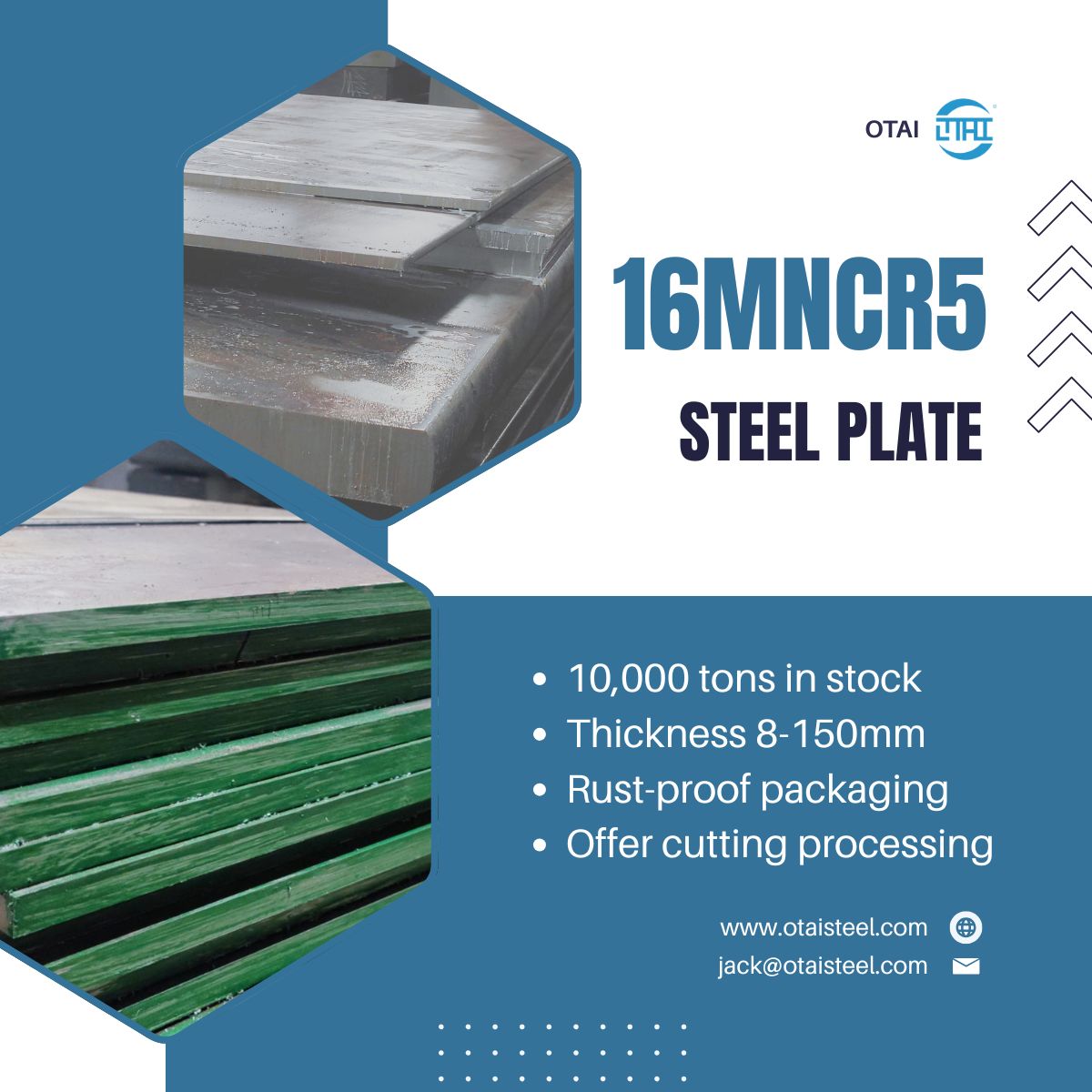
As a professional steel supplier, Otai Special Steel provides stable supply and technical support for 16MnCr5 and related carburizing steels. Meanwhile, we support global customers with flexible processing solutions.

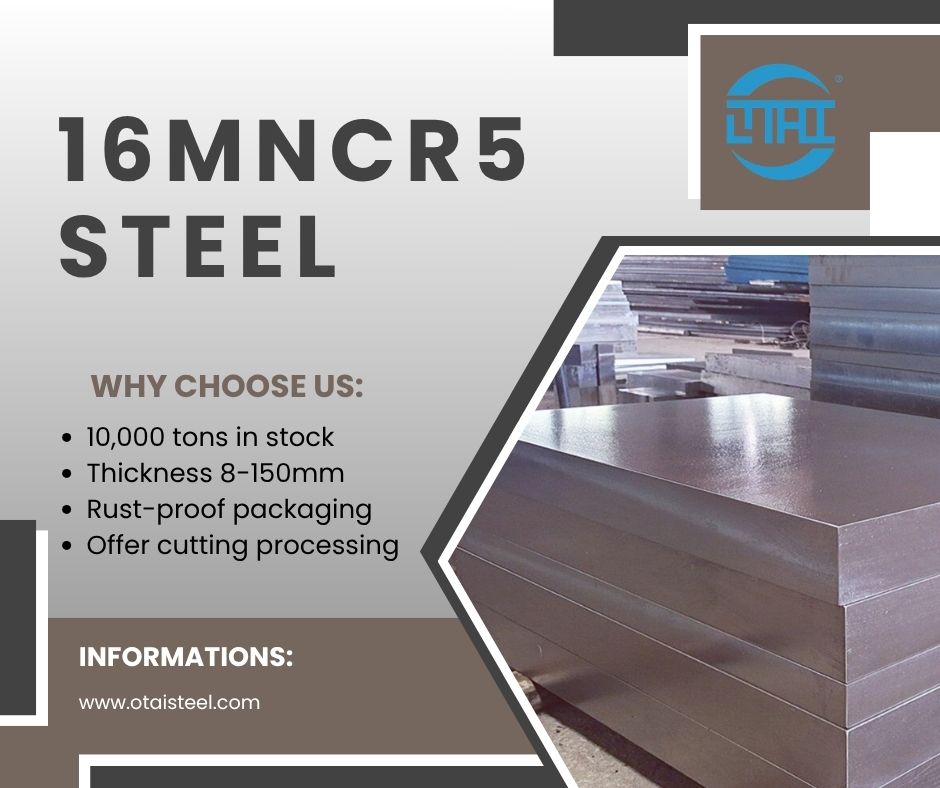
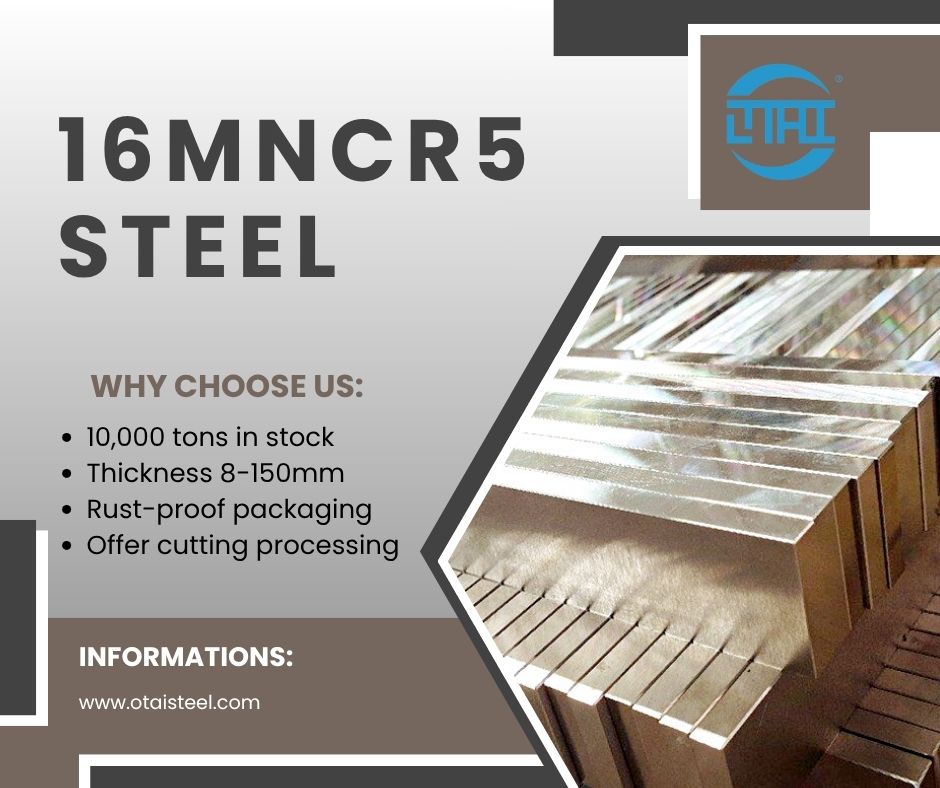
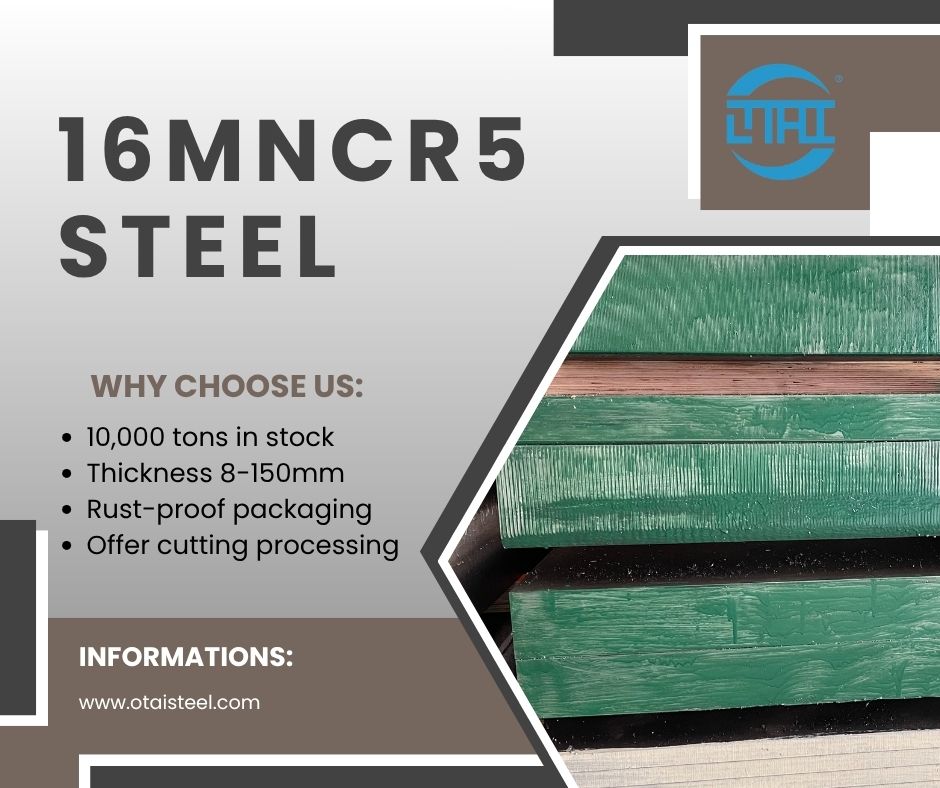
  • Large Stock Availability: 10,000 tons inventory with 8–150mm 16MnCr5 plates ready for fast delivery
  • Processing Services: Cutting, machining, heat treatment, and customized sizing available
  • Quality Control: Ultrasonic testing and third-party inspection supported
  • Export Experience: Long-term supply to Europe, USA, and Asia industrial markets
  • Stable Supply Chain: Consistent quality for batch production requirements

Therefore, customers can reduce sourcing risk and improve production efficiency when purchasing from a stable supplier.

❓ FAQ – What 16MnCr5 Means

Q1: What does 16MnCr5 means in engineering?
It means a carburizing steel system designed for surface hardness and core toughness through heat treatment.

Q2: Is 16MnCr5 a structural steel?
No, it is a case-hardening steel.

Q3: Why is carburizing necessary?
Because low carbon steel cannot achieve high surface hardness without carbon diffusion.

Q4: What is the main advantage?
Balanced wear resistance and toughness after heat treatment.

Q5: What is the biggest risk?
Improper carburizing depth leading to premature fatigue failure.
0 0 Continue Reading →

16MnCr5 1.7131 Equivalent – Full EN Standard Mapping & Engineering Selection Guide

16MnCr5 1.7131 Equivalent – Full EN Standard Mapping & Engineering Selection Guide16MnCr5 1.7131 Equivalent – Full EN Standard Mapping & Engineering Selection Guide
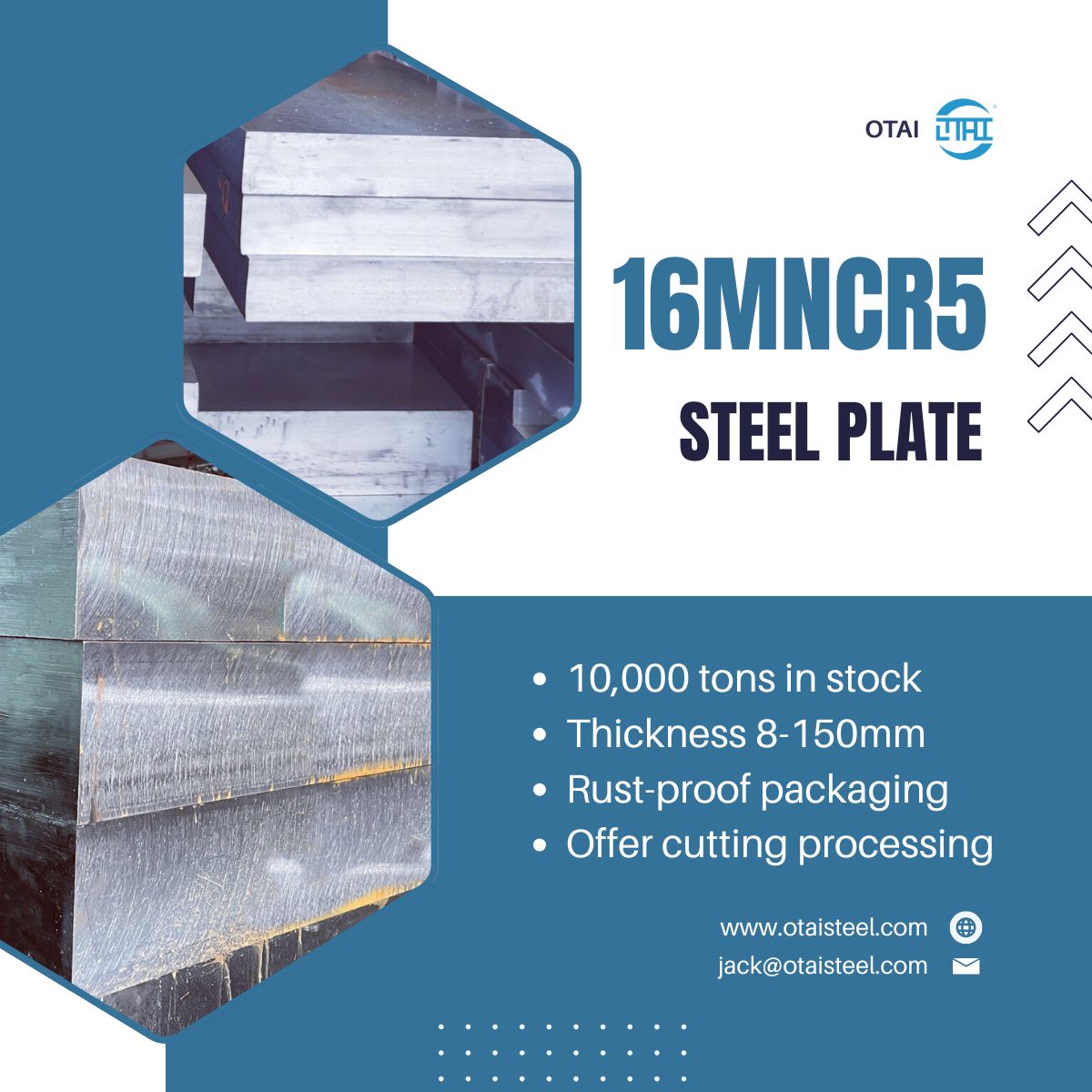
The topic 16MnCr5 steel (EN material number 1.7131) is one of the most important carburizing steels in European mechanical engineering systems. It is widely used in automotive transmission, gear manufacturing, heavy machinery, and precision mechanical components.

🔍 1. Engineering Definition of 16MnCr5 Steel (EN 1.7131)

16MnCr5 is a low-carbon chromium-manganese alloy steel designed specifically for carburizing applications under EN 10084 standard. Its primary engineering function is not to achieve high strength in the as-delivered state, but to develop a hardened surface layer after heat treatment while maintaining a tough core.

When engineers search for 16MnCr5 steel, they are usually referring to a material system rather than a simple alloy grade. This system depends heavily on thermal processing and carbon diffusion behavior.

Key engineering characteristics:

  • Low carbon base for carburizing capability
  • High surface hardness after heat treatment
  • Tough and ductile core structure
  • Designed for cyclic loading systems

This means 16MnCr5 is a process-dependent engineering material, not a fixed-property steel.

⚙️ 2. Chemical Composition and Metallurgical Function System

The chemical composition of 16MnCr5 defines its carburizing capability and mechanical transformation behavior.

Element Typical Range Engineering Function
Carbon (C) 0.14–0.19% Controls carburized hardness depth potential
Manganese (Mn) 1.00–1.30% Improves hardenability and core strength
Chromium (Cr) 0.80–1.10% Enhances wear resistance and case stability
Silicon (Si) ≤0.40% Improves oxidation resistance and deoxidation

The combination of low carbon and alloying elements is critical. Carbon provides surface hardening potential, while Cr and Mn stabilize transformation during quenching.

This balance is what makes 16MnCr5 suitable for controlled diffusion engineering.

🔥 3. Carburizing Heat Treatment Mechanism (Core Engineering Logic)

Heat treatment is the most critical stage in the lifecycle of 16MnCr5 steel. Without carburizing, the material does not achieve its designed performance.

Standard industrial process:

  • Carburizing: 880–980°C (carbon diffusion into austenite phase)
  • Holding time: controls case depth
  • Oil quenching: martensite formation
  • Tempering: stress relief and toughness adjustment

During carburizing, carbon atoms diffuse into the surface layer, creating a gradient carbon profile. This gradient is essential for fatigue resistance.

Too shallow carburizing leads to early wear failure. Too deep carburizing reduces core toughness. Therefore, engineering control of case depth is essential.

🧪 4. Microstructure Evolution and Phase Transformation System

The microstructure of 16MnCr5 changes significantly during heat treatment. This transformation defines its mechanical performance.

Before heat treatment:

  • Ferrite + pearlite structure

After carburizing and quenching:

  • Surface: high-carbon martensite
  • Transition zone: bainite + martensite mixture
  • Core: ferrite + low-carbon bainite

This layered structure is the foundation of fatigue resistance design in mechanical systems.

The gradient structure reduces crack propagation speed and increases service life under cyclic stress.

⚙️ 5. Mechanical Properties and Performance Envelope

The mechanical properties of 16MnCr5 are not fixed values. They depend strongly on heat treatment parameters and case depth control.

Property Typical Range
Surface Hardness 58–62 HRC
Core Hardness 25–35 HRC
Tensile Strength 800–1100 MPa
Fatigue Resistance High (case-dependent)
Wear Resistance Excellent (surface layer)

Engineering interpretation: 16MnCr5 is designed for surface strength + core toughness synergy, not uniform hardness distribution.

🚗 6. Industrial Applications and Load Behavior Analysis

16MnCr5 is widely used in mechanical systems where cyclic loading dominates.

  • Automotive gearbox systems
  • Transmission shafts and pinions
  • Industrial reducers
  • Agricultural machinery
  • Heavy-duty rotating equipment

These components experience combined stresses:

  • Torsional stress
  • Bending fatigue
  • Contact wear
  • Impact loading

Therefore, material selection must consider both surface wear and internal stress distribution.

🛠 7. Machining Strategy and Manufacturing Process Control

Manufacturing 16MnCr5 components requires a controlled process chain.

Typical workflow:

  • Soft machining in annealed condition
  • Carburizing heat treatment
  • Quenching and tempering
  • Finish grinding for tolerance control

Important engineering note: final dimensional accuracy is achieved after heat treatment, not before.

This is due to distortion caused by phase transformation during quenching.

⚖️ 8. Comparison with Similar Carburizing Steels

Steel Grade Main Feature Application Focus
16MnCr5 Balanced toughness and wear resistance General gear systems
20MnCr5 Higher strength and deeper case capability Heavy-duty gears
8620 Good carburizing response Automotive drivetrain

Selection depends on load intensity, required case depth, and cost-performance balance.

🧭 9. Failure Mechanisms in Engineering Applications

Understanding failure behavior is critical for real engineering use of 16MnCr5 steel.

Main failure modes:

  • Surface fatigue cracking due to contact stress
  • Insufficient carburizing depth leading to wear-through
  • Overload fracture in core region
  • Heat treatment distortion causing stress concentration

Fatigue cracks typically initiate at the surface and propagate inward. Proper carburizing depth significantly delays crack initiation.

🏭 10. Industrial Supply Capability – Otai Special Steel

As a professional steel supplier, Otai Special Steel provides stable supply and technical support for 16MnCr5 and related carburizing steels. Meanwhile, we support global customers with flexible processing solutions.

  • Large Stock Availability: 10,000 tons inventory with 8–150mm 16MnCr5 plates ready for fast delivery
  • Processing Services: Cutting, machining, heat treatment, and customized sizing available
  • Quality Control: Ultrasonic testing and third-party inspection supported
  • Export Experience: Long-term supply to Europe, USA, and Asia industrial markets
  • Stable Supply Chain: Consistent quality for batch production requirements

Therefore, customers can reduce sourcing risk and improve production efficiency when purchasing from a stable supplier.

❓ FAQ – 16MnCr5 1.7131 Equivalent

Q1: What is 16MnCr5 steel mainly used for?
It is used for carburized gears, shafts, and transmission components requiring wear resistance and core toughness.

Q2: Why is carburizing necessary for 16MnCr5?
Because its low carbon base cannot achieve high hardness without carbon diffusion treatment.

Q3: What is the biggest advantage of 16MnCr5?
It provides a strong balance between surface hardness and core ductility.

Q4: What causes failure in 16MnCr5 components?
Most failures come from fatigue cracking, insufficient case depth, or overload stress.

Q5: Is 16MnCr5 suitable for high-load gears?
Yes, but for extremely heavy loads, 20MnCr5 is often preferred.

0 0 Continue Reading →

What is 16MnCr5 Steel?

What is 16MnCr5 Steel?What is 16MnCr5 Steel?
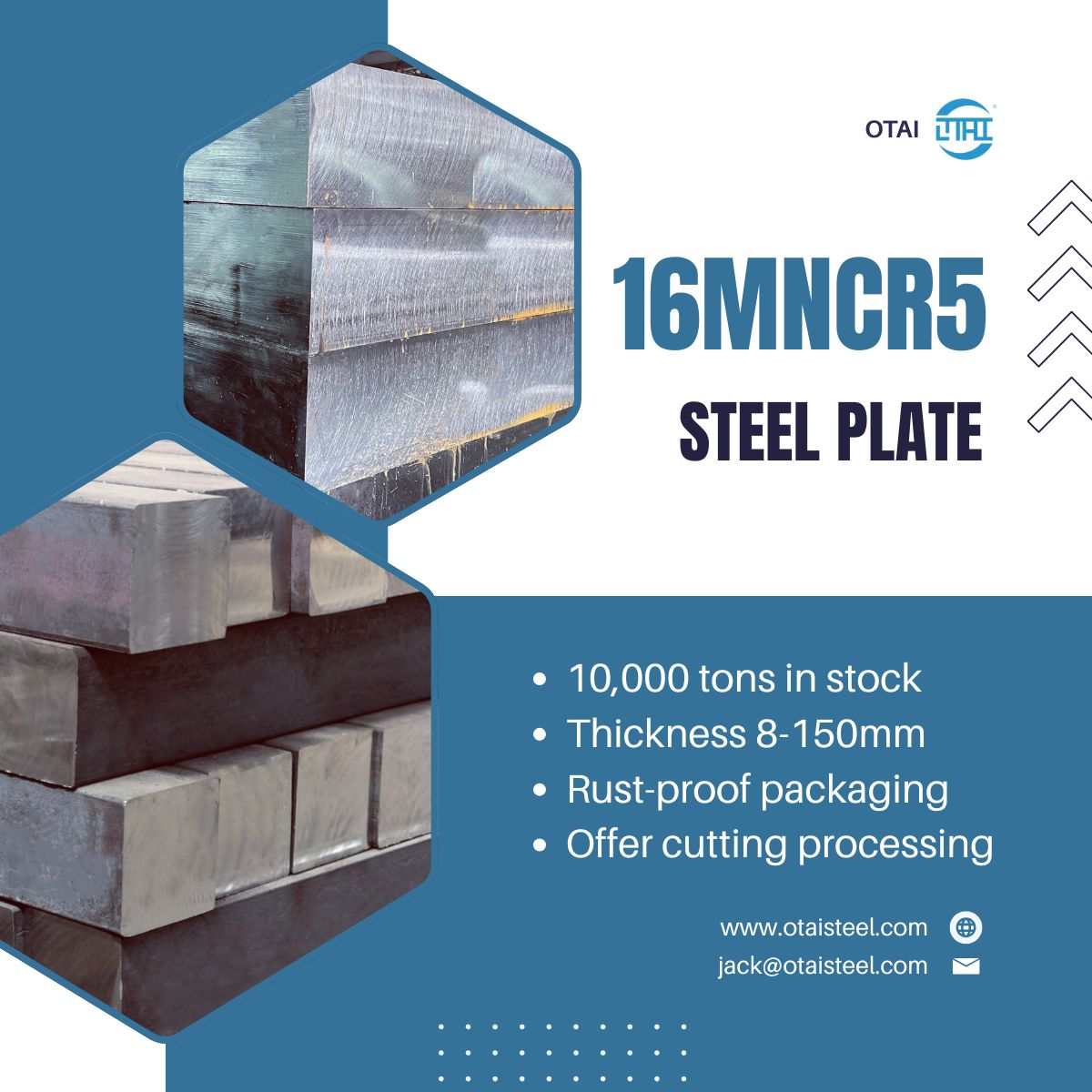
The question what is 16MnCr5 steel is one of the most important topics in case-hardening steel selection, especially in automotive gear systems, transmission components, and mechanical engineering design.

16MnCr5 is not just a material grade. When engineers ask what is 16MnCr5 steel, they are usually referring to a carburizing steel system designed to achieve a hard wear-resistant surface while maintaining a tough and ductile core after heat treatment.

This article provides a full engineering breakdown including chemical composition, microstructure evolution, heat treatment response, mechanical performance, applications, and material selection logic.

🔍 1. What is 16MnCr5 Steel in Engineering Terms?

16MnCr5 is a low-carbon alloy steel that engineers design for carburizing. It belongs to the EN case-hardening steel family, and manufacturers widely use it in components that require high surface hardness and good core toughness.
To understand what 16MnCr5 steel is, we must focus on its design purpose rather than only its chemical composition. Engineers engineer it to perform through heat treatment rather than in the as-delivered condition.
  • Designed for carburizing and surface hardening
  • Used in gears, shafts, pinions, and transmission parts
  • Combines hard surface + tough core structure

Therefore, 16MnCr5 is a process-dependent engineering steel system.

⚙️ 2. Chemical Composition of 16MnCr5 Steel

The chemical composition is the foundation of what is 16MnCr5 steel. Each element plays a specific role in carburizing behavior and mechanical performance.

Element Typical Range Function
Carbon (C) 0.14–0.19% Controls hardness after carburizing
Manganese (Mn) 1.00–1.30% Improves hardenability and core strength
Chromium (Cr) 0.80–1.10% Improves wear resistance and case depth stability
Silicon (Si) ≤0.40% Strength stability and deoxidation

The low carbon content is critical. It allows carbon diffusion during carburizing, forming a high-hardness surface layer while maintaining a ductile core.

🔥 3. Heat Treatment Process of 16MnCr5 Steel

A key part of answering what is 16MnCr5 steel is understanding its heat treatment behavior. The material is designed for carburizing followed by quenching and tempering.

Typical process:

  • Carburizing: 880–980°C (carbon diffusion into surface layer)
  • Quenching: oil cooling to form martensite
  • Tempering: stress relief and toughness improvement

During this process, carbon concentration increases at the surface while the core remains low-carbon and tough. This creates a gradient structure that is essential for fatigue resistance.

🧪 4. Microstructure Evolution and Metallurgical Behavior

Before heat treatment, 16MnCr5 has a ferrite and pearlite structure. After carburizing and quenching, the surface transforms into high-carbon martensite.

This transformation is central to understanding what is 16MnCr5 steel from a metallurgical perspective.

  • Surface layer → high-carbon martensite (high hardness)
  • Transition zone → mixed bainite/martensite
  • Core → low-carbon ferrite + bainite (toughness)

This layered structure provides a balance between wear resistance and impact resistance.

⚙️ 5. Mechanical Properties After Heat Treatment

The performance of 16MnCr5 depends heavily on heat treatment quality. This is why what is 16MnCr5 steel cannot be answered without considering processing conditions.

Property Typical Range
Surface Hardness 58–62 HRC
Core Hardness 25–35 HRC
Tensile Strength 800–1100 MPa
Impact Toughness Good (process dependent)

The combination of a hard surface and tough core makes it suitable for cyclic loading applications.

🚗 6. Industrial Applications of 16MnCr5 Steel

Understanding what is 16MnCr5 steel also requires looking at real-world applications.

  • Automotive transmission gears
  • Gear shafts and pinions
  • Industrial reducers
  • Agricultural machinery components
  • General mechanical transmission parts

These applications rely on surface wear resistance and core toughness working together under cyclic loads.

🛠 7. Machinability and Manufacturing Process

In annealed condition, 16MnCr5 has good machinability. This is important in production planning and cost control.

  • Rough machining before heat treatment
  • Carburizing and quenching process
  • Finish grinding for dimensional accuracy

This manufacturing route reflects the engineering logic behind what is 16MnCr5 steel: a process-designed material rather than a fixed-property steel.

🏭 8. Comparison with Similar Carburizing Steels

Steel Grade Main Feature Typical Application
16MnCr5 Balanced toughness and wear resistance General gears
20MnCr5 Higher strength and hardness Heavy-duty gears
8620 Good toughness and carburizing response Automotive components

This comparison helps clarify what is 16MnCr5 steel in relation to similar engineering materials.

🏢 9. Material Supply Capability – Otai Special Steel

As a professional steel supplier, Otai Special Steel provides stable supply and technical support for 16MnCr5 and related carburizing steels. Meanwhile, we support global customers with flexible processing solutions.

  • Large Stock Availability: 10,000 tons inventory with 8–150mm 16MnCr5 plates ready for fast delivery
  • Processing Services: Cutting, machining, heat treatment, and customized sizing available
  • Quality Control: Ultrasonic testing and third-party inspection supported
  • Export Experience: Long-term supply to Europe, USA, and Asia industrial markets
  • Stable Supply Chain: Consistent quality for batch production requirements

Therefore, customers can reduce sourcing risk and improve production efficiency when purchasing from a stable supplier.

❓ FAQ – What is 16MnCr5 Steel

Q1: What is 16MnCr5 steel used for?
It is mainly used for carburized gears, shafts, and transmission components.

Q2: Is 16MnCr5 a high strength steel?
It is not high strength in raw state, but gains strength after heat treatment.

Q3: Can 16MnCr5 be welded?
Yes, but preheating and post-treatment are recommended.

Q4: What is the main advantage of 16MnCr5?
Excellent balance between surface hardness and core toughness.

Q5: What industries use 16MnCr5 most?
Automotive, machinery manufacturing, and industrial gear systems.

0 0 Continue Reading →

What is the Difference Between 16MnCr5 and 20MnCr5?

What is the Difference Between 16MnCr5 and 20MnCr5?What is the Difference Between 16MnCr5 and 20MnCr5?
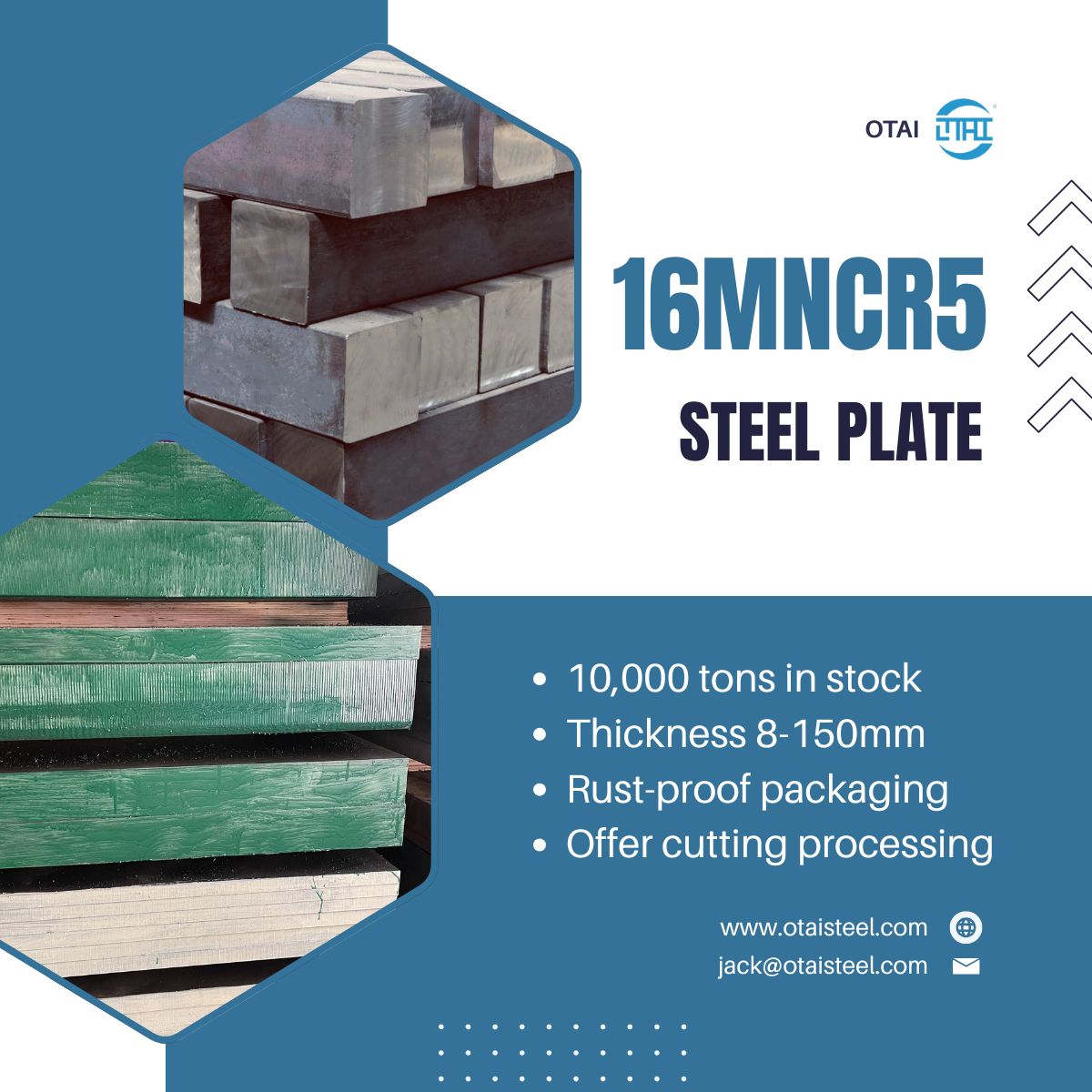
The question what is the difference between 16MnCr5 and 20MnCr5 is widely asked in gear manufacturing, automotive transmission systems, and industrial machinery design. Both steels belong to the EN case-hardening steel family and are commonly used for carburized components such as gears, shafts, and pinions.

However, what is the difference between 16MnCr5 and 20MnCr5 is not only a chemical comparison. It directly affects heat treatment response, fatigue life, core strength, machining cost, and final application reliability in real engineering systems.

This article provides a deep engineering breakdown from material science, mechanical behavior, heat treatment mechanism, failure risk, and industrial selection perspective.

🔍 1. Engineering Definition of 16MnCr5 and 20MnCr5

Both steels are carburizing steels designed to achieve a hard surface layer and tough core after heat treatment. They are not used in quenched and tempered condition like 4140 steel, but rely on surface engineering.

To understand what is the difference between 16MnCr5 and 20MnCr5, we must focus on carbon content and hardenability behavior.

  • 16MnCr5 → lower carbon steel, optimized for toughness and stable deformation control
  • 20MnCr5 → higher carbon steel, optimized for load-bearing and higher surface hardness

Both materials are widely used in gear systems, but they are not interchangeable in high-precision designs without engineering validation.

⚙️ 2. Chemical Composition and Metallurgical Impact

The most direct explanation of what is the difference between 16MnCr5 and 20MnCr5 lies in carbon content variation and its impact on martensite formation after carburizing.

Element 16MnCr5 20MnCr5 Engineering Effect
Carbon (C) 0.14–0.19% 0.17–0.22% Controls hardness gradient and surface strength
Manganese (Mn) 1.00–1.30% 1.10–1.40% Improves hardenability and core strength
Chromium (Cr) 0.80–1.10% 0.90–1.20% Enhances wear resistance and carburized layer stability

Even a small carbon increase significantly improves final hardness but reduces ductility. This is the core metallurgical trade-off.

🔥 3. Carburizing Heat Treatment Behavior

Both steels rely on carburizing, quenching, and tempering to achieve final performance. However, what is the difference between 16MnCr5 and 20MnCr5 becomes clear during carbon diffusion and phase transformation.

Carburizing typically occurs at 880–980°C, where carbon diffuses into the surface layer forming a high-carbon zone.

  • 16MnCr5 → more stable carbon diffusion, lower distortion risk
  • 20MnCr5 → deeper carbon penetration, higher surface hardness potential

However, 20MnCr5 requires stricter control during quenching because higher carbon increases crack sensitivity and dimensional distortion risk.

🧪 4. Microstructure Evolution and Phase Transformation

Before heat treatment, both steels consist of ferrite and pearlite microstructure. After carburizing and quenching, the surface transforms into high-carbon martensite while the core remains low-carbon bainite or ferrite-pearlite.

This layered structure explains what is the difference between 16MnCr5 and 20MnCr5 from a metallurgical perspective.

The transition zone plays a key role in fatigue resistance:

  • Steep gradient → higher crack risk
  • Smooth gradient → better fatigue performance

16MnCr5 generally produces a more ductile core, while 20MnCr5 produces a stronger but slightly less forgiving transition structure.

⚙️ 5. Mechanical Properties After Heat Treatment

The mechanical performance difference is one of the most practical answers to what is the difference between 16MnCr5 and 20MnCr5.

Property 16MnCr5 20MnCr5
Surface Hardness 58–62 HRC 60–64 HRC
Core Hardness 25–35 HRC 30–45 HRC
Tensile Strength 800–1100 MPa 900–1200 MPa
Fatigue Resistance Good Better under high torque

These differences directly affect service life in gear systems and rotating components.

🚗 6. Industrial Application and Load Condition Analysis

In real engineering systems, what is the difference between 16MnCr5 and 20MnCr5 becomes a load-dependent selection problem.

  • 16MnCr5 → suitable for light and medium load gears, standard transmission systems
  • 20MnCr5 → suitable for heavy load gears, high torque reducers, and industrial machinery

Using 20MnCr5 in low-load systems may increase cost unnecessarily, while using 16MnCr5 in high-torque systems may reduce fatigue life.

🛠 7. Machining Behavior and Manufacturing Cost

Before heat treatment, both steels have good machinability, but differences still exist.

  • 16MnCr5 → lower cutting resistance, longer tool life
  • 20MnCr5 → slightly higher tool wear due to higher carbon content

From a manufacturing perspective, this affects production efficiency, especially in mass production of gears and shafts.

🏭 8. Engineering Selection Logic (Failure Avoidance Perspective)

Choosing the wrong material can lead to early failure. Understanding what is the difference between 16MnCr5 and 20MnCr5 helps avoid design risks.

Condition Recommended Steel Reason
High impact load 16MnCr5 Better toughness absorption
High torque transmission 20MnCr5 Higher core strength
Cost-sensitive production 16MnCr5 Lower machining cost
Long service life requirement 20MnCr5 Better fatigue resistance

🏢 9. Material Supply Capability – Otai Special Steel

As a professional steel supplier, Otai Special Steel provides stable supply and technical support for 16MnCr5 and related carburizing steels. Meanwhile, we support global customers with flexible processing solutions.

  • Large Stock Availability: 10,000 tons inventory with 8–150mm 16MnCr5 plates ready for fast delivery
  • Processing Services: Cutting, machining, heat treatment, and customized sizing available
  • Quality Control: Ultrasonic testing and third-party inspection supported
  • Export Experience: Long-term supply to Europe, USA, and Asia industrial markets
  • Stable Supply Chain: Consistent quality for batch production requirements

Therefore, customers can reduce sourcing risk and improve production efficiency when purchasing from a stable supplier.

❓ FAQ – What is the Difference Between 16MnCr5 and 20MnCr5

Q1: What is the main difference?
Carbon content and resulting mechanical strength after carburizing.

Q2: Which steel is stronger?
20MnCr5 has higher strength and hardness.

Q3: Which is easier to machine?
16MnCr5 is easier to machine and process.

Q4: Which is better for gears?
Both are used depending on load conditions.

Q5: Can they replace each other?
Only with engineering validation based on design requirements.

0 0 Continue Reading →

16MnCr5 AISI Equivalent Guide – Composition & Engineering Applications

16MnCr5 AISI Equivalent Guide – Composition, Heat Treatment & Engineering Applications16MnCr5 AISI Equivalent Guide – Composition, Heat Treatment & Engineering Applications
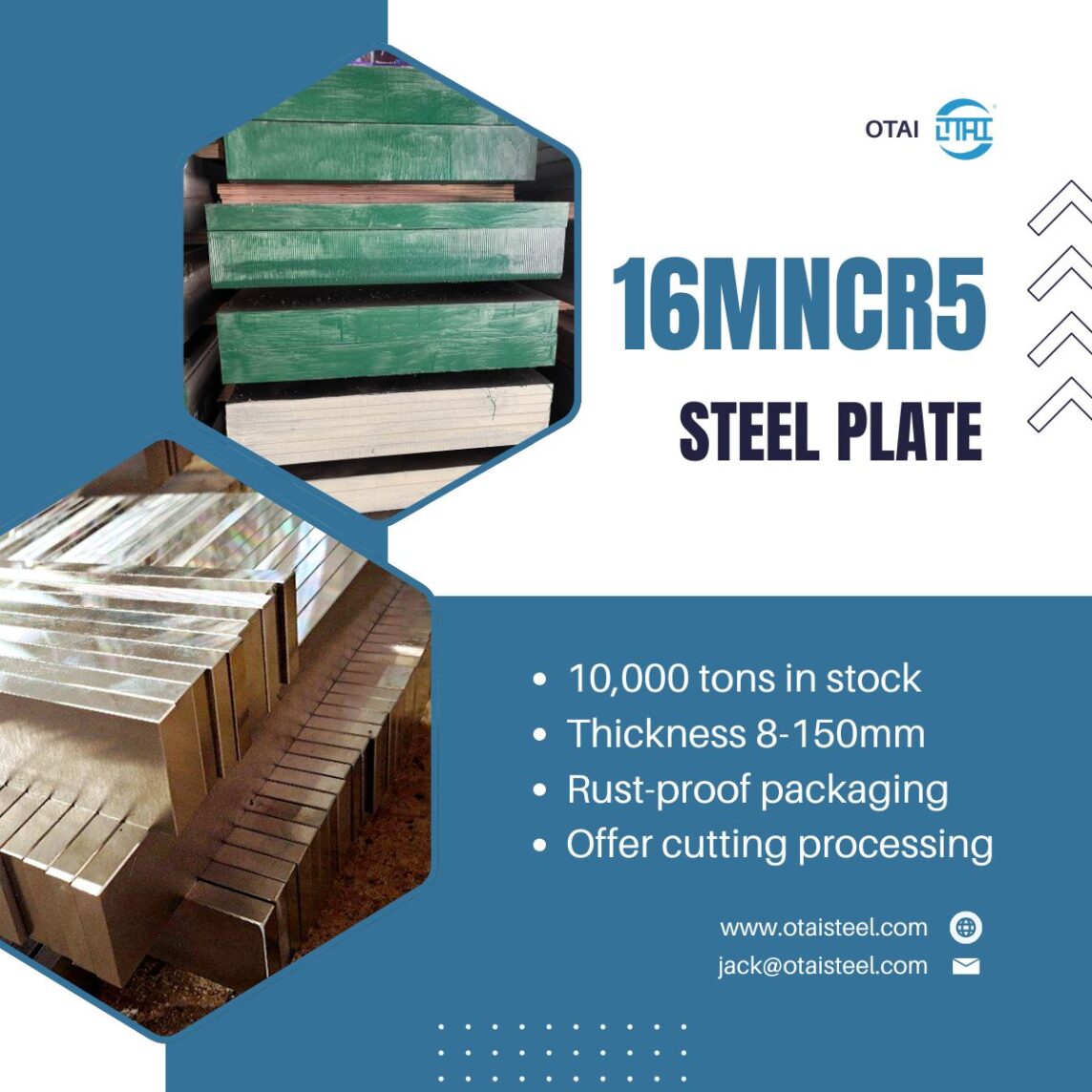
🔍 1. Engineering Meaning of 16MnCr5 AISI Equivalent

The concept of 16MnCr5 AISI equivalent is not a simple one-to-one mapping. Instead, it represents a range of carburizing steels that share similar surface hardening behavior and core toughness characteristics.

In engineering practice, the 16MnCr5 AISI equivalent must be evaluated based on heat treatment response rather than only chemical composition. Therefore, material selection becomes a performance-driven decision.

Meanwhile, this steel is widely used in gears, shafts, and transmission systems because it can achieve a hard wear-resistant surface while maintaining a ductile core structure capable of absorbing impact loads.

In short, the 16MnCr5 AISI equivalent refers to steels that replicate this surface-core performance balance under carburizing conditions.

🧪 2. Common AISI Grades Compared with 16MnCr5

There is no single exact replacement, however several AISI grades are commonly considered as equivalents depending on application requirements.

  • AISI 5115: Light-duty carburized parts with low stress
  • AISI 5120: Closest general equivalent in most applications
  • AISI 8620: Higher toughness due to nickel addition

Among them, AISI 5120 is often selected as the closest match. However, AISI 8620 performs better when impact resistance is critical.

Therefore, selecting the correct 16MnCr5 AISI equivalent depends on load conditions, case depth requirements, and fatigue expectations.

⚙️ 3. Chemical Composition and Functional Role

Element 16MnCr5 AISI 5120 AISI 8620
C 0.14–0.19% 0.18–0.23% 0.18–0.23%
Cr 0.80–1.10% 0.70–0.90% 0.40–0.70%
Mn 1.00–1.30% 0.70–0.90% 0.70–0.90%
Ni — — 0.40–0.70%

These differences explain why the 16MnCr5 AISI equivalent cannot be defined as a single fixed grade. Instead, engineers focus on how alloying elements affect carburizing response.

In addition, low carbon content allows controlled diffusion, while chromium and manganese improve hardenability and case stability.

🔥 4. Heat Treatment Behavior and Carburizing Process

A key factor in understanding the 16MnCr5 AISI equivalent is its carburizing response. This process introduces carbon into the surface layer at high temperature to form a hardness gradient.

The process includes several stages. First, carbon diffusion occurs at 880–950°C. Then, controlled holding time determines case depth. After that, oil quenching forms martensite on the surface, followed by tempering to reduce stress.

As a result, a hard outer shell and tough core structure are created. This balance is essential for fatigue resistance in mechanical systems.

However, improper carburizing control may lead to cracks or uneven hardness distribution, which significantly reduces service life.

🧬 5. Microstructure and Fatigue Performance

Before heat treatment, 16MnCr5 consists mainly of ferrite and pearlite. After carburizing and quenching, the surface transforms into high-carbon martensite while the core remains low-carbon bainite or ferrite-pearlite.

This gradient structure defines the real engineering meaning behind the 16MnCr5 AISI equivalent.

Fatigue failure typically follows a predictable sequence:

  • Crack initiation at surface stress concentration
  • Micro-crack propagation in hardened layer
  • Transition zone crack growth
  • Final fracture in core region

Meanwhile, surface treatments such as shot peening can significantly delay crack initiation and improve fatigue life.

🏭 6. Mechanical Properties After Heat Treatment

Property Typical Range
Tensile Strength 650–900 MPa
Yield Strength 400–650 MPa
Surface Hardness 58–62 HRC
Core Hardness 25–45 HRC
Fatigue Resistance High (process dependent)

These results clearly show that the 16MnCr5 AISI equivalent cannot be evaluated in raw material form alone. Instead, heat treatment determines final performance.

🚗 7. Industrial Applications and Load Conditions

The practical value of the 16MnCr5 AISI equivalent becomes most obvious in rotating and cyclic-loaded components.

  • Automotive gearbox gears under torsional stress
  • Drive shafts under bending cycles
  • Pinions with high surface contact pressure
  • Industrial reducers under continuous operation
  • Agricultural machinery under impact loading

These applications require both wear resistance and core toughness. Therefore, 16MnCr5 is widely adopted in mechanical transmission systems.

🛠 8. Machining Process and Manufacturing Strategy

In annealed condition, 16MnCr5 has good machinability, which allows rough machining before heat treatment.

The standard manufacturing route is as follows:

  • Rough machining in soft state
  • Carburizing and quenching process
  • Final grinding for dimensional accuracy

This process ensures both precision and surface performance. In addition, it reflects the true industrial meaning of the 16MnCr5 AISI equivalent: a process-controlled engineering material rather than a fixed property steel.

🔄 9. Material Selection Comparison

Steel Grade Type Application
16MnCr5 Case hardening Standard gears
20MnCr5 Higher hardenability Heavy-duty gears
8620 Ni-alloy carburizing steel Automotive parts
4140 Through-hardening steel Shafts and structural parts

This comparison shows that 16MnCr5 is not selected for maximum strength, but for balanced surface and core performance.

🏢 10. Company Advantages – Otai Special Steel

As a professional steel supplier, Otai Special Steel provides stable supply and technical support for 16MnCr5 and related carburizing steels. Meanwhile, we support global customers with flexible processing solutions.

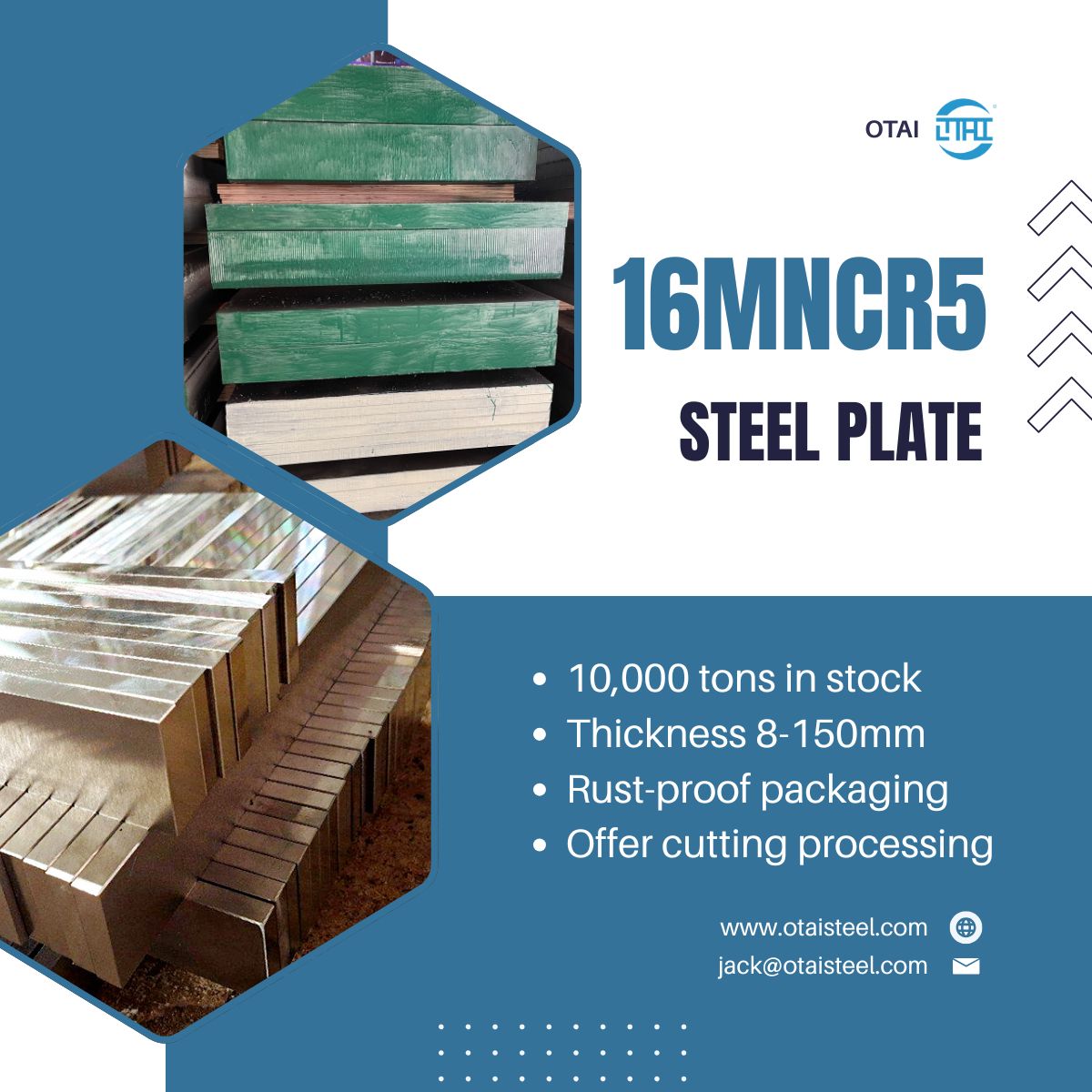
  • Large Stock Availability: 10,000 tons inventory with 8–150mm 16MnCr5 plates ready for fast delivery
  • Processing Services: Cutting, machining, heat treatment, and customized sizing available
  • Quality Control: Ultrasonic testing and third-party inspection supported
  • Export Experience: Long-term supply to Europe, USA, and Asia industrial markets
  • Stable Supply Chain: Consistent quality for batch production requirements

Therefore, customers can reduce sourcing risk and improve production efficiency when purchasing from a stable supplier.

❓ 11. FAQ – 16MnCr5 AISI Equivalent

Q1: What is the closest AISI equivalent of 16MnCr5?
AISI 5120 is generally considered the closest match in most engineering applications.

Q2: Can AISI 8620 replace 16MnCr5?
Yes, but it provides higher toughness due to nickel content, so heat treatment behavior will differ slightly.

Q3: Why is 16MnCr5 widely used in gears?
Because it provides a strong combination of surface hardness and core toughness after carburizing.

Q4: Is 16MnCr5 suitable for heavy load applications?
It is suitable for medium to heavy load systems, but correct heat treatment is required for optimal performance.

Q5: What affects the performance most?
Heat treatment process and carburizing depth are the most critical factors affecting final performance.

🏭 12. Conclusion and Industrial Understanding

In conclusion, the 16MnCr5 AISI equivalent represents a group of carburizing steels with similar performance behavior rather than a fixed substitution grade.

Therefore, correct selection must consider heat treatment response, load conditions, and fatigue requirements. Otherwise, performance failure may occur in real applications.

0 0 Continue Reading →

What Does 16MnCr5 Mean?


What Does 16MnCr5 Mean?What Does 16MnCr5 Mean?
🔍 1. True Engineering Meaning of 16MnCr5

To understand what does 16MnCr5 mean, we must go beyond simple definition. 16MnCr5 is a case-hardening alloy steel designed for components that require a hard wear-resistant surface and a tough core after carburizing treatment.

In engineering practice, what does 16MnCr5 mean is not just a material label. It represents a controlled transformation system where mechanical performance is created during heat treatment rather than in the raw state.

This steel is widely used in gears, shafts, and transmission systems because it can form a high-carbon martensitic surface layer while maintaining a ductile inner core capable of absorbing shock and vibration.

So, what does 16MnCr5 mean in real design terms? It means a predictable carburizing response material optimized for fatigue-loaded mechanical systems.

🧪 2. Decoding the 16MnCr5 Naming Logic and Material System

The designation system behind what does 16MnCr5 mean follows EN steel naming rules. Each part of the code reflects chemical intent and engineering behavior.

  • 16: Approx. 0.16% carbon content enabling carburizing capability
  • Mn: Manganese improves hardenability and core toughness
  • Cr: Chromium enhances wear resistance and case depth stability
  • 5: Alloy grouping indicator within EN classification system

This means what does 16MnCr5 mean is directly linked to surface engineering design rather than structural load-bearing bulk strength.

Unlike medium carbon steels, its performance depends heavily on diffusion-based carbon enrichment and phase transformation control.

⚙️ 3. Chemical Composition and Functional Engineering Logic

Element Range Engineering Function
C 0.14–0.19% Controls carburized hardness potential
Mn 0.80–1.10% Improves toughness and hardenability
Cr 0.80–1.10% Enhances wear resistance and diffusion stability
Si ≤0.40% Strength stability and deoxidation
P/S ≤0.035% Controls brittleness and inclusions

The chemical balance explains why what does 16MnCr5 mean is strongly connected to carburizing performance. Low carbon ensures safe diffusion during heat treatment, while Mn and Cr stabilize hardened case formation.

If alloy balance is not controlled, case cracking or uneven hardness distribution may occur, reducing fatigue life significantly.

🔥 4. Carburizing Heat Treatment Mechanism and Case Formation

A critical part of what does 16MnCr5 mean is its response to carburizing. This process introduces carbon into the surface layer at high temperature, creating a gradient structure.

The process is not just heating. It is controlled diffusion followed by phase transformation:

  • Carbon diffusion into austenite phase at 880–950°C
  • Time-controlled case depth formation
  • Oil quenching to form martensite on surface
  • Tempering to reduce residual stress

This creates a hard outer layer and a tough core. The gradient is what gives 16MnCr5 its fatigue resistance under cyclic loads.

If carburizing depth is too shallow, fatigue cracks initiate early. If too deep, core toughness may be reduced. This balance is central to what does 16MnCr5 mean in real engineering design.

🧬 5. Microstructure Evolution and Fatigue Crack Mechanism

Before heat treatment, 16MnCr5 consists of ferrite and pearlite. After carburizing and quenching, the surface transforms into high-carbon martensite while the core remains low-carbon bainite or ferrite-pearlite.

This structural gradient defines the engineering meaning behind what does 16MnCr5 mean.

Fatigue behavior follows a typical mechanism:

  • Crack initiation at surface stress concentration points
  • Micro-crack propagation through hardened layer
  • Slow crack growth in transition zone
  • Final fracture when core can no longer support load

Shot peening or surface polishing can delay crack initiation and significantly improve fatigue life.

🏭 6. Mechanical Performance After Heat Treatment

Property Typical Range
Tensile Strength 600–900 MPa
Yield Strength 400–650 MPa
Surface Hardness 58–62 HRC
Core Hardness 30–45 HRC
Fatigue Resistance High (case dependent)

These values show that what does 16MnCr5 mean cannot be judged without heat treatment condition. Performance is process-driven, not material-fixed.

Engineering selection must always consider case depth, hardness gradient, and loading type.

🚗 7. Industrial Applications and Load Behavior

The practical meaning of what does 16MnCr5 mean becomes clear in rotating and cyclic-loaded systems.

  • Automotive gearbox gears under torsional fatigue
  • Drive shafts under bending stress cycles
  • Pinions with high contact stress
  • Industrial reducers with continuous loading
  • Agricultural machinery with impact + fatigue combination

These components rely on surface hardness for wear resistance and core toughness for impact absorption. Without both, failure occurs prematurely.

🛠 8. Machinability, Manufacturing Strategy and Process Control

In annealed condition, 16MnCr5 has stable machinability, allowing gear cutting, drilling, and shaping before heat treatment.

Manufacturing sequence is critical:

  • Rough machining in soft state
  • Carburizing and quenching
  • Finish grinding after heat treatment

This workflow ensures dimensional accuracy and surface hardness. It also reflects real industrial interpretation of what does 16MnCr5 mean: a process-engineered material system.

🔄 9. Comparison with Engineering Steels and Selection Logic

Steel Grade Strength Type Main Use
16MnCr5 Case hardening Gears
20MnCr5 Higher case depth potential Heavy-duty gears
8620 Balanced carburizing steel Automotive components
4140 Through-hardening alloy steel Shafts and structural parts

This comparison shows that 16MnCr5 is not chosen for maximum strength, but for optimized surface-core performance balance.

🏭 10. Industrial Supply Capability – Otai Special Steel

OTAI supplies 16MnCr5 steel with stable inventory, cutting services, and heat treatment support for global customers.

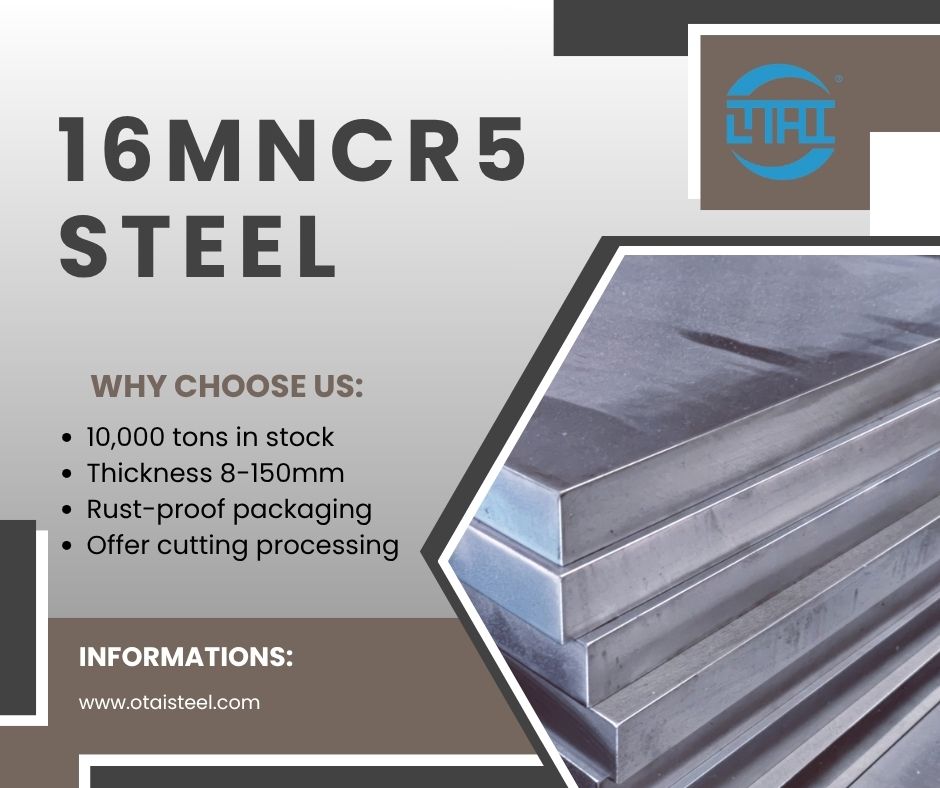
  • 8–150mm thickness plates in stock
  • Large inventory for fast delivery
  • Cutting, heat treatment, machining services
  • Ultrasonic testing and third-party inspection
  • Global export experience

❓ FAQ – What Does 16MnCr5 Mean

Q1: What does 16MnCr5 mean in engineering?
It is a carburizing steel designed for surface hardening and fatigue-loaded components.

Q2: Why is carburizing important?
It creates a hard surface layer while maintaining a tough core structure.

Q3: Is 16MnCr5 a structural steel?
No, it is a case-hardening steel system.

Q4: What controls its performance most?
Heat treatment and case depth control.

Q5: Where is it mainly used?
In gears, shafts, and transmission systems with cyclic loading.

0 0 Continue Reading →

Material Equivalent 16MnCr5: Cross Reference and Engineering Applications


Material Equivalent 16MnCr5: Cross Reference and Engineering ApplicationsMaterial Equivalent 16MnCr5: Cross Reference and Engineering Applications

🔍 1. Introduction to Material Equivalent 16MnCr5

The keyword material equivalent 16MnCr5 refers to the cross-reference understanding of 16MnCr5 steel in different international standards such as ASTM, DIN, SAE, and EN systems. Engineers often need equivalent grades when sourcing materials globally, especially in automotive and mechanical manufacturing industries.

In practical engineering use, the material equivalent 16MnCr5 concept helps buyers identify alternative steels with similar chemical composition, mechanical properties, and heat treatment behavior. This is critical when original EN-grade material is not available in local markets.

The material equivalent 16MnCr5 is widely searched in global procurement because manufacturers want to replace European steel grades with American or Chinese equivalents without affecting performance or safety.

🧪 2. What Does Material Equivalent 16MnCr5 Mean in Engineering Terms?

The material equivalent 16MnCr5 does not refer to a single exact steel grade. Instead, it refers to a group of steels that share similar carburizing behavior, low-carbon base structure, and manganese-chromium alloying system.

In engineering design, equivalence is based on:

  • Chemical composition similarity
  • Heat treatment response
  • Surface hardness after carburizing
  • Core toughness and fatigue resistance

This is why the material equivalent 16MnCr5 concept is more functional than symbolic. Engineers care about performance matching rather than exact naming alignment.

⚙️ 3. Chemical Composition Basis of 16MnCr5 Equivalent Grades

Element Typical Range Engineering Role
C 0.14–0.19% Carburizing response
Mn 0.80–1.10% Core toughness
Cr 0.80–1.10% Wear resistance
Si ≤0.40% Strength stability
P/S ≤0.035% Impurity control

The chemical logic behind the material equivalent 16MnCr5 is simple: low carbon ensures carburizing capability, while manganese and chromium ensure hardenability and surface performance.

Any equivalent steel must maintain similar carbon range and alloy balance to qualify as a true material equivalent 16MnCr5.

🏭 4. Mechanical Properties of 16MnCr5 Equivalent Steels

Property Typical Range
Tensile Strength 600–900 MPa
Yield Strength 400–650 MPa
Core Hardness 30–45 HRC
Surface Hardness 58–62 HRC
Elongation 10–14%
Elastic Modulus ~210 GPa

These mechanical values define the performance baseline of any material equivalent 16MnCr5. Even if chemical composition slightly varies, the final heat-treated performance must remain within this range.

This is especially important in gear manufacturing, where fatigue strength and surface hardness directly affect service life.

🔥 5. Heat Treatment Behavior of Equivalent Materials

A key factor in defining material equivalent 16MnCr5 is its response to carburizing heat treatment. The steel must be able to form a high-carbon surface layer while maintaining a ductile core.

  • Carburizing at 880–950°C
  • Carbon diffusion into surface layer
  • Oil quenching for martensite formation
  • Tempering for stress relief

If a steel cannot achieve similar case depth and hardness profile, it cannot be considered a true material equivalent 16MnCr5.

🧬 6. Microstructure Comparison of Equivalent Grades

The microstructure of material equivalent 16MnCr5 is defined by transformation behavior during heat treatment.

Before carburizing, the structure consists of ferrite and pearlite. After carburizing and quenching, the surface becomes martensitic while the core remains ferrite-bainite.

This gradient structure is essential because it provides:

  • High wear resistance at surface
  • Shock absorption in core
  • Improved fatigue life

🔄 7. Common Material Equivalents of 16MnCr5

Standard Equivalent Grade Notes
EN (Europe) 16MnCr5 Base reference
DIN 16MnCr5 / 1.7131 German classification
SAE/AISI 5115 / 5120 (approx.) Similar carburizing steels
GB (China) 15CrMn / 20CrMn (close) Functional equivalents

These grades are commonly used as material equivalent 16MnCr5 depending on availability and application requirements.

🚗 8. Industrial Applications of Equivalent Steels

The material equivalent 16MnCr5 is widely used in industries where carburized surface performance is critical.

  • Automotive gearbox systems
  • Drive shafts and axle systems
  • Industrial reducers
  • Worm gears and pinions
  • Construction machinery components

In all these applications, the goal of using a material equivalent 16MnCr5 is to ensure stable torque transmission and long fatigue life under cyclic loading.

🛠 9. Machinability and Manufacturing Considerations

One important advantage of material equivalent 16MnCr5 steels is their good machinability in annealed condition.

Manufacturers typically perform rough machining before heat treatment because carburized surfaces become extremely hard afterward.

This production sequence ensures dimensional accuracy and reduces tooling cost while maintaining performance of the final component.

📐 10. Engineering Selection Guidelines

When selecting a material equivalent 16MnCr5, engineers must consider more than just chemical composition.

  • Required case depth after carburizing
  • Fatigue strength under cyclic load
  • Gear contact stress limits
  • Dimensional stability after quenching

A correct selection ensures long-term reliability in mechanical systems and reduces failure risk in high-load environments.

🏭 Company Advantages – Otai Special Steel

OTAI supplies 16MnCr5 and equivalent carburizing steels with stable inventory and processing capability.

  • 8–150mm thickness plates in stock
  • Large inventory for fast delivery
  • Cutting, heat treatment, machining services
  • Ultrasonic testing and third-party inspection
  • Global export experience

❓ FAQ

Q1: What is material equivalent 16MnCr5?
It refers to steels with similar composition and carburizing performance as 16MnCr5.

Q2: Is there a direct exact equivalent?
No single exact match exists, only functional equivalents.

Q3: What is the closest Chinese equivalent?
Common alternatives include 15CrMn and 20CrMn steels.

Q4: Why is equivalence important?
It helps global sourcing when original EN material is unavailable.

Q5: What is the main requirement for equivalence?
Similar carburizing response and mechanical performance after heat treatment.

0 0 Continue Reading →

Material 16MnCr5 Meaning: Complete Engineering and Application Guide

Material 16MnCr5 Meaning: Complete Engineering and Application GuideMaterial 16MnCr5 Meaning: Complete Engineering and Application Guide

🔍 1. Material 16MnCr5 Meaning in Engineering Context

The material 16MnCr5 meaning refers to a low-carbon alloy case hardening steel designed for components that require high surface hardness combined with a tough and ductile core. It is widely used in automotive transmission systems, industrial gearboxes, and precision mechanical structures.

From an engineering perspective, the material 16MnCr5 meaning is not just a chemical definition. It represents a performance-based steel grade optimized for carburizing heat treatment. The key idea is transformation: the material is relatively soft in delivery condition but becomes extremely hard at the surface after heat treatment.

This behavior makes the material 16MnCr5 meaning closely linked to fatigue resistance, contact stress performance, and long-term reliability under cyclic loading conditions.

Engineers choose this steel when they need predictable carburizing depth, stable dimensional control, and a strong balance between hardness and toughness.

🧪 2. Steel Naming Logic Behind 16MnCr5 Meaning

The material 16MnCr5 meaning follows the European EN steel designation system, which directly reflects its chemical composition and design intent.

  • 16 → approximately 0.16% carbon content, indicating low-carbon base structure
  • Mn → manganese improves hardenability and toughness of the core
  • Cr → chromium improves wear resistance and carburizing response
  • 5 → indicates alloy proportion class in EN system grouping

This naming structure explains why the material 16MnCr5 meaning is strongly connected to surface engineering rather than bulk strength design.

Unlike structural steels such as 1045 or 4140, this grade is engineered specifically for case hardening applications where performance is defined after heat treatment rather than in raw condition.

⚙️ 3. Chemical Composition and Metallurgical Design

Element Content (%) Metallurgical Role
C 0.14–0.19 Controls hardness potential after carburizing
Si ≤0.40 Deoxidation and strength stability
Mn 0.80–1.10 Improves hardenability and toughness
Cr 0.80–1.10 Enhances wear resistance and case depth
P ≤0.035 Impurity control
S ≤0.035 Machinability control

This balanced chemical system defines the engineering foundation of the material 16MnCr5 meaning. The relatively low carbon content allows deep carburizing without cracking risk, while chromium ensures stable hardened case formation.

Manganese plays a critical role in maintaining core toughness, especially in thick-section components where internal stress distribution is uneven.

🏭 4. Mechanical Properties and Load Performance Behavior

The mechanical behavior of 16MnCr5 is strongly influenced by heat treatment, which directly defines the real-world interpretation of the material 16MnCr5 meaning.

Property Typical Range Engineering Interpretation
Tensile Strength 600–900 MPa Load carrying capacity
Yield Strength 400–650 MPa Elastic limit stability
Core Hardness 30–45 HRC Impact resistance
Surface Hardness 58–62 HRC Wear resistance layer
Elongation 10–14% Ductility and deformation capacity
Elastic Modulus ~210 GPa Stiffness (unchanged by heat treatment)

The key engineering insight behind the material 16MnCr5 meaning is that strength and hardness are surface-driven, while stiffness remains constant. This makes it highly predictable in structural calculations.

In dynamic systems, this stability ensures consistent gear meshing and reduces vibration-related failure risk.

🔥 5. Heat Treatment Mechanism and Carburizing Process

A central part of the material 16MnCr5 meaning is its carburizing capability. The steel is designed to absorb carbon at high temperature and redistribute it into the surface layer.

  • Carburizing: 880–950°C carbon diffusion stage
  • Holding stage: carbon penetration depth control
  • Oil quenching: martensite transformation on surface
  • Tempering: 150–200°C stress relief and toughness recovery

This process creates a gradient structure that defines the engineering identity of the material 16MnCr5 meaning.

The outer layer becomes high-carbon martensite with extreme hardness, while the core remains low-carbon bainite or ferrite structure, ensuring energy absorption under shock loading.

🧬 6. Microstructure Evolution and Material Transformation

Before heat treatment, the microstructure is mainly ferrite + pearlite. This gives good machinability but limited wear resistance.

After carburizing and quenching, the surface transforms into martensite while the core retains ductile phases. This transformation is the scientific core of the material 16MnCr5 meaning.

The gradient structure improves resistance against:

  • Contact fatigue in gears
  • Surface pitting under rolling load
  • Impact loading in transmission systems

🚗 7. Industrial Applications and Real Engineering Usage

The material 16MnCr5 meaning becomes practical in industrial systems where repeated load cycles and surface wear dominate failure mechanisms.

  • Automotive gearbox gears and pinions
  • Drive shafts and axle components
  • Camshaft systems
  • Industrial reducers and gearboxes
  • Mining machinery transmission parts
  • Agricultural equipment drive systems

In these applications, the steel ensures stable torque transfer and long service life under lubrication and cyclic stress conditions.

🛠 8. Machinability and Manufacturing Strategy

In annealed condition, 16MnCr5 provides good machinability, which is essential for precision gear cutting and shaft turning operations.

Manufacturers typically complete machining before carburizing because the hardened surface becomes extremely difficult to process afterward.

This manufacturing strategy is part of the practical engineering logic behind the material 16MnCr5 meaning.

🔄 9. Comparison with Other Engineering Steels

Steel Grade Carbon Key Feature Application
16MnCr5 0.16% Balanced carburizing steel Standard gears
20MnCr5 0.20% Higher hardness potential Heavy load gears
AISI 8620 0.20% Good toughness balance Automotive parts
4140 0.40% High strength bulk steel Shafts & structural parts

This comparison highlights the positioning of the material 16MnCr5 meaning as a carburizing-optimized steel rather than a bulk-strength alloy.

📐 10. Engineering Design Considerations

Design engineers rely on the material 16MnCr5 meaning when calculating gear tooth stress, shaft deflection, and fatigue life.

Key design factors include:

  • Contact stress distribution on gear surfaces
  • Bending fatigue in rotating shafts
  • Dimensional stability after heat treatment
  • Surface lubrication performance under load

These factors determine whether the material performs reliably in long-term industrial operation.

🏭 Company Advantages – Otai Special Steel

OTAI supplies industrial-grade 16MnCr5 steel with stable stock and processing capability.

  • 8–150mm thickness plates available in stock
  • Large inventory for fast delivery
  • Cutting, heat treatment, machining services
  • Ultrasonic testing and third-party inspection
  • Global export experience

❓ FAQ – Material 16MnCr5 Meaning

Q1: What is material 16MnCr5 meaning?
It refers to a carburizing alloy steel designed for surface hardened mechanical components.

Q2: Why is it widely used in industry?
Because it offers a balance of machinability, carburizing performance, and fatigue resistance.

Q3: Does heat treatment change stiffness?
No, elastic modulus remains nearly constant.

Q4: What are its main applications?
Automotive, industrial gear systems, and heavy machinery components.

Q5: What is the main engineering advantage?
Hard surface combined with tough core structure for long service life.

0 0 Continue Reading →

16MnCr5 Steel Gear – Full Engineering Guide & Industrial Applications

16MnCr5 Steel Gear – Full Engineering Guide & Industrial Applications16MnCr5 Steel Gear – Full Engineering Guide & Industrial Applications

Manufacturers widely use 16MnCr5 steel gear in automotive, industrial machinery, and power transmission systems because it delivers an ideal combination of surface hardness and core toughness. In modern mechanical engineering, this balance is essential because gears must resist both wear and impact under continuous load conditions.

Unlike standard carbon steel gears, 16MnCr5 steel gears rely on carburizing heat treatment to achieve their final performance. Therefore, engineers carefully control processing parameters to ensure consistent hardness depth, dimensional stability, and long fatigue life.

In addition, global demand for high-efficiency transmission systems continues to increase. As a result, 16MnCr5 has become one of the most widely adopted case-hardening steels in gear manufacturing.

—

🧪 1. Metallurgical Basis of 16MnCr5 Steel Gear Performance

The performance of a 16MnCr5 steel gear is based on its chemical composition, which includes controlled levels of carbon, manganese, and chromium. These elements play different roles in determining hardenability and wear resistance.

Carbon enables surface hardening during carburizing. Meanwhile, chromium improves hardenability and increases resistance to wear and oxidation. In addition, manganese enhances strength and improves deep hardening capability.

Because of this balanced composition, engineers achieve a stable carburized layer while maintaining a ductile core. Therefore, the gear can absorb shock loads without cracking or deformation.

Moreover, metallurgical stability ensures consistent performance during long-term cyclic loading. As a result, 16MnCr5 gears perform reliably in demanding mechanical systems such as gearboxes and differential drives.

In industrial practice, this material is preferred when engineers require both cost efficiency and mechanical reliability in medium-load applications.

—

🔥 2. Carburizing and Heat Treatment Behavior

Heat treatment is the most critical step in producing a high-performance 16MnCr5 steel gear. First, manufacturers heat the gear to approximately 900°C–950°C. During this stage, carbon atoms diffuse into the surface layer.

Then, the carburized gear is rapidly quenched. This process transforms the outer layer into martensite, which significantly increases hardness and wear resistance. Meanwhile, the core remains relatively soft and tough.

After quenching, tempering is applied to reduce internal stress. In addition, tempering improves structural stability and prevents brittle failure during operation.

As a result, the gear achieves a hardness gradient structure. This gradient is essential because it allows the surface to resist wear while the core absorbs mechanical shock.

Furthermore, precise control of carburizing time and temperature directly influences case depth. Therefore, manufacturers must carefully adjust process parameters based on gear size and load requirements.

In high-end applications, engineers also perform post-heat-treatment grinding to ensure dimensional accuracy and surface finish quality.

—

⚙️ 3. Mechanical Performance Under Real Working Conditions

A properly processed 16MnCr5 steel gear exhibits excellent mechanical performance under real operating conditions. Surface hardness typically reaches 58–62 HRC, which provides strong resistance to abrasion and contact fatigue.

Meanwhile, the core hardness remains significantly lower. Therefore, the gear maintains toughness and avoids brittle fracture when exposed to shock loads or sudden torque changes.

In addition, the hardness gradient structure improves resistance to pitting failure. Pitting is one of the most common failure modes in gear systems operating under rolling contact stress.

Moreover, 16MnCr5 gears perform well under variable load conditions. Even when torque fluctuates frequently, the material maintains structural stability and dimensional integrity.

Because of these advantages, engineers often select this steel grade for medium-to-high load transmission systems that require long service life without frequent maintenance.

In addition, fatigue resistance plays a major role in extending operational life. Therefore, 16MnCr5 gears are widely used in continuous-duty industrial environments.

—

🏭 4. Industrial Applications and Engineering Use Cases

Manufacturers apply 16MnCr5 steel gear across multiple industries due to its balanced mechanical properties. In automotive systems, it is widely used in transmission gears, differential systems, and timing mechanisms.

In addition, industrial gearbox manufacturers rely on this material for reducers and heavy-duty drive systems. These applications require stable torque transmission and long operational life.

Furthermore, agricultural machinery uses 16MnCr5 gears because they perform reliably under harsh working environments. Dust, vibration, and irregular load conditions require materials with strong fatigue resistance.

Construction machinery also benefits from this material. Excavators, loaders, and cranes use gears that must withstand high torque and frequent load variation.

Because of its versatility, 16MnCr5 has become a standard engineering material for power transmission systems across global industries.

Moreover, its cost-performance ratio makes it more attractive compared to higher-alloy steels, especially in medium-load applications.

—

💡 5. Manufacturing Process and Precision Control

Manufacturing a high-quality 16MnCr5 steel gear requires strict process control. First, engineers prepare the raw blank through forging or machining. This ensures material uniformity and structural integrity.

Next, machining operations define the gear geometry. At this stage, dimensional accuracy is critical because any deviation may affect meshing performance and noise levels.

After machining, heat treatment introduces structural changes. However, carburizing also causes volume expansion. Therefore, manufacturers intentionally leave machining allowance before heat treatment.

Following heat treatment, grinding is often required to achieve final precision. This step ensures correct tooth profile and surface finish quality.

In addition, quality inspection plays a key role. Engineers use hardness testing and dimensional measurement to verify performance consistency.

As a result, well-controlled manufacturing processes ensure high reliability and long service life of 16MnCr5 gears.

—

🏭 Company Advantages – Otai Special Steel

  • 📦 Large stock of alloy steel including 16MnCr5 gear materials
  • ✂️ Cutting, machining, and customization services
  • 🔥 Heat treatment technical support
  • 🔬 Ultrasonic testing (UT) inspection
  • 📦 Export-grade packaging with rust protection
  • 🌍 Stable supply for global gear manufacturers

❓ FAQ – 16MnCr5 Steel Gear

1. Why is 16MnCr5 used for gears?
Because it provides excellent wear resistance and strong core toughness after carburizing.

2. What hardness does it achieve?
Surface hardness typically reaches 58–62 HRC after heat treatment.

3. Is it suitable for high-load gears?
Yes, it performs well in medium to high-load transmission systems.

4. Why is carburizing important?
It creates a hard surface layer while maintaining a tough core.

5. Which industries use it most?
Automotive, machinery, agriculture, and construction equipment industries.

🏁 Conclusion

The 16MnCr5 steel gear remains a widely used engineering solution due to its excellent balance of hardness, toughness, and cost efficiency. Moreover, its carburizing response ensures stable performance in demanding mechanical systems.

Therefore, engineers continue to select this material for gear applications that require durability, reliability, and long service life under real industrial conditions.

0 0 Continue Reading →

16MnCr5 Material Price – Market Trends & Supplier Strategy

16MnCr5 Material Price – Market Trends & Supplier Strategy16MnCr5 Material Price – Market Trends & Supplier Strategy

The 16MnCr5 material price is one of the most important cost considerations in the mechanical engineering and automotive supply chain. Engineers widely use this alloy steel for carburized components such as gears, shafts, pinions, and transmission systems that require a hard wear-resistant surface and a tough core.

Unlike standard carbon steel, the 16MnCr5 material price is not stable or universal. It varies significantly depending on alloy composition, heat treatment condition, dimensional requirements, and global steel market conditions. For industrial buyers, understanding these pricing mechanisms is essential to reduce procurement risk and improve cost efficiency.

This article provides a complete technical and commercial breakdown of how pricing is formed, how it changes, and how buyers can optimize purchasing decisions in real industrial environments.

📊 1. Core Factors That Determine 16MnCr5 Material Price

The 16MnCr5 material price is driven by multiple upstream and downstream factors. Each factor affects production cost, processing complexity, and final market quotation.

Among all variables, alloy composition and heat treatment are the most critical. Chromium and manganese content directly influence hardenability, while carburizing capability determines its industrial value in transmission parts.

In addition, steelmaking route (EAF or BOF), raw material fluctuations, and energy consumption also play important roles in determining base pricing levels.

Pricing Factor Influence on Cost
Raw material cost Primary driver of base price
Alloy content (Cr, Mn) Moderate to high impact
Heat treatment process High impact (carburizing increases cost)
Product size & thickness Thicker sections increase cost
Surface condition Machined surfaces increase cost
Order quantity Bulk orders reduce unit price

🏭 2. Material Condition and Its Direct Price Impact

One of the most important variables affecting 16MnCr5 material price is the delivery condition. The same steel grade can have significantly different pricing depending on whether suppliers deliver it annealed, normalized, or carburized.

Annealed material generally costs the least because it requires minimal processing. However, carburized and quenched material involves multiple thermal cycles, precision control, and longer production time.

Manufacturers typically use pre-hardened or specially processed conditions in high-performance mechanical components where dimensional stability and wear resistance are critical.

Condition Processing Level Price Level
Annealed Low processing Low
Normalized Medium processing Medium
Carburized + quenched High processing High
Pre-hardened / precision Very high processing Highest

In many industrial cases, the 16MnCr5 material price difference between annealed and fully heat-treated material can exceed 30–60% depending on specification requirements.

📦 3. Product Form, Thickness & Manufacturing Complexity

Product geometry plays a major role in determining the 16MnCr5 material price. Plates, bars, and forged blocks require different production routes, resulting in different cost structures.

Thicker sections require longer rolling cycles and more controlled cooling rates to ensure uniform microstructure. Forged products involve additional deformation steps, increasing energy consumption and processing time.

Machined or precision-ground materials add further cost due to additional CNC processing, tolerance control, and inspection requirements.

Form / Thickness Cost Level
Thin plates (8–30 mm) Low
Medium plates (30–80 mm) Medium
Heavy plates (80–150 mm) High
Extra thick (150 mm+) Premium

As thickness increases, the 16MnCr5 material price rises not only due to weight but also due to processing difficulty and quality control requirements.

🌍 4. Global Market Influence on Pricing Behavior

The global steel industry directly affects the 16MnCr5 material price. Since this steel is widely used in automotive and industrial transmission systems, demand fluctuations in these sectors strongly influence market pricing.

Energy costs, iron ore prices, and logistics expenses are major contributors to international price volatility. Shipping cost variations also significantly impact export pricing structures.

Currency exchange rates further influence purchasing decisions, especially for international buyers purchasing in USD or EUR.

Market Factor Impact Level
Raw material price High
Energy cost High
Shipping cost Medium–High
Currency fluctuation Medium

💡 5. Industrial Cost Optimization Strategy

Professional buyers do not only focus on the lowest 16MnCr5 material price, but instead evaluate total lifecycle cost, including machining efficiency, scrap rate, and production time.

Selecting standard sizes close to final dimensions significantly reduces waste and machining time. Bulk purchasing also improves price negotiation power and stabilizes long-term supply.

Working with stockist suppliers reduces lead time and helps maintain consistent production schedules.

Strategy Benefit
Standard size selection Lower machining cost
Bulk purchasing Better price control
Stock supplier cooperation Stable delivery

🏭 6. Company Advantages – Otai Special Steel

  • 📦 Over 10,000 tons of alloy steel inventory in stock
  • 📏 Full range of 16MnCr5 plates and bars available
  • ✂️ Cutting, machining, drilling and processing services
  • 🔥 Heat treatment and technical support available
  • 🔬 Ultrasonic testing (UT) inspection support
  • 📦 Export packaging with anti-rust protection
  • 🌍 Global supply experience across automotive and machinery industries

❓ 7. FAQ – 16MnCr5 Material Price

1. Why does 16MnCr5 material price change frequently?
Because it depends on raw materials, alloy content, and global market demand.

2. Is carburized 16MnCr5 more expensive?
Yes, due to additional heat treatment processes.

3. Does thickness affect price?
Yes, thicker materials increase production cost significantly.

4. How can buyers reduce cost?
Use standard sizes and buy in bulk from stock suppliers.

5. Is 16MnCr5 a high-cost steel?
No, it is a medium-cost alloy steel.

🏁 Conclusion

The 16MnCr5 material price is determined by a combination of technical specifications and global economic conditions. Buyers should evaluate not only unit price but also processing efficiency, material condition, and supplier reliability.

A strategic purchasing approach helps reduce total manufacturing cost while ensuring stable mechanical performance and long-term supply security.

0 0 Continue Reading →