Skip to Content

Blog Archives

Density of 16MnCr5 – Material Properties and Engineering Applications

Density of 16MnCr5 – Material Properties and Engineering ApplicationsDensity of 16MnCr5 – Material Properties and Engineering Applications

The density of 16MnCr5 is an important physical property for engineers, machinists, and material buyers involved in the design and manufacturing of gears, shafts, pinions, and carburized mechanical components. Density directly affects component weight, machining calculations, transportation cost, structural design, and rotational performance.

16MnCr5 is a widely used low-carbon chromium-manganese alloy steel designed for case hardening applications. Because this steel combines a hard wear-resistant surface with a tough core, industries such as automotive, heavy equipment, industrial machinery, and agricultural engineering rely on it for high-performance components.

Understanding the density of 16MnCr5 also helps engineers accurately calculate:

  • Material weight
  • Machining stock requirements
  • Rotational inertia
  • Load distribution
  • Structural efficiency

🔍 What is the Density of 16MnCr5?

The standard density of 16MnCr5 steel is approximately:

Property Value
Density 7.80 – 7.85 g/cm³
Density 7800 – 7850 kg/m³
Density 0.282 – 0.284 lb/in³

In most engineering calculations, a standard value of:

ρ= 7.85  g/cm³

is commonly used.

The density remains relatively stable regardless of heat treatment condition because carburizing and tempering mainly change the microstructure, not the overall mass-to-volume ratio.

⚗️ Why Density Matters in Engineering

Density is more than a simple physical property. It directly influences the behavior and cost of mechanical components.

🔹 Weight Calculation

Engineers use density to estimate the final weight of parts before production. This is especially important for:

  • Automotive transmission systems
  • Rotating shafts
  • Aerospace support components
  • Industrial machinery assemblies

For example, a heavier shaft increases rotational inertia, which may affect acceleration and energy efficiency.

🔹 Structural Design

The density of 16MnCr5 helps determine:

  • Dead load in machinery
  • Bearing load requirements
  • Dynamic balance in rotating systems
  • Transportation and installation costs

🔹 Machining and Material Planning

Manufacturers use density to estimate:

  • Raw material requirements
  • Machining waste
  • Cutting stock dimensions
  • Shipping weight and packaging design

📊 Chemical Composition of 16MnCr5

The density of 16MnCr5 comes from its alloy composition, mainly iron combined with chromium and manganese.

Element Content (%) Influence on Material
Carbon (C) 0.14 – 0.19 Improves hardness after carburizing
Silicon (Si) 0.17 – 0.37 Increases strength and oxidation resistance
Manganese (Mn) 1.00 – 1.30 Improves hardenability and toughness
Chromium (Cr) 0.80 – 1.10 Enhances wear resistance
Phosphorus (P) ≤ 0.025 Controlled impurity level
Sulfur (S) ≤ 0.035 Improves machinability in small amounts

Although alloying elements slightly influence density, the value remains close to standard alloy steel densities because iron remains the primary element.

🔥 Relationship Between Density and Heat Treatment

Heat treatment significantly changes the microstructure of 16MnCr5, but it only slightly affects density.

Heat Treatment Microstructure Density Change
Annealed Ferrite + Pearlite Minimal
Normalized Refined Pearlite Minimal
Carburized Hardened Surface Layer Very slight
Quenched & Tempered Tempered Martensite Very slight

Engineering Insight: While the density remains nearly constant, the internal microstructure changes dramatically, affecting hardness, fatigue resistance, and wear performance.

For this reason, engineers often use the same density value in CAD and FEA software regardless of heat treatment condition.

⚙️ Weight Calculation Example

Density becomes extremely useful when calculating steel weight for manufacturing and procurement.

Formula for Weight Calculation

Weight= Volume/Density

Example

A 16MnCr5 steel plate measuring:

  • Length: 2000 mm
  • Width: 1000 mm
  • Thickness: 20 mm

Volume:

2.0×1.0×0.02 = 0.04m³

Using a density of:

7850 kg/m³

Weight becomes:

0.04 ×7850 = 314kg

This calculation helps buyers estimate:

  • Shipping cost
  • Material handling requirements
  • Machining allowance
  • Inventory planning

⚙️ Mechanical Properties Related to Density

Although density itself does not determine strength, it contributes to the strength-to-weight ratio, which is critical in engineering design.

Property Typical Value
Tensile Strength 800 – 1200 MPa
Yield Strength 550 – 850 MPa
Hardness After Carburizing 58 – 62 HRC
Elongation 12 – 16%
Density 7.85 g/cm³

This combination of moderate density and high strength makes 16MnCr5 ideal for:

  • High-speed rotating shafts
  • Automotive gears
  • Industrial drive systems
  • Heavy-duty couplings

🚗 Industrial Applications of 16MnCr5

The density and mechanical performance of 16MnCr5 support many demanding engineering applications.

Industry Components Key Advantage
Automotive Gears, pinions, shafts Wear resistance and fatigue strength
Industrial Machinery Rollers, couplings Tough core with hardened surface
Agricultural Equipment Gearboxes, axles High shock resistance
Heavy Equipment Drive systems Good balance of strength and weight

🔹 Automotive Engineering Example

In transmission gears, engineers select 16MnCr5 because it provides:

  • High surface hardness after carburizing
  • Stable density for rotational balance
  • Excellent fatigue resistance
  • Reliable dimensional stability during operation

This improves gearbox efficiency and extends service life under repeated torque loading.

🌐 International Equivalent Grades

Several international steels have similar density and mechanical characteristics.

Standard Equivalent Grade
AISI / SAE SAE 5115
JIS SCM420
GB 20CrMnTi
DIN / EN 16MnCr5

Even though chemical composition varies slightly, the density of these equivalent steels remains close to 7.85 g/cm³.

🏭 Company Advantages

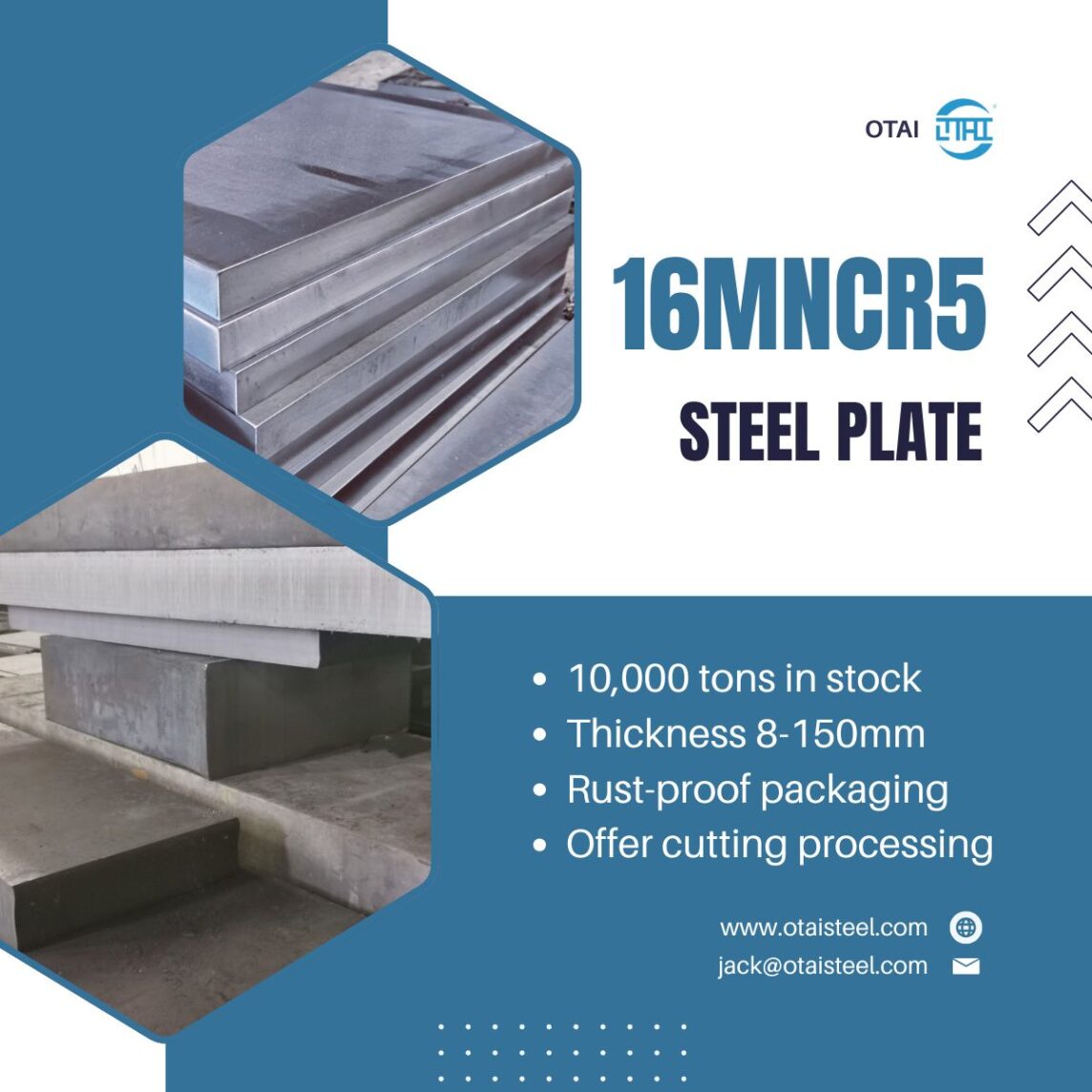
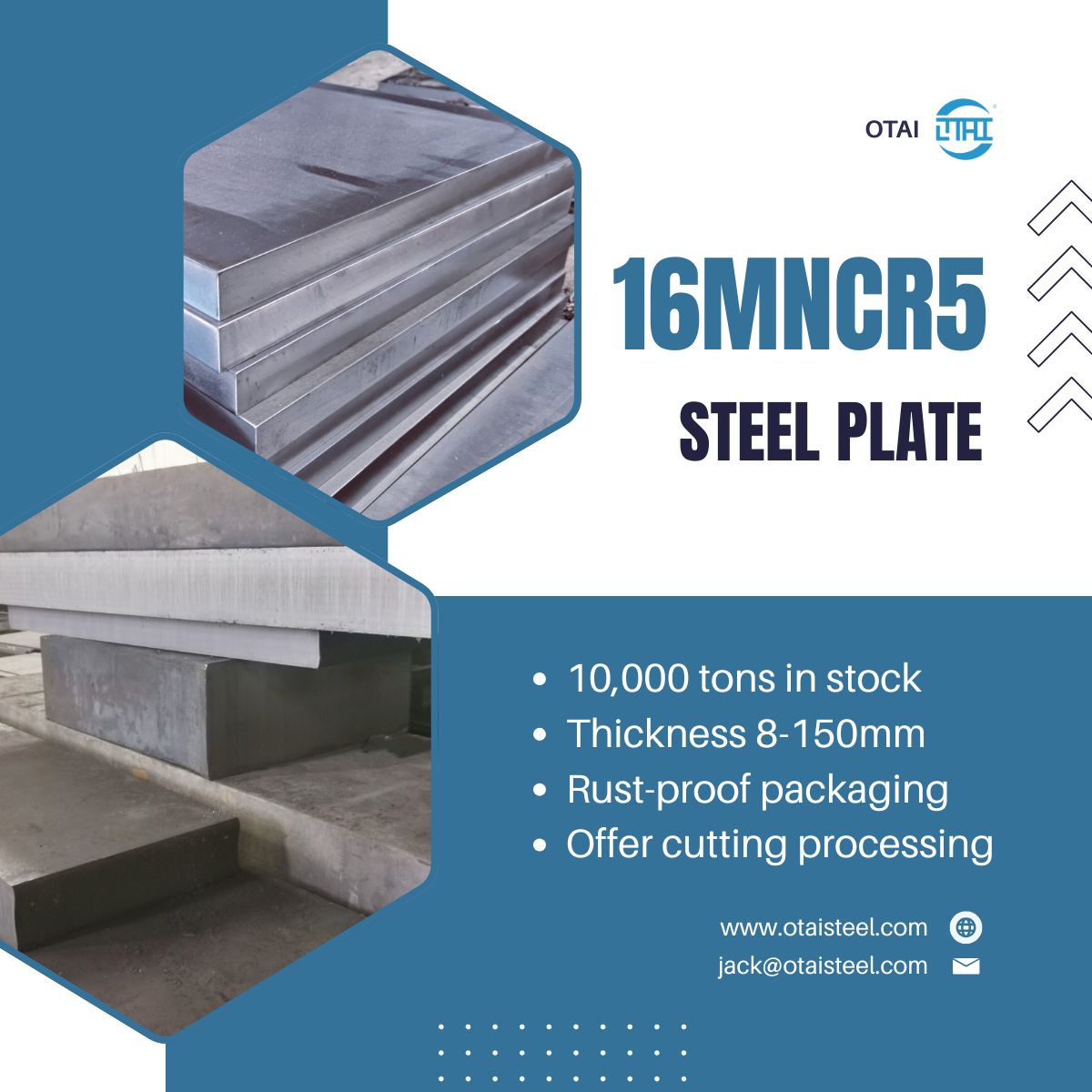
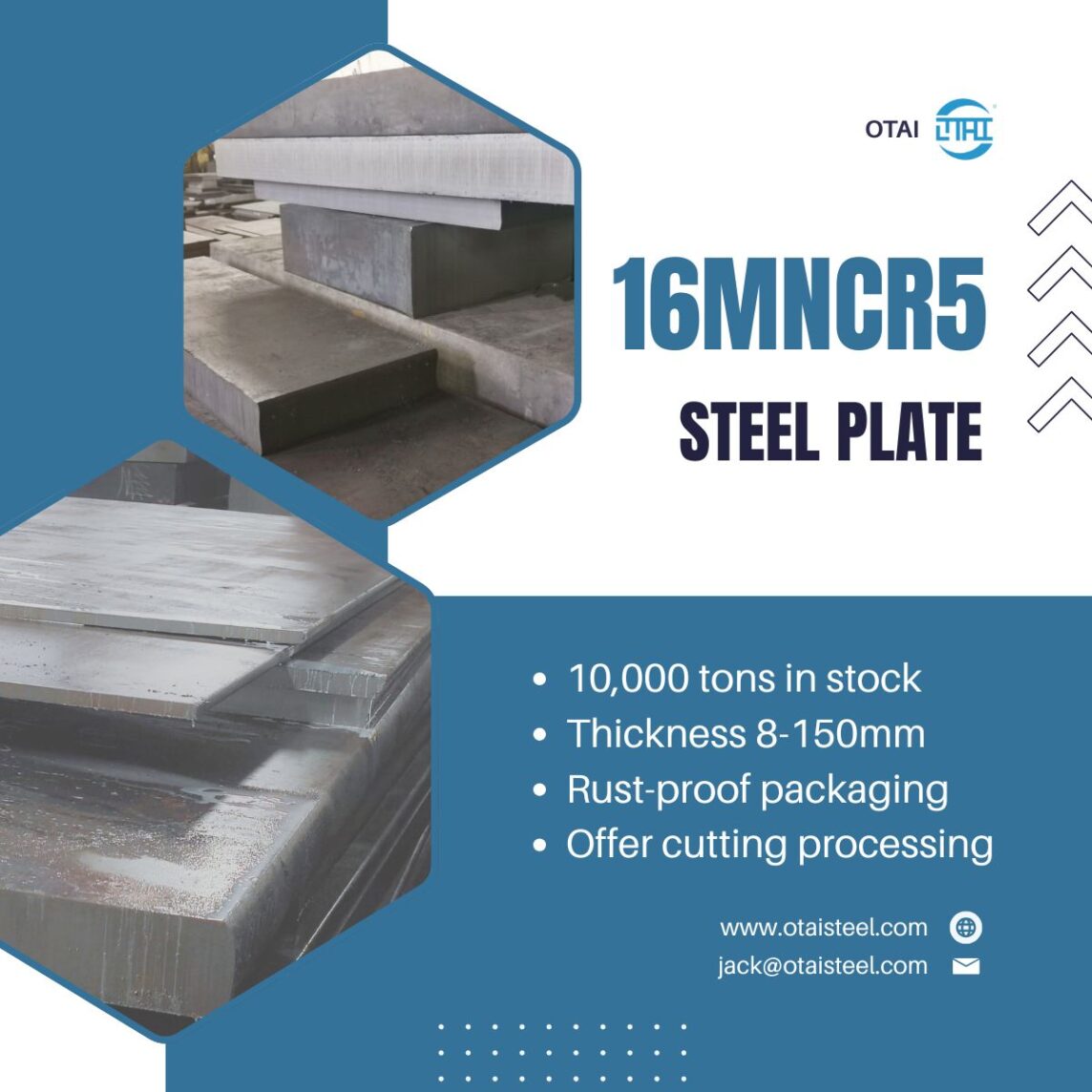
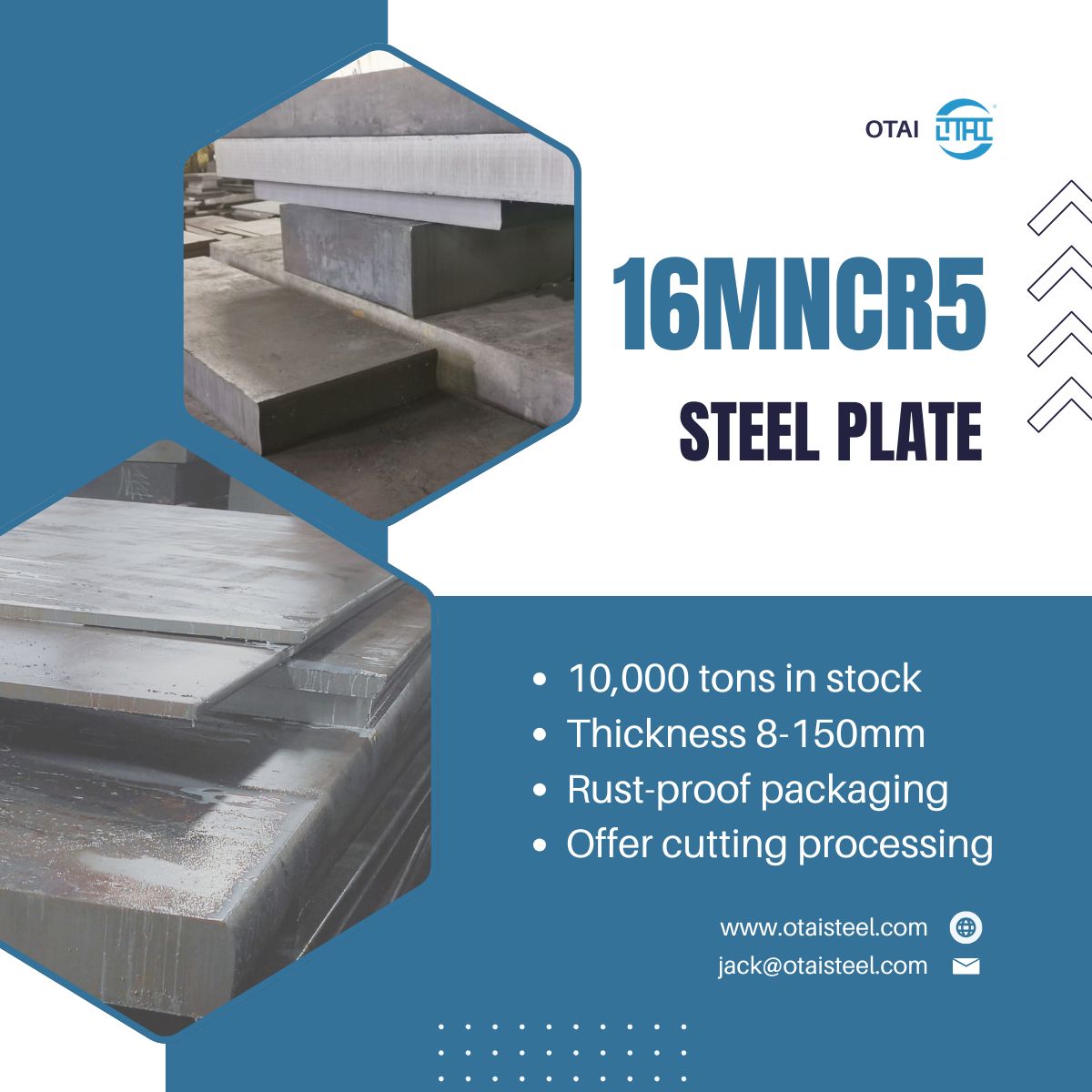
Otai Special Steel supplies premium-quality 16MnCr5 steel materials for demanding engineering applications.

  • Large inventory and stable supply
  • 8–150mm thickness plates available in stock
  • Custom cutting and heat treatment services
  • Ultrasonic testing (UT) and chemical composition verification
  • Third-party inspection support (SGS)
  • Professional export packaging and logistics support

We support customers in the automotive, industrial machinery, heavy equipment, and precision engineering sectors with reliable quality and technical assistance.

❓ FAQ

Q1: What is the standard density of 16MnCr5 steel?

A1: The standard density is approximately 7.85 g/cm³ or 7850 kg/m³.

Q2: Does heat treatment change the density of 16MnCr5?

A2: Heat treatment only slightly affects density because it changes microstructure rather than mass.

Q3: Why is density important for engineering design?

A3: Density helps calculate weight, rotational inertia, structural load, and material requirements.

Q4: Is the density of 16MnCr5 similar to SAE 5115?

A4: Yes. Equivalent steels such as SAE 5115 and SCM420 have very similar density values.

Q5: Which applications require accurate density calculations?

A5: Automotive gears, rotating shafts, heavy machinery components, and precision mechanical systems all require accurate density data.

0 0 Continue Reading →

Composition 16MnCr5 – Chemical Analysis and Engineering Applications

Composition 16MnCr5 – Chemical Analysis and Engineering ApplicationsComposition 16MnCr5 – Chemical Analysis and Engineering Applications

The composition of 16MnCr5 plays a critical role in determining its performance in case hardening, carburizing, and high-fatigue engineering applications. 16MnCr5 is a widely used low-carbon chromium-manganese alloy steel designed for components that require a hard wear-resistant surface combined with a tough and ductile core. Because of this balanced performance, engineers frequently select this material for automotive gears, transmission shafts, industrial pinions, and heavy-duty machinery parts.

Understanding the chemical composition of 16MnCr5 helps manufacturers optimize heat treatment, machining, and final mechanical performance. Even small variations in alloying elements can influence surface hardness, hardenability, fatigue resistance, and dimensional stability during service.

🔍 What is 16MnCr5 Steel?

16MnCr5 is a European case-hardening steel grade standardized under the EN system. The name itself provides useful information about the steel chemistry:

  • 16 indicates approximately 0.16% carbon
  • Mn represents manganese alloying
  • Cr represents chromium alloying
  • 5 relates to the approximate alloy content level

This alloy combination makes 16MnCr5 ideal for applications where components experience:

  • Continuous friction and wear
  • Cyclic loading and fatigue
  • Torque and bending stress
  • Impact loading under dynamic conditions

Unlike higher-carbon steels, 16MnCr5 maintains excellent core toughness after carburizing because the carbon content remains relatively low in the center of the material.

🧪 Chemical Composition of 16MnCr5

The standard chemical composition of 16MnCr5 typically falls within the following ranges:

Element Content (%) Function in Steel
Carbon (C) 0.14 – 0.19 Improves hardness and strength after carburizing
Silicon (Si) 0.17 – 0.37 Enhances strength and oxidation resistance
Manganese (Mn) 1.00 – 1.30 Increases hardenability and tensile strength
Chromium (Cr) 0.80 – 1.10 Improves wear resistance and surface hardness
Phosphorus (P) ≤ 0.025 Controlled impurity level
Sulfur (S) ≤ 0.035 Improves machinability in small amounts

Engineering Insight: The combination of manganese and chromium gives 16MnCr5 excellent hardenability during carburizing, allowing the steel to achieve a high-hardness surface layer while maintaining a tough core.

📊 How the Composition Affects Mechanical Properties

The chemical composition directly influences the final mechanical performance of the steel after heat treatment.

Property Annealed Condition Carburized & Tempered Condition
Tensile Strength 550 – 800 MPa 800 – 1200 MPa
Yield Strength 300 – 500 MPa 550 – 850 MPa
Surface Hardness 180 HB 58 – 62 HRC
Elongation 20 – 25% 12 – 16%
Core Toughness Excellent Excellent

🔹 Carbon Content Influence

Carbon is one of the most important elements in 16MnCr5.

  • Low carbon content keeps the core ductile
  • Surface carbon increases during carburizing
  • Higher carbon on the surface improves wear resistance

This structure allows gears and shafts to resist surface abrasion without becoming brittle internally.

🔹 Chromium Contribution

Chromium improves:

  • Hardenability
  • Wear resistance
  • Surface strength
  • Fatigue performance

In carburized applications, chromium helps create a uniform hardened layer, which improves service life under repeated stress cycles.

🔹 Manganese Effects

Manganese increases:

  • Tensile strength
  • Quench response
  • Toughness
  • Dimensional stability during heat treatment

This element also reduces the risk of cracking during quenching, especially in larger sections.

🔥 Heat Treatment and Composition Relationship

The chemical composition of 16MnCr5 makes it highly responsive to carburizing and quench hardening.

Heat Treatment Process Temperature Range Main Purpose
Annealing 650 – 700°C Improve machinability
Normalizing 870 – 900°C Refine grain structure
Carburizing 880 – 980°C Increase surface carbon content
Quenching 820 – 860°C Form martensitic surface layer
Tempering 150 – 200°C Reduce brittleness

Practical Tip: For transmission gears, a carburized case depth of 0.8–1.2 mm often provides an ideal balance between wear resistance and impact toughness.

Because of its chemistry, 16MnCr5 develops a hard martensitic outer layer after quenching while retaining a tough ferrite-pearlite core. This combination is essential for components exposed to torsional loads and repeated impacts.

⚙️ Industrial Applications of 16MnCr5

The composition of 16MnCr5 makes it suitable for industries requiring reliable fatigue performance and wear resistance.

Industry Typical Components Why 16MnCr5 is Used
Automotive Gears, shafts, pinions Excellent fatigue and wear resistance
Heavy Machinery Drive systems, couplings Tough core and hard surface
Agricultural Equipment Gearboxes, axles Resists shock loading
Industrial Manufacturing Rollers, spindles Dimensional stability and hardness

🔹 Automotive Engineering Example

In automotive transmission systems, gears manufactured from 16MnCr5 benefit from:

  • Hard carburized surfaces for wear protection
  • Tough cores resisting sudden torque loads
  • Long fatigue life under high rotational speed

This combination significantly reduces the risk of tooth cracking and surface pitting during long-term operation.

🌐 International Equivalent Grades

Several international grades offer similar chemical composition and performance characteristics:

Standard Equivalent Grade
AISI / SAE SAE 5115
JIS SCM420
GB 20CrMnTi
DIN / EN 16MnCr5

Although these equivalents are similar, slight composition differences may affect:

  • Hardenability
  • Machining performance
  • Carburizing response
  • Fatigue life

Engineers should always verify exact specifications before material substitution.

🏭 Company Advantages

Otai Special Steel supplies high-quality 16MnCr5 steel materials for demanding engineering applications.

  • Large inventory and stable supply
  • 8–150mm thickness plates available in stock
  • Custom cutting and heat treatment services
  • Ultrasonic testing (UT) and chemical composition verification
  • Third-party inspection support (SGS)
  • Professional export packaging and logistics support

We support customers in the automotive, industrial machinery, heavy equipment, and precision engineering sectors with reliable quality and technical assistance.

❓ FAQ

Q1: What is the carbon content of 16MnCr5?

A1: The carbon content typically ranges from 0.14% to 0.19%.

Q2: Why does 16MnCr5 contain chromium?

A2: Chromium improves hardenability, wear resistance, and surface hardness after carburizing.

Q3: What is the main advantage of the 16MnCr5 composition?

A3: It provides an excellent combination of a hard wear-resistant surface and a ductile, impact-resistant core.

Q4: Can the composition affect heat treatment results?

A4: Yes. Variations in carbon, manganese, and chromium directly influence hardenability, hardness depth, and fatigue performance.

Q5: Which industries commonly use 16MnCr5 steel?

A5: Automotive, industrial machinery, agricultural equipment, and heavy engineering industries widely use this steel for gears, shafts, and transmission components.

0 0 Continue Reading →

16MnCr5 Chemistry – Composition, Properties, and Industrial Applications

16MnCr5 Chemistry – Composition, Properties, and Industrial Applications 16MnCr5 Chemistry – Composition, Properties, and Industrial Applications

Understanding the 16MnCr5 chemistry is essential for engineers, manufacturers, and material buyers aiming to select a reliable low-carbon alloy steel for components requiring case hardening and durable cores. 16MnCr5 is a chromium-manganese alloy steel widely used in automotive, industrial machinery, and heavy equipment applications, where a balance of surface hardness, core toughness, and machinability is critical. Accurate knowledge of its chemical composition ensures proper heat treatment, mechanical performance, and service life.

🔍 Overview of 16MnCr5 Chemistry

16MnCr5 is a low-carbon steel alloyed primarily with manganese and chromium, sometimes containing small amounts of silicon, phosphorus, and sulfur. The chemical composition is carefully designed to:

  • Enhance surface hardenability during carburizing
  • Maintain a tough, ductile core
  • Ensure good machinability in the annealed state
  • Provide reliable fatigue resistance after heat treatment

Standard Chemical Composition

Element Content (%) Function
Carbon (C) 0.14 – 0.19 Low carbon ensures ductile core and prevents brittleness
Silicon (Si) 0.17 – 0.37 Improves strength and oxidation resistance
Manganese (Mn) 1.00 – 1.30 Increases hardenability and tensile strength
Chromium (Cr) 0.80 – 1.10 Enhances hardenability, wear resistance, and corrosion resistance
Phosphorus (P) ≤ 0.025 Minor impurity, improves machinability in controlled amounts
Sulfur (S) ≤ 0.035 Minor impurity, facilitates free-cutting behavior when low

Insight: The combination of manganese and chromium ensures that 16MnCr5 achieves excellent surface hardness after carburizing, while maintaining ductile core properties suitable for shafts, gears, and high-load components.

🌐 Impact of Chemistry on Mechanical Properties

The chemical composition directly affects tensile strength, yield strength, and hardness. Typical mechanical properties of 16MnCr5 after heat treatment are:

Property Annealed Carburized & Tempered Units
Tensile Strength 550 – 800 800 – 1200 MPa
Yield Strength 300 – 500 550 – 850 MPa
Surface Hardness 180 HB 58 – 62 HRC
Core Toughness Excellent Excellent
Elongation 20 – 25 12 – 16 %

🔹 Engineering Implications

  • Low carbon content ensures core ductility, which is essential for components under torsion or cyclic loads.
  • Chromium and manganese improve hardenability, allowing the steel to develop a hard, wear-resistant surface after carburizing.
  • Slight variations in chemistry between equivalents like SAE 5115 can impact surface hardness, fatigue resistance, and machinability, so precise composition control is critical.

🔥 Heat Treatment Considerations

The chemical composition influences the heat treatment response of 16MnCr5:

Process Temperature Purpose
Normalizing 870 – 900°C Refines grain, improves toughness
Carburizing 880 – 980°C Raises surface carbon for high hardness
Quenching 820 – 860°C Hardens surface layer
Tempering 150 – 200°C Reduces brittleness, stabilizes core properties

Practical Tip: For automotive shafts and gears, tempering at 180–200°C after carburizing ensures the optimal balance between surface hardness (58–62 HRC) and core toughness.

⚙️ Applications

Industry Components Notes
Automotive Gears, shafts, pinions, axles High fatigue resistance and wear performance
Industrial Machinery Spindles, rollers, couplings Handles cyclic loads efficiently
Heavy Equipment Drive shafts, gear reducers Resists torsion and bending
Agricultural Machinery Rotors, gearboxes Maintains performance under moderate wear

Engineering Example: A gearbox designed with 16MnCr5 shafts achieves high surface hardness for wear resistance while maintaining core ductility, reducing the risk of component failure under torque and repeated stress cycles.

🏭 Company Advantages

Otai Special Steel supplies 16MnCr5 and equivalent materials for critical engineering applications:

  • Large inventory and stable supply
  • 8–150mm thickness plates available in stock
  • Custom cutting, heat treatment, and surface finishing
  • Ultrasonic testing (UT) and chemical composition verification
  • Third-party inspection support (SGS)
  • Professional export packaging

We support automotive, industrial machinery, heavy equipment, and precision engineering sectors, ensuring reliable supply, consistent quality, and technical guidance.

❓ FAQ

Q1: What is the chemical composition range of 16MnCr5?
A1: Carbon 0.14–0.19%, Manganese 1.0–1.3%, Chromium 0.8–1.1%, Silicon 0.17–0.37%, Phosphorus ≤0.025%, Sulfur ≤0.035%.

Q2: How does the chemistry affect performance?
A2: Manganese and chromium increase hardenability, carbon affects core ductility, and small silicon content improves strength and oxidation resistance.

Q3: Can 16MnCr5 chemistry be compared directly with SAE 5115?
A3: Yes, SAE 5115 is the AISI/SAE equivalent, with slight variations in manganese and carbon affecting hardenability and machining.

Q4: Why is precise chemical control important?
A4: Even minor deviations can affect carburizing response, surface hardness, fatigue life, and machining performance, especially in critical shafts and gears.

Q5: What components benefit most from 16MnCr5?
A5: Automotive gears, industrial machinery spindles, heavy equipment drive shafts, and agricultural rotors, where surface wear resistance and core toughness are essential.


Jack Tan


📧 jack@otaisteel.com

📱 WhatsApp: +8676923190193

0 0 Continue Reading →

16MnCr5 AISI Equivalent – Material Specifications and Applications

16MnCr5 AISI Equivalent – Material Specifications and Applications16MnCr5 AISI Equivalent – Material Specifications, Mechanical Properties, and Applications

Understanding the 16MnCr5 AISI equivalent is essential for engineers, material suppliers, and manufacturers who need reliable low-carbon alloy steel for components requiring surface hardening and durable cores. 16MnCr5 is a chromium-manganese steel widely used in automotive, industrial, and machinery applications. Its combination of surface hardness, core toughness, and machinability makes it ideal for shafts, gears, and other high-wear components. Identifying international equivalents such as SAE 5115 ensures consistent material performance and compatibility in global engineering projects.

🔍 Overview of 16MnCr5

16MnCr5 is a low-carbon case-hardening steel with manganese and chromium. Its key characteristics include:

  • Surface hardenability for wear resistance
  • Ductile core to withstand bending and torsion
  • Good machinability in the annealed state
  • Reliable fatigue resistance after heat treatment

This steel is commonly used in components such as:

  • Automotive pinions, gears, and axles
  • Industrial spindles, rollers, and couplings
  • Agricultural machinery components
  • Construction and heavy machinery shafts

By combining low carbon content with alloying elements, 16MnCr5 achieves high strength, toughness, and dimensional stability after carburizing and tempering.

Chemical Composition

Element Content (%)
Carbon (C) 0.14 – 0.19
Silicon (Si) 0.17 – 0.37
Manganese (Mn) 1.00 – 1.30
Chromium (Cr) 0.80 – 1.10
Phosphorus (P) ≤ 0.025
Sulfur (S) ≤ 0.035

Insight: The combination of manganese and chromium increases hardenability and wear resistance, while low carbon ensures a ductile core suitable for components subjected to high fatigue loads.

🌐 AISI / SAE Equivalents

The most common AISI equivalent of 16MnCr5 is SAE 5115, widely recognized in North America. Other comparable international standards include:

Standard Equivalent Notes
EN / Germany 16MnCr5 Original European standard
AISI / SAE SAE 5115 US equivalent for carburized components
JIS / Japan SCM420 Japanese low-alloy steel with similar properties
GB / China 20CrMnTi Chinese equivalent with minor differences

Tip: Even when using equivalents, engineers should verify mechanical properties and heat treatment requirements to ensure performance meets design specifications.

📊 Mechanical Properties

16MnCr5 and its equivalents are engineered for high surface hardness and ductile cores. Mechanical properties vary depending on heat treatment:

Property Annealed Carburized & Tempered Units
Tensile Strength 550 – 800 800 – 1200 MPa
Yield Strength 300 – 500 550 – 850 MPa
Surface Hardness 180 HB 58 – 62 HRC
Core Toughness Excellent Excellent
Elongation 20 – 25 12 – 16 %

🔹 Engineering Considerations

  • Fatigue resistance: The ductile core resists cyclic loading, making the steel ideal for gears and shafts.
  • Surface wear: Carburized layer ensures high hardness, reducing friction and wear in high-load applications.
  • Machinability: Annealed 16MnCr5 allows easy machining, reducing tool wear and production time.

🔥 Heat Treatment Recommendations

Proper heat treatment is crucial to achieve the desired surface hardness and core ductility:

Process Temperature Effect
Normalizing 870 – 900°C Refines grain, improves toughness
Carburizing 880 – 980°C Increases surface carbon, enhancing hardness
Quenching 820 – 860°C Raises surface hardness
Tempering 150 – 200°C Reduces brittleness, stabilizes core toughness

Practical Tip: For automotive pinions or small gears, tempering at 180–200°C after carburizing balances surface hardness and core ductility, ensuring optimal fatigue performance.

⚙️ Applications

Industry Components Notes
Automotive Shafts, pinions, gears, axles High fatigue resistance and wear performance
Industrial Machinery Spindles, rollers, couplings Handles cyclic loads efficiently
Heavy Equipment Drive shafts, gear reducers Resists torsion and bending
Agricultural Machinery Rotors, gearboxes High wear resistance under moderate loads

Case Study: In an automotive gearbox, using 16MnCr5 or SAE 5115 shafts ensures surface hardness ≥60 HRC after carburizing while maintaining core toughness ≥550 MPa, resulting in longer service life and fewer failures under torque.

🏭 Company Advantages

Otai Special Steel supplies 16MnCr5 and equivalent materials with consistent quality for critical engineering applications:

  • Large inventory and stable supply
  • 8–150mm thickness plates available in stock
  • Custom cutting, heat treatment, and surface finishing
  • Ultrasonic testing (UT) and chemical composition verification
  • Third-party inspection support (SGS)
  • Professional export packaging

We serve automotive, industrial machinery, heavy equipment, and precision engineering sectors, ensuring reliable supply and technical support.

❓ FAQ

Q1: What is the AISI equivalent of 16MnCr5?
A1: SAE 5115 is the most common AISI/SAE equivalent, closely matching chemical composition and mechanical performance.

Q2: Can SAE 5115 fully replace 16MnCr5?
A2: Yes, but verify heat treatment and mechanical property requirements for critical components.

Q3: What applications suit 16MnCr5 equivalents?
A3: Automotive gears, shafts, pinions, industrial spindles, heavy machinery, and agricultural equipment.

Q4: Does the AISI equivalent respond the same in heat treatment?
A4: Generally yes; SAE 5115 behaves similarly in carburizing, quenching, and tempering, achieving high surface hardness and ductile cores.

Q5: What should engineers check when using equivalents?
A5: Confirm mechanical properties, alloy composition, hardenability, and dimensional tolerances to ensure compatibility with design specifications.


Jack Tan


📧 jack@otaisteel.com

📱 WhatsApp: +8676923190193

0 0 Continue Reading →

16MnCr5 Equivalent – Material Comparison, Specifications, and Applications

16MnCr5 Equivalent – Material Comparison, Specifications, and Applications16MnCr5 Equivalent – Material Comparison, Specifications, and Applications

For engineers, manufacturers, and material buyers, understanding the 16MnCr5 equivalent grades is essential for selecting the right low-carbon alloy steel for case hardening, carburizing, and high-wear applications. 16MnCr5, a widely used chromium-manganese steel, combines excellent surface hardness, wear resistance, and core toughness. However, depending on regional standards, designers and procurement specialists often need to know the equivalent material grades to ensure consistent performance across international projects.

🔍 What is 16MnCr5?

16MnCr5 is a low-carbon alloy steel with moderate amounts of manganese and chromium. Its properties make it ideal for carburized parts with tough cores, such as:

  • Automotive gears and shafts
  • Pinions and axles
  • Industrial machinery spindles
  • Agricultural and construction equipment components

Its chemical composition allows for excellent machinability in the soft state and high surface hardness after case hardening, making it a reliable material for components subjected to wear and repeated torsion.

Chemical Composition of 16MnCr5

Element Content (%)
Carbon (C) 0.14 – 0.19
Silicon (Si) 0.17 – 0.37
Manganese (Mn) 1.00 – 1.30
Chromium (Cr) 0.80 – 1.10
Phosphorus (P) ≤ 0.025
Sulfur (S) ≤ 0.035

The low carbon content ensures high ductility and core toughness, while chromium and manganese improve hardening capacity and wear resistance.

🌐 International Equivalents of 16MnCr5

Depending on regional standards, 16MnCr5 has several equivalent materials that offer similar mechanical and chemical properties:

Standard Equivalent Grade Notes
EN / Germany 16MnCr5 Original European standard
AISI / ASTM SAE 5115 US equivalent for carburized components
JIS / Japan SCM420 Japanese low-alloy steel with similar properties
GB / China 20CrMnTi Chinese equivalent with minor differences in alloying

Practical tip: When sourcing 16MnCr5 internationally, always check mechanical properties and heat treatment requirements, as minor variations can impact core toughness and surface hardness.

📊 Mechanical Properties

16MnCr5 and its equivalents are designed for high surface hardness with ductile cores. The mechanical properties vary depending on heat treatment:

Property Annealed Pre-Hardened Carburized & Tempered
Tensile Strength (MPa) 550 – 800 600 – 900 800 – 1200
Yield Strength (MPa) 300 – 500 400 – 650 550 – 850
Surface Hardness (HRC) 180 HB 28 – 32 HRC 58 – 62 HRC
Core Toughness Excellent Good Excellent

16MnCr5’s combination of surface hardness and core toughness ensures reliable performance under torsion, bending, and cyclic loading.

🔥 Heat Treatment Recommendations

Proper heat treatment is critical to achieving the expected performance:

Process Temperature Effect
Normalizing 870 – 900°C Refines grain structure, improves core toughness
Carburizing 880 – 980°C Increases surface carbon for higher hardness
Hardening 820 – 860°C Maximizes surface hardness
Tempering 150 – 200°C Relieves stresses, maintains core toughness

Engineering tip: For automotive pinions and shafts, a tempering temperature around 180–200°C after carburizing achieves a balanced surface hardness of 60 HRC and core toughness of 45–50 HRC equivalent, which is ideal for fatigue-resistant applications.

⚙️ Applications of 16MnCr5 Equivalents

Industry Typical Components Notes
Automotive Gears, axles, pinions, shafts Requires high surface hardness and fatigue resistance
Industrial Machinery Spindles, rollers, couplings Components subjected to cyclic loads
Heavy Equipment Drive shafts, structural connectors High torsion and bending stress applications
Agricultural Equipment Gearboxes, rotors Resistant to wear and surface deformation

16MnCr5 equivalents, such as SAE 5115 or SCM420, are widely used in international projects to ensure material compatibility while maintaining mechanical performance.

🏭 Company Advantages

Otai Special Steel supplies 16MnCr5 and its equivalents in plates, bars, and rounds, providing high-quality steel for critical applications.

Our advantages include:

  • Large inventory year-round
  • 8–150mm thickness plates in stock
  • Custom cutting, heat treatment, and surface finishing
  • Ultrasonic testing (UT) and chemical composition verification
  • Third-party inspection support (SGS)
  • Stable export packaging and fast delivery

We serve automotive, industrial machinery, heavy equipment, and precision engineering sectors worldwide.

❓ FAQ

Q1: What are the international equivalents of 16MnCr5?
A1: SAE 5115 (US), SCM420 (Japan), and 20CrMnTi (China) are commonly used equivalents. Always compare mechanical properties and heat treatment requirements.

Q2: Can 16MnCr5 equivalents be carburized and hardened?
A2: Yes, all equivalents are suitable for case hardening and carburizing, providing high surface hardness and ductile cores.

Q3: Which applications are best suited for 16MnCr5 equivalents?
A3: Automotive gears, shafts, pinions, industrial spindles, and heavy-duty machinery components.

Q4: How to ensure proper material performance?
A4: Verify chemical composition, mechanical properties, and heat treatment processes to match the intended design specifications.

Q5: Can equivalents fully replace 16MnCr5 in projects?
A5: Generally yes, but always confirm mechanical properties, carbon content, and hardenability to ensure compatibility.


Jack Tan


📧 jack@otaisteel.com

📱 WhatsApp: +8676923190193

0 0 Continue Reading →

Difference Between 16MnCr5 and 20MnCr5 – Detailed Specifications, Applications, and Practical Selection

Difference Between 16MnCr5 and 20MnCr5 – Detailed Specifications, Applications, and Practical SelectionDifference Between 16MnCr5 and 20MnCr5 – Detailed Specifications, Applications, and Practical Selection

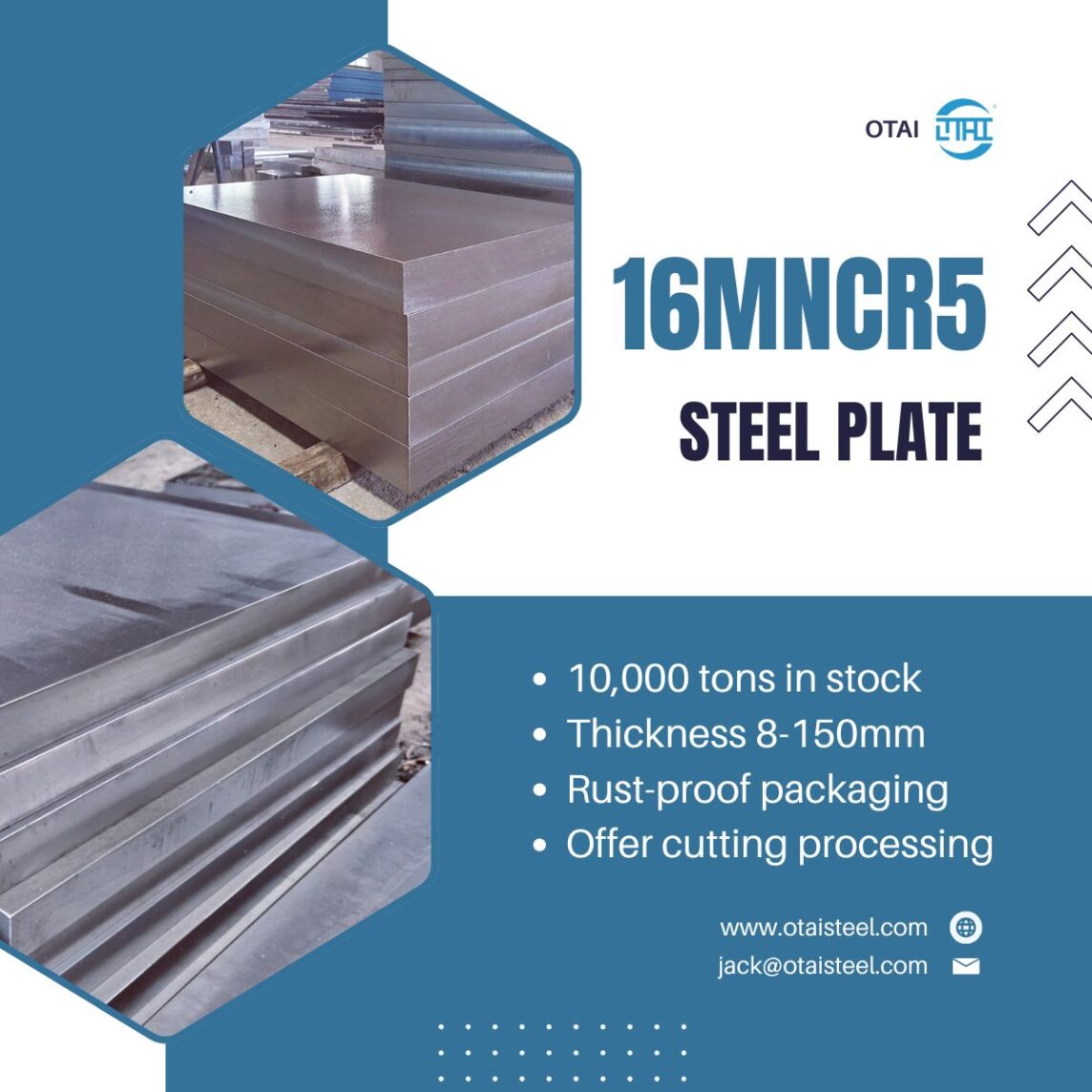
Understanding the difference between 16MnCr5 and 20MnCr5 is essential for engineers, manufacturers, and material buyers working in automotive, industrial, and heavy machinery sectors. Both are low-carbon chromium-manganese alloy steels commonly used for case hardening and carburizing, but subtle differences in chemical composition, mechanical properties, and performance determine the best grade for specific applications. Choosing the right steel can influence component life, fatigue resistance, machining efficiency, and cost-effectiveness.
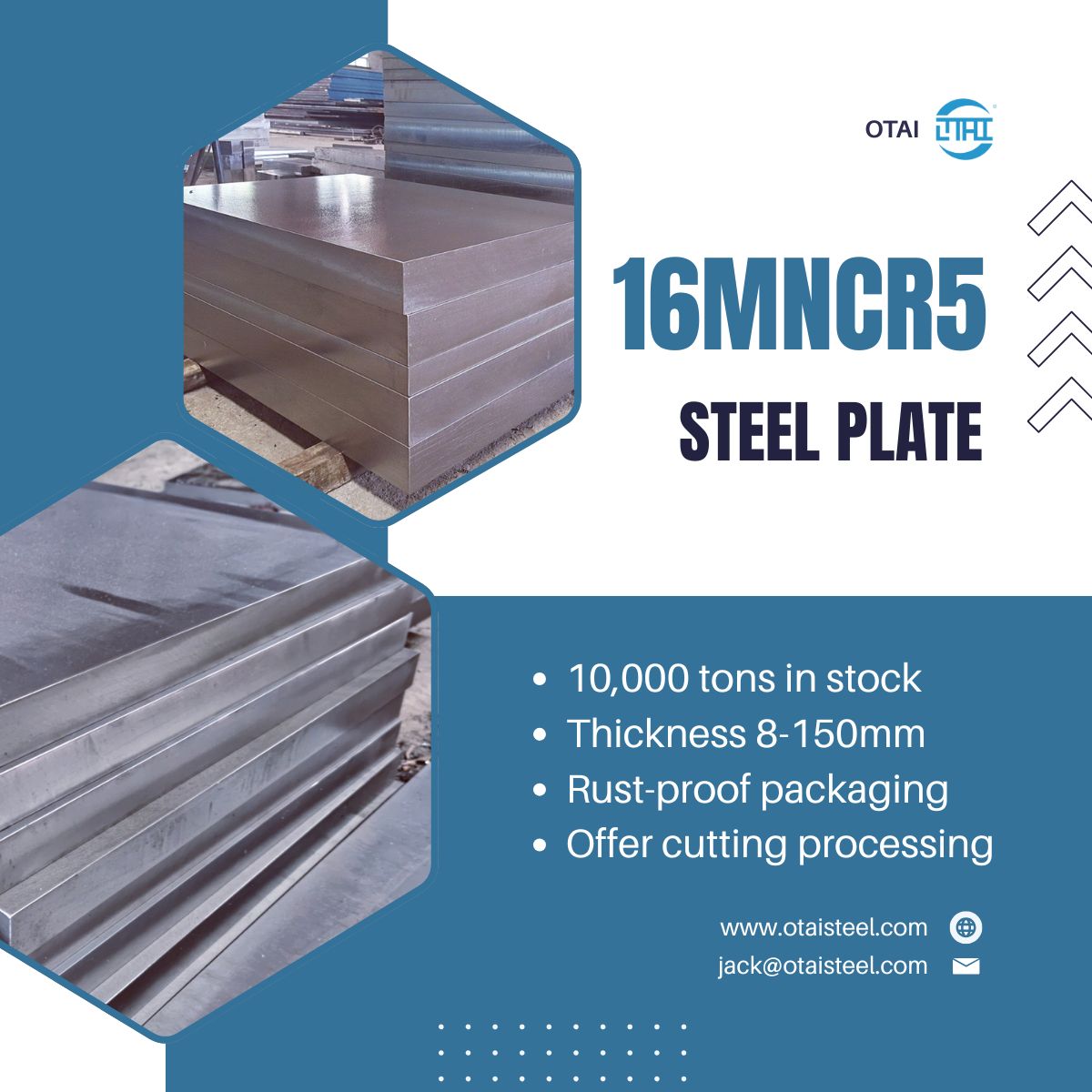
🔍 Overview of 16MnCr5 and 20MnCr5

16MnCr5 and 20MnCr5 belong to the chromium-manganese low-carbon steel family. They share common advantages:

  • Excellent surface hardness after carburizing
  • Good core toughness
  • Strong wear resistance and fatigue performance

However, they differ in carbon content and alloying balance, which affects machinability, hardenability, and core strength.

  • 16MnCr5: Lower carbon content, better machinability, higher core toughness, suitable for precision components like automotive pinions and shafts.
  • 20MnCr5: Higher carbon content, higher core strength, slightly lower machinability, suitable for heavy-duty components subjected to high loads.
Grade Carbon Content (%) Typical Applications Industry Use
16MnCr5 0.14 – 0.19 Shafts, pinions, small gears Automotive, precision machinery
20MnCr5 0.18 – 0.23 Axles, heavy-duty gears, industrial reducers Heavy machinery, construction, automotive

16MnCr5 is preferred for components where precision machining and fatigue resistance are critical, while 20MnCr5 is chosen for parts subjected to higher torsional or bending stresses.

🧪 Chemical Composition Comparison

Element 16MnCr5 (%) 20MnCr5 (%)
Carbon (C) 0.14 – 0.19 0.18 – 0.23
Silicon (Si) 0.17 – 0.37 0.17 – 0.37
Manganese (Mn) 1.00 – 1.30 1.10 – 1.40
Chromium (Cr) 0.80 – 1.10 0.80 – 1.10
Phosphorus (P) ≤ 0.025 ≤ 0.025
Sulfur (S) ≤ 0.035 ≤ 0.035

Technical implications:

  1. Carbon: Higher carbon in 20MnCr5 increases core strength after quenching.
  2. Manganese: Slightly higher in 20MnCr5, improving hardenability and resistance to wear under heavy load.
  3. Machinability: Lower carbon in 16MnCr5 enhances ease of machining, reducing tool wear and improving surface finish.

📊 Mechanical Properties

Mechanical properties differ based on heat treatment. Both grades achieve high surface hardness after carburizing, but core properties vary:

Property 16MnCr5 20MnCr5
Tensile Strength (MPa) 800 – 1200 850 – 1300
Yield Strength (MPa) 550 – 850 600 – 900
Surface Hardness (HRC) 58 – 62 60 – 63
Core Toughness Excellent Good
Machinability Very Good Good

🔹 Practical Implications

  • 16MnCr5: Ideal for precision shafts, small gears, and components with tight tolerances, where machinability and fatigue life are crucial.
  • 20MnCr5: Suited for heavy-load gears, axles, and industrial reducers, where higher core strength ensures longevity under stress.

🔥 Heat Treatment Considerations

Both steels respond well to carburizing, quenching, and tempering, but treatment parameters must match alloy content for optimal results.

Process 16MnCr5 20MnCr5
Normalizing 870 – 900°C 880 – 910°C
Carburizing 880 – 980°C 880 – 1000°C
Hardening 820 – 860°C 830 – 870°C
Tempering 150 – 200°C 150 – 220°C

Engineering tip: Components requiring both high surface hardness and ductile cores benefit from precise control of carburizing time, quenching medium, and tempering temperature. Improper tempering can lead to brittleness or premature failure.

⚙️ Applications and Industry Use

Industry 16MnCr5 Applications 20MnCr5 Applications
Automotive Small gears, shafts, pinions, differential components Heavy-duty gear wheels, drive axles, suspension components
Industrial Machinery Precision spindles, rollers, couplings Large gear reducers, industrial shafts, mining equipment
Heavy Equipment Light structural components Structural shafts, heavy-duty connectors

Application insights:

  • 16MnCr5: Preferred for light to medium loads where accuracy and surface finish are critical.
  • 20MnCr5: Chosen for high-load, fatigue-prone environments, such as construction machinery, heavy-duty pumps, and large industrial gearboxes.

🔧 Practical Selection Guidelines

  1. Load and Fatigue Considerations: Use 20MnCr5 for heavily loaded components.
  2. Machining and Manufacturing: Select 16MnCr5 for complex geometries and precision machining.
  3. Heat Treatment Constraints: Both allow carburizing; temper carefully to maintain ductility and toughness.
  4. Cost Efficiency: 16MnCr5 generally reduces machining costs due to lower tool wear and easier shaping.
  5. Component Life: Consider expected fatigue cycles; 16MnCr5 often extends life in precision automotive applications.

🏭 Company Advantages

Otai Special Steel supplies high-quality 16MnCr5 and 20MnCr5 plates, bars, and blocks for critical engineering applications.

Advantages include:

  • Large inventory year-round
  • 8–150mm thickness plates in stock
  • Custom cutting, heat treatment, and machining support
  • Ultrasonic testing (UT) and chemical verification
  • Third-party inspection support (SGS)
  • Professional packaging for export and fast delivery

We serve automotive, heavy machinery, industrial equipment, and precision engineering sectors worldwide.

❓ FAQ

Q1: What is the main difference between 16MnCr5 and 20MnCr5?
A1: 16MnCr5 has lower carbon content, better machinability, and higher core toughness. 20MnCr5 has higher carbon and manganese, increasing core strength for heavier loads.

Q2: Can both grades be carburized and hardened?
A2: Yes, both grades respond well to carburizing, quenching, and tempering, achieving a high surface hardness and durable core.

Q3: Which grade is better for precision gears and small shafts?
A3: 16MnCr5 is preferred for machinability, precision tolerances, and fatigue resistance.

Q4: Which grade is better for heavy-duty industrial machinery?
A4: 20MnCr5 is ideal for high-load shafts, axles, and large gears due to superior core strength.

Q5: Can these grades be interchanged?
A5: They are similar but not identical. Selection should consider load conditions, fatigue requirements, and machining capabilities.


Jack Tan


📧 jack@otaisteel.com

📱 WhatsApp: +8676923190193

0 0 Continue Reading →

16MnCr5 Grade – Specifications, Properties, and Applications

16MnCr5 Grade – Specifications, Properties, and Applications16MnCr5 Grade – Specifications, Properties, and Applications

The 16MnCr5 grade is one of the most widely used low-carbon alloy steels in the engineering and automotive sectors. Known for its excellent case hardening properties, high fatigue strength, and balanced toughness, engineers use this grade to manufacture gears, shafts, pinions, and other high-stress mechanical components. Understanding its specifications, chemical composition, and mechanical properties helps engineers, buyers, and heat treatment specialists select the right material for demanding applications.

🔍 Standard Definition of 16MnCr5 Grade

The 16MnCr5 grade follows DIN / EN standards as a chromium-manganese low-carbon steel. Its designation ensures consistent properties across international suppliers, simplifying material selection and procurement.

Standard Grade Steel Number
DIN / EN 16MnCr5 1.7131
GB (China) 16CrMnH
JIS (Japan) SCM420
AISI / SAE (USA) 5115
AFNOR (France) 16MC5
BS (UK) 817M40

Engineers primarily use this grade in carburizing and case hardening applications because it develops a hard surface while maintaining a tough core.

🧪 Chemical Composition of 16MnCr5 Grade

The chemical composition of the 16MnCr5 grade provides excellent hardenability, wear resistance, and core toughness.

Element Content (%)
Carbon (C) 0.14 – 0.19
Silicon (Si) 0.17 – 0.37
Manganese (Mn) 1.00 – 1.30
Chromium (Cr) 0.80 – 1.10
Phosphorus (P) ≤ 0.025
Sulfur (S) ≤ 0.035

Chromium increases hardenability and surface wear resistance, while manganese enhances toughness and fatigue strength.

📊 Mechanical Properties

The 16MnCr5 grade delivers excellent performance depending on heat treatment and carburizing depth.

Property Typical Value
Tensile Strength 800 – 1200 MPa
Yield Strength 550 – 850 MPa
Elongation 8 – 12%
Hardness (Normalized) 160 – 220 HB
Surface Hardness (After Carburizing) 58 – 62 HRC

This combination of high surface hardness and a ductile core allows components to withstand cyclic loading, friction, and wear.

🔥 Heat Treatment Process

The 16MnCr5 grade responds extremely well to carburizing, quenching, and tempering.

Process Temperature
Forging 850 – 1050°C
Normalizing 870 – 900°C
Carburizing 880 – 980°C
Hardening 820 – 860°C
Tempering 150 – 200°C

Engineers typically achieve a case depth of 0.8 – 1.5 mm depending on component requirements. This process ensures high surface wear resistance and a tough core for gears, pinions, and shafts.

⚙️ Machining and Weldability

Machining

Engineers can machine 16MnCr5 grade easily in the normalized condition:

  • CNC machines cut it stably
  • Turning and drilling produce good surface finish
  • Minimal dimensional distortion occurs after heat treatment

Welding

You can weld 16MnCr5 with proper precautions:

  • Preheat at 150–250°C
  • Control cooling during welding
  • Temper critical components after welding

Avoid welding after carburizing to prevent hard brittle zones.

🌍 Applications of 16MnCr5 Grade

Industries worldwide use the 16MnCr5 grade in automotive, machinery, and industrial equipment applications.

Automotive Industry

  • Transmission gears
  • Differential pinions
  • Shafts and camshafts

Heavy Machinery

  • Gear reducers
  • Industrial couplings
  • Conveyor shafts

Precision Engineering

  • CNC machined pinions
  • Hardened bushings
  • Mechanical drive components

This grade suits applications where surface hardness, core toughness, and fatigue resistance matter most.

⚖️ Comparison with 20MnCr5

Property 16MnCr5 20MnCr5
Carbon Content Lower Higher
Core Toughness Better Slightly Lower
Surface Hardness Excellent Excellent
Machinability Very Good Good

Engineers prefer 16MnCr5 when toughness and machinability are more important than maximum core strength.

🏭 Company Advantages

At Otai Special Steel, we supply high-quality 16MnCr5 grade alloy steel plates, rounds, and forged blocks for industrial applications.

Our advantages include:

  • Large stock inventory available year-round
  • 8–150mm thickness plates available in stock
  • Customized cutting services
  • Heat treatment support
  • Ultrasonic testing (UT)
  • Chemical composition verification
  • Third-party inspection support such as SGS
  • Reliable export packaging
  • Fast global delivery

We serve clients in automotive, machinery, precision engineering, and industrial equipment sectors worldwide.

❓ FAQ

What is 16MnCr5 grade?

It is a low-carbon alloy steel designed for carburizing and case hardening applications.

What are the mechanical properties of 16MnCr5 grade?

After carburizing, it achieves 58–62 HRC surface hardness, 800–1200 MPa tensile strength, and maintains a ductile core.

Can 16MnCr5 grade be welded?

Yes, when engineers preheat and temper components after welding.

What is the difference between 16MnCr5 and 20MnCr5?

16MnCr5 has lower carbon content and better machinability, while 20MnCr5 provides higher core strength but slightly less toughness.

What are typical applications of 16MnCr5 grade?

Gears, pinions, shafts, bushings, and mechanical components that require high surface hardness and strong fatigue resistance.


Jack Tan


📧 jack@otaisteel.com

📱 WhatsApp: +8676923190193

0 0 Continue Reading →

Equivalent 16MnCr5 – Global Material Alternatives and Specifications

Equivalent 16MnCr5 – Global Material Alternatives and SpecificationsEquivalent 16MnCr5 – Global Material Alternatives and Specifications

When engineers and purchasing managers look for equivalent 16MnCr5, they are seeking alloy steels with similar chemical composition, mechanical properties, and heat treatment behavior. Finding the right equivalent material is crucial for international procurement, OEM replacement parts, or applications in automotive, machinery, and industrial equipment.

16MnCr5 is a widely used low-carbon chromium-manganese alloy steel designed for carburizing applications. Its balanced properties make it ideal for components requiring a hard wear-resistant surface and a tough, ductile core.

🔍 What Is 16MnCr5?

16MnCr5 is primarily used in components that demand:

  • High surface hardness after carburizing
  • Strong fatigue resistance
  • Excellent core toughness
  • Good machinability in the annealed state

Common applications include:

  • Gears and pinions
  • Shafts and axles
  • Camshafts
  • Bushings
  • Industrial mechanical components

Its ability to achieve a hard outer layer while retaining a ductile inner core makes 16MnCr5 a standard choice for case-hardened alloy steel applications.

🧪 Chemical Composition of 16MnCr5

The chemical composition ensures good carburizing performance and mechanical properties.

Element Content (%)
Carbon (C) 0.14 – 0.19
Silicon (Si) 0.17 – 0.37
Manganese (Mn) 1.00 – 1.30
Chromium (Cr) 0.80 – 1.10
Phosphorus (P) ≤ 0.025
Sulfur (S) ≤ 0.035

The chromium content increases hardenability and wear resistance, while manganese enhances toughness and core strength.

🌍 Global Equivalent Materials

Depending on regional standards, the equivalent materials for 16MnCr5 vary. Understanding these equivalents is important for sourcing and engineering accuracy.

Country / Standard Equivalent Grade
Germany / DIN 16MnCr5 / 1.7131
USA / SAE 5115
Japan / JIS SCM420
China / GB 16CrMnH
France / AFNOR 16MC5
UK / BS 817M40

Other comparable case-hardening steels include 20MnCr5, SAE 8620, and SCM415, depending on desired mechanical characteristics.

📊 Mechanical Properties Comparison

Grade Surface Hardness (HRC) Core Toughness Tensile Strength (MPa)
16MnCr5 58–62 Excellent 800–1200
SAE 5115 58–62 Good 750–1100
SCM420 58–62 Very Good 780–1150
16CrMnH 58–62 Excellent 800–1200

These steels achieve a hard surface after carburizing while retaining ductile cores, making them suitable for gears, shafts, and heavily loaded components.

🔥 Heat Treatment Process

16MnCr5 and its equivalents respond well to carburizing, quenching, and tempering.

🌡️ Typical Parameters

Process Temperature
Forging 850–1050°C
Normalizing 870–900°C
Carburizing 880–980°C
Hardening 820–860°C
Tempering 150–200°C

Effective case depth usually ranges from 0.8 mm to 1.5 mm depending on the application.

⚙️ Machining and Weldability

Machining

16MnCr5 and its equivalents offer good machinability in normalized condition:

  • CNC machining is stable
  • Turning and drilling perform well
  • Minimal dimensional distortion during heat treatment

Welding

  • Preheating (150–250°C)
  • Controlled cooling
  • Post-weld stress relief for critical parts

Welding after carburizing is generally avoided to prevent cracking.

🚗 Applications of Equivalent 16MnCr5

Due to its strength and surface wear resistance, equivalent 16MnCr5 steels are widely used in:

Automotive Industry

  • Transmission gears
  • Differential pinions
  • Shafts and camshafts

Heavy Machinery

  • Gear reducers
  • Conveyor shafts
  • Industrial couplings

Agricultural and Precision Equipment

  • Drive shafts
  • Hardened pinions
  • Mechanical bushings

⚖️ 16MnCr5 vs 20MnCr5

Property 16MnCr5 20MnCr5
Carbon Content Lower Higher
Toughness Better Slightly lower
Surface Hardness Excellent Excellent
Core Strength Good Higher
Machinability Very Good Good

16MnCr5 is preferred when a combination of toughness, machinability, and carburizing performance is required.

🏭 Company Advantages

At Otai Special Steel, we provide high-quality 16MnCr5 alloy steel plates, flats, rounds, and forged blocks for international industrial applications.

Our advantages include:

  • Large stock inventory available year-round
  • 8–150mm thickness plates available in stock
  • Customized cutting services
  • Heat treatment support
  • Ultrasonic testing (UT)
  • Chemical composition verification
  • Third-party inspection support such as SGS
  • Reliable export packaging
  • Fast international delivery

We serve clients in automotive manufacturing, heavy machinery, precision engineering, and industrial equipment globally.

❓ FAQ

What is the equivalent 16MnCr5 in the USA?

The closest American equivalent is SAE 5115 steel.

What is the Japanese equivalent of 16MnCr5?

SCM420 is the closest Japanese equivalent.

Can 16MnCr5 be carburized?

Yes. It is specifically designed for carburizing applications.

What hardness can equivalent materials achieve?

After carburizing and quenching, surface hardness reaches approximately 58–62 HRC.

Is 16MnCr5 suitable for gears and shafts?

Yes. It is commonly used for gears, shafts, pinions, and other high-load components.


Jack Tan


📧 jack@otaisteel.com

📱 WhatsApp: +8676923190193

0 0 Continue Reading →

Equivalent Material for 16MnCr5 – International Steel Grades

Equivalent Material for 16MnCr5 – International Steel GradesEquivalent Material for 16MnCr5 – International Steel Grades and Global Alternatives

When manufacturers search for equivalent material for 16MnCr5, they usually need compatible carburizing steels that match similar mechanical properties, chemical composition, and heat treatment performance. This information becomes especially important for international sourcing, engineering drawings, OEM replacement projects, and export manufacturing.

16MnCr5 is one of the most widely used alloy case hardening steels in Europe. It offers an excellent balance of wear resistance, core toughness, fatigue strength, and machinability after carburizing treatment.

The most common equivalent materials for 16MnCr5 include:

Country/Standard Equivalent Grade
Germany (DIN/EN) 16MnCr5 / 1.7131
USA (AISI/SAE) SAE 5115
Japan (JIS) SCM420
China (GB) 16CrMnH
France (AFNOR) 16MC5
Italy (UNI) 16MnCr5
ISO 16MnCr5

Many buyers also compare this material with 20MnCr5 steel, SAE 8620, SCM415, and other case hardening alloy steels depending on application requirements.

🔍 What Is 16MnCr5 Steel?

16MnCr5 is a low-carbon chromium-manganese alloy steel primarily designed for carburizing applications. The steel develops:

  • A hard wear-resistant surface
  • A strong and impact-resistant core
  • Excellent fatigue resistance
  • Stable dimensional properties after heat treatment

These characteristics make the material highly suitable for power transmission and rotating components.

Typical applications include:

  • Automotive gears
  • Transmission shafts
  • Pinions
  • Camshafts
  • Worm gears
  • Bushings
  • Mechanical couplings

Because of its excellent carburizing response, many engineers searching for equivalent material for 16MnCr5 are often selecting substitutes for gear manufacturing or heavy-duty machinery parts.

🧪 Chemical Composition of 16MnCr5

The chemical composition directly influences hardenability, wear resistance, and core toughness.

Element Content (%)
Carbon (C) 0.14 – 0.19
Silicon (Si) 0.17 – 0.37
Manganese (Mn) 1.00 – 1.30
Chromium (Cr) 0.80 – 1.10
Phosphorus (P) ≤ 0.025
Sulfur (S) ≤ 0.035

The relatively low carbon content improves machinability before carburizing, while chromium enhances surface hardness and wear resistance after quenching.

🌍 International Equivalent Materials for 16MnCr5

Different countries use different naming systems for carburizing steels. Understanding these equivalents helps avoid procurement mistakes during global sourcing.

🇺🇸 SAE 5115 Steel

SAE 5115 is considered one of the closest American equivalents.

Key similarities:

  • Comparable carbon level
  • Similar carburizing behavior
  • Good core toughness
  • Suitable for gears and shafts

However, slight differences in manganese and chromium levels may influence hardenability in large cross-sections.

🇯🇵 SCM420 Steel

SCM420 is a Japanese chromium-molybdenum alloy steel widely used in automotive and precision machinery industries.

Advantages include:

  • Excellent hardenability
  • Good fatigue resistance
  • Stable mechanical performance

SCM420 sometimes offers slightly better high-temperature strength due to molybdenum addition.

🇨🇳 16CrMnH Steel

16CrMnH is the common Chinese equivalent of 16MnCr5.

Applications are highly similar:

  • Automotive transmission gears
  • Heavy machinery parts
  • Wear-resistant components

Many Chinese factories use this grade for export-oriented mechanical production.

⚙️ Mechanical Properties Comparison

Although equivalent grades are similar, exact mechanical properties depend on heat treatment condition and section size.

Grade Surface Hardness Core Toughness Hardenability
16MnCr5 Excellent Excellent Good
SAE 5115 Excellent Good Good
SCM420 Excellent Very Good Very Good
16CrMnH Excellent Excellent Good

After carburizing and quenching, these steels generally achieve:

  • 58–62 HRC surface hardness
  • Strong fatigue resistance
  • Excellent wear performance

This is why they are widely used in carburized gear steel applications.

🔥 Heat Treatment Characteristics

One major reason manufacturers look for equivalent material for 16MnCr5 is to ensure similar heat treatment response.

🌡️ Typical Heat Treatment Parameters

Process Temperature
Forging 850 – 1050°C
Normalizing 870 – 900°C
Carburizing 880 – 980°C
Hardening 820 – 860°C
Tempering 150 – 200°C

The carburizing process enriches the surface carbon content, allowing the steel to develop high hardness while preserving a tougher inner core.

Typical case depth:

  • 0.8 mm
  • 1.0 mm
  • 1.2 mm
  • 1.5 mm

depending on engineering requirements.

🛠️ Machining Performance and Weldability

16MnCr5 and its equivalents offer good machinability in normalized condition. Manufacturers often complete machining before carburizing to improve productivity and reduce cutting tool wear.

⚙️ Machining Advantages

  • Stable CNC machining
  • Good drilling performance
  • Consistent dimensional accuracy
  • Moderate cutting forces

🔩 Weldability

Equivalent materials such as SAE 5115 and 16CrMnH can be welded, but proper precautions are necessary.

Recommended procedures:

  • Preheating
  • Controlled cooling
  • Stress relief after welding

Improper welding may create hard brittle zones around the weld area.

🚗 Common Applications of 16MnCr5 Equivalent Materials

These carburizing steels are widely used in industries requiring high wear resistance and fatigue strength.

🚘 Automotive Industry

  • Differential gears
  • Transmission components
  • Synchronizer hubs
  • Drive shafts

🏗️ Industrial Machinery

  • Gear reducers
  • Conveyor systems
  • Couplings
  • Heavy-duty gear assemblies

🚜 Agricultural Equipment

  • Rotary drive systems
  • Hardened shafts
  • Gear mechanisms

⚡ Precision Engineering

  • CNC gears
  • Hardened bushings
  • Precision pinions

Many OEMs choose equivalent grades based on local availability, cost efficiency, and heat treatment capability.

⚖️ 16MnCr5 vs SAE 8620

Although SAE 8620 is sometimes used as an alternative, important differences exist.

Property 16MnCr5 SAE 8620
Chromium Content Higher Lower
Nickel Content Lower Higher
Core Toughness Good Excellent
Wear Resistance Excellent Very Good
Machinability Very Good Good

SAE 8620 may provide better toughness, while 16MnCr5 often delivers stronger wear resistance after carburizing.

🏭 Company Advantages

At Otai Special Steel, we supply high-quality 16MnCr5 alloy steel plates, forged blocks, flats, and rounds for international industrial applications.

Our advantages include:

  • Large stock inventory available year-round
  • 8–150mm thickness plates available in stock
  • Customized cutting services
  • Heat treatment support
  • Ultrasonic testing (UT)
  • Chemical composition verification
  • Third-party inspection support such as SGS
  • Reliable export packaging
  • Fast global delivery capability

We support customers from automotive manufacturing, heavy machinery, engineering fabrication, and industrial equipment industries worldwide.

❓ FAQ

What is the equivalent material for 16MnCr5 in the USA?

The closest American equivalent is SAE 5115 steel.

What is the Japanese equivalent of 16MnCr5?

SCM420 is commonly regarded as the Japanese equivalent.

Is 16MnCr5 the same as 20MnCr5?

No. 20MnCr5 contains higher carbon content and generally provides higher core strength.

What is the steel number of 16MnCr5?

The official DIN steel number is 1.7131.

Is 16MnCr5 suitable for carburizing?

Yes. It is specifically designed for carburizing and case hardening applications.

What hardness can equivalent materials achieve?

After carburizing and quenching, most equivalent materials achieve approximately 58–62 HRC surface hardness.

0 0 Continue Reading →

16MnCr5 Steel Number – Understanding Global Material Equivalents

16MnCr5 Steel Number – Understanding Global Material Equivalents16MnCr5 Steel Number – Understanding DIN 1.7131 and Global Material Equivalents

When engineers, buyers, and heat treatment specialists search for 16MnCr5 steel number, they usually want to identify the exact material designation used in international standards. This carburizing alloy steel is widely used in automotive, gear manufacturing, and mechanical engineering industries because of its excellent surface hardness, core toughness, and machinability.

The official steel number for 16MnCr5 is:

Standard Steel Grade Steel Number
EN / DIN 16MnCr5 1.7131
EN 10084 16MnCr5 1.7131
DIN Standard 16MnCr5 1.7131

Many global manufacturers also compare this material with other case hardening steels such as 16MnCr5 equivalent grade, SAE 5115 steel, 20MnCr5 steel, and JIS SCM420 due to their similar carburizing performance.

🔍 What Is 16MnCr5 Steel?

16MnCr5 is a low-carbon alloy carburizing steel containing manganese and chromium. Manufacturers primarily use it for components requiring:

  • High wear resistance
  • Strong fatigue strength
  • Tough core properties
  • Excellent hardenability after carburizing

The steel performs especially well in applications involving repeated stress, friction, and contact loading.

Common products include:

  • Transmission gears
  • Pinions
  • Shafts
  • Bushings
  • Camshafts
  • Worm gears
  • Heavy-duty mechanical parts

Because of its balanced composition, many buyers searching for 16MnCr5 steel number are actually sourcing material for gear manufacturing and precision-machined components.

🧪 Chemical Composition of 16MnCr5 Steel

The alloy chemistry directly affects carburizing response and mechanical performance.

Element Content (%)
Carbon (C) 0.14 – 0.19
Silicon (Si) 0.17 – 0.37
Manganese (Mn) 1.00 – 1.30
Phosphorus (P) ≤ 0.025
Sulfur (S) ≤ 0.035
Chromium (Cr) 0.80 – 1.10

The chromium content improves hardenability and wear resistance, while manganese enhances strength and toughness. This combination makes the material suitable for case hardening steel applications requiring durable surfaces and impact-resistant cores.

📊 Mechanical Properties of 16MnCr5

Mechanical properties depend heavily on heat treatment condition, carburizing depth, and quenching process.

Property Typical Value
Tensile Strength 800 – 1200 MPa
Yield Strength 550 – 850 MPa
Elongation 8 – 12%
Hardness Before Heat Treatment 160 – 220 HB
Surface Hardness After Carburizing 58 – 62 HRC

After carburizing and quenching, the steel develops a hard outer case while maintaining a relatively ductile inner core. This structure helps reduce cracking under cyclic loading conditions.

🌍 Why Is the Steel Number 1.7131 Important?

The steel number system provides a universal identification method across international markets. Many global buyers prefer ordering by steel number rather than grade name because naming conventions vary between countries.

For example:

Country/Region Equivalent Designation
Germany 1.7131 / 16MnCr5
USA SAE 5115
Japan SCM420
China 16CrMnH
France 16MC5
Italy 16MnCr5

When sourcing alloy steel internationally, using the correct DIN steel number 1.7131 reduces confusion and ensures material traceability.

This becomes especially important for:

  • Export orders
  • Third-party inspection
  • OEM manufacturing
  • Automotive supply chains
  • Heat treatment certification

🔥 Heat Treatment Process of 16MnCr5

One reason why 16MnCr5 steel number receives global attention is the steel’s excellent response to carburizing and quenching.

🌡️ Typical Heat Treatment Parameters

Process Temperature
Forging 850 – 1050°C
Normalizing 870 – 900°C
Carburizing 880 – 980°C
Hardening 820 – 860°C
Tempering 150 – 200°C

The carburizing process increases carbon concentration on the surface layer, producing high hardness after quenching.

Typical effective case depth:

  • 0.8 mm
  • 1.0 mm
  • 1.2 mm
  • 1.5 mm

depending on component requirements.

Manufacturers often choose this steel for carburized gear steel applications where surface wear resistance and internal toughness must coexist.

🛠️ Machining and Weldability

16MnCr5 offers good machinability in normalized condition. Many workshops machine the material before carburizing to reduce tool wear and improve dimensional control.

⚙️ Machining Characteristics

  • Good turning performance
  • Stable drilling behavior
  • Suitable for CNC machining
  • Good dimensional stability after heat treatment

🔩 Weldability

The steel can be welded, but preheating is usually recommended because chromium alloy steels may develop hard zones near weld areas.

Typical recommendations:

  • Preheat: 150–250°C
  • Controlled cooling
  • Post-weld stress relief when necessary

For high-performance gears or shafts, manufacturers usually avoid welding after carburizing.

🚗 Common Industrial Applications

Due to its excellent combination of hardness and toughness, 16MnCr5 is widely used in several industries.

🚘 Automotive Industry

  • Gearboxes
  • Differential gears
  • Transmission shafts
  • Clutch components

🏗️ Heavy Machinery

  • Mining gears
  • Industrial reducers
  • Power transmission parts

🚜 Agricultural Equipment

  • Drive shafts
  • Wear-resistant couplings
  • Gear systems

🧩 Precision Engineering

  • CNC machined gears
  • Hardened pinions
  • Mechanical bushings

Many OEMs searching for 16MnCr5 material specifications prioritize stable hardness distribution and fatigue resistance in rotating parts.

⚖️ 16MnCr5 vs 20MnCr5

Both steels belong to the carburizing alloy steel family, but they have slight differences.

Property 16MnCr5 20MnCr5
Carbon Content Lower Higher
Toughness Better Slightly Lower
Surface Hardness Excellent Excellent
Core Strength Good Higher
Machinability Very Good Good

16MnCr5 often becomes the preferred option when toughness and machinability matter more than maximum core strength.

🏭 Company Advantages

At Otai Special Steel, we supply high-quality 16MnCr5 alloy steel plates, flats, rounds, and forged blocks for global industrial applications.

Our advantages include:

  • Large stock availability year-round
  • 8–150mm thickness plates available in stock
  • Customized cutting services
  • Heat treatment support
  • Ultrasonic testing (UT)
  • Chemical composition verification
  • Third-party inspection support such as SGS
  • Stable export packaging
  • Fast delivery for international orders

We provide 16MnCr5 materials in multiple dimensions suitable for gear manufacturing, machinery production, and precision engineering projects.

❓ FAQ

What is the steel number of 16MnCr5?

The official steel number is 1.7131 under DIN and EN standards.

Is 16MnCr5 a carburizing steel?

Yes. It is a low-carbon alloy carburizing steel widely used for case hardening applications.

What is the equivalent of 16MnCr5 in the USA?

The closest American equivalent is SAE 5115 steel.

What hardness can 16MnCr5 achieve?

After carburizing and quenching, the surface hardness typically reaches 58–62 HRC.

Is 16MnCr5 suitable for gears?

Yes. The material is commonly used for gears, pinions, shafts, and transmission components due to its wear resistance and fatigue strength.

Can 16MnCr5 be welded?

Yes, but controlled preheating and post-weld treatment are recommended to minimize cracking risks.

0 0 Continue Reading →