Skip to Content

Blog Archives

4140 Steel Standard: All You Need to Know About Its Specifications

4140 Steel Standard: All You Need to Know About Its Specifications4140 Steel Standard: All You Need to Know About Its Specifications

If you’re sourcing alloy steel for tough jobs, you’ve likely heard of 4140 steel. But knowing it’s strong isn’t enough—what about its standards? Which countries classify it differently? And which version of 4140 should you choose based on your application? 🤔 Whether you’re a machinist, buyer, or project engineer, understanding the 4140 steel standard is key to making the right decision.

Let’s break it all down with clear specs, comparison charts, and global equivalents!


📏 What Does “4140 Steel Standard” Actually Mean?

In simple terms, a steel standard is a classification system that defines the composition, mechanical properties, and processing methods of a particular steel grade. For 4140 steel, multiple standards exist depending on the country or organization—like AISI, ASTM, DIN, JIS, and ISO.

The U.S. version is typically referenced as AISI 4140 steel standard specifications, but if you’re dealing with suppliers or clients in Germany, Japan, or Europe, you’ll need to translate those specs into DIN, JIS, or ISO terms.


🌐 Global Standards for 4140 Steel

Here’s a helpful comparison table of the 4140 steel standard equivalents in different countries and specifications:

Standard System Equivalent Grade Country/Region Notable Notes
AISI/SAE 4140 United States Base reference standard
ASTM A29 / A322 4140 United States Often used for bar and forging stock
DIN 1.7225 / 42CrMo4 Germany Most used 4140 steel DIN equivalent
JIS SCM440 Japan Common JIS standard for 4140 steel
ISO 683-1 Grade 42CrMo4 International ISO-aligned 4140 alloy steel specification
BS (British) 708M40 UK Older British standard for 4140-type steel

As you can see, while the base chemistry is similar, each standard may vary in tolerance, heat treatment, and dimensional accuracy.


🧪 Chemical Composition According to Standards

Although the core chemical elements stay relatively consistent across most 4140 steel classification systems, some small tolerances exist.

Element Typical Range (%)
Carbon (C) 0.38 – 0.43
Chromium (Cr) 0.80 – 1.10
Manganese (Mn) 0.75 – 1.00
Molybdenum (Mo) 0.15 – 0.25
Silicon (Si) 0.15 – 0.30
Sulfur (S, max) 0.035
Phosphorus (P, max) 0.035

Understanding this helps ensure you’re choosing a material that meets both regulatory and functional needs—especially when heat treating or machining.


⚙️ Mechanical Properties of 4140 Steel in Different Standards

Another way to compare 4140 steel standard comparison is through mechanical performance. Let’s look at tensile strength, yield strength, and hardness:

Property Normalized (approx.) Quenched & Tempered
Tensile Strength (MPa) 850 – 1000 1080 – 1320
Yield Strength (MPa) 650 – 800 900 – 1000
Hardness (HRC) ~24 – 30 Up to 55 HRC
Elongation (%) ~20 ~14 – 16

So, while the ASTM standard for 4140 steel defines these within certain ranges, always confirm the specific condition (annealed, normalized, Q&T) when comparing.


🛠️ Common Applications Based on Standards

Depending on the 4140 steel standard number used, the application focus may shift slightly.

  • ASTM 4140: Used in crankshafts, axles, and downhole tools.

  • DIN 42CrMo4: Popular in European automotive parts.

  • JIS SCM440: Frequently used in heavy-duty gears in Japanese industries.

  • ISO Grade 42CrMo4: Widely accepted for international machinery standards.

These standards guide heat treatment, machining parameters, and inspection tolerances—critical for engineers working in different countries.


🧭 When Does the Standard Matter Most?

  • 🌍 International Procurement: If you’re sourcing from overseas, you’ll want to ensure the local equivalent meets your design specs.

  • 🛠️ Heat Treatment Requirements: Some standards require specific hardness levels or microstructural properties.

  • 📐 Dimensional Tolerance: Standards often define allowable size deviations for round bars, flats, and forged components.

If you’re unsure, a 4140 steel standard comparison chart can be your best friend.


🏭 Otai Special Steel – Your Reliable Source for 4140 Steel

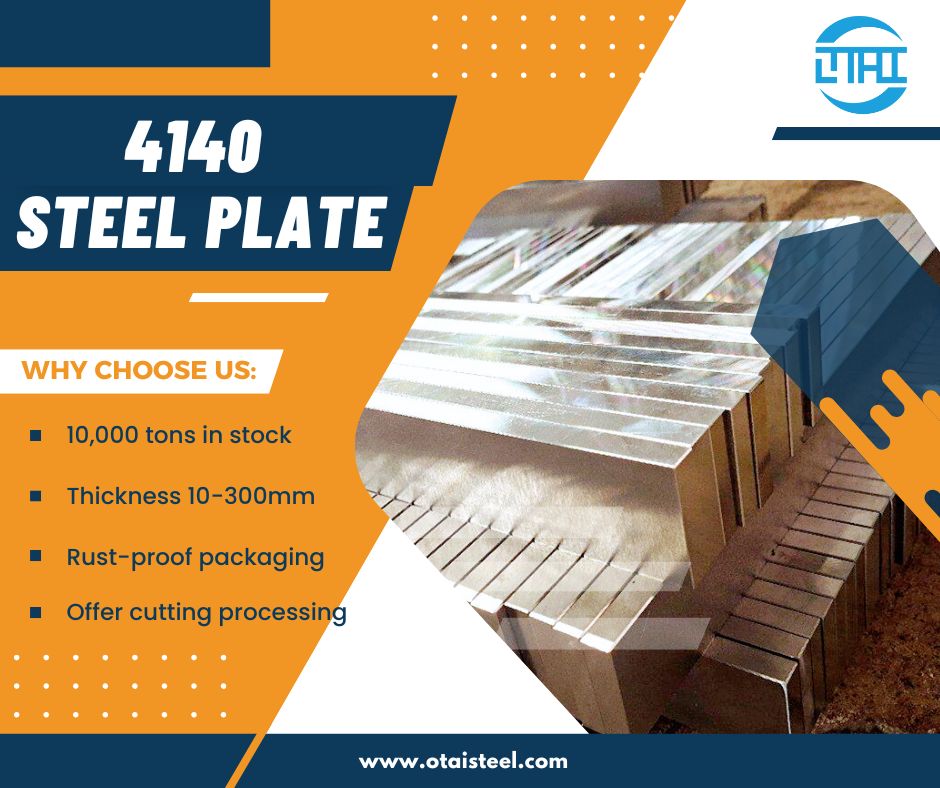
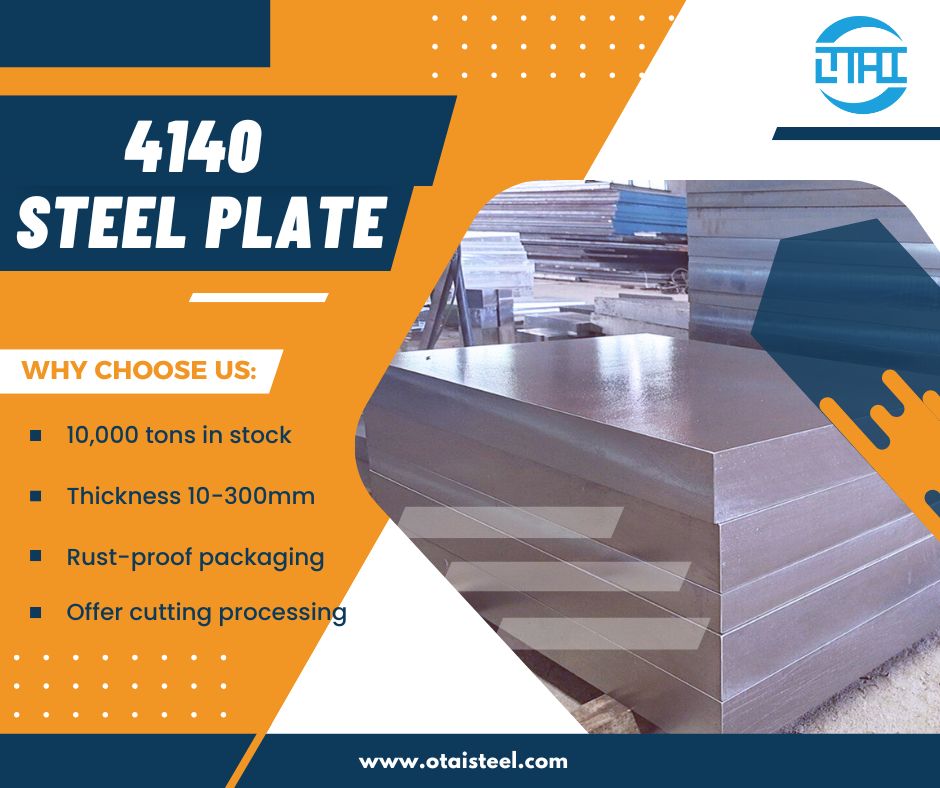
At Otai Special Steel, we carry over 10,000 tons of alloy steel inventory, including full spec ranges of 4140 steel bars and plates. We provide materials that meet AISI, ASTM, DIN, and JIS standards—ready for cutting, heat treatment, and export packaging.

✅ Services we offer:

  • Ultrasonic Testing (UT)

  • Third-party inspection (SGS/BV)

  • Custom cutting (6mm–300mm thick)

  • Heat treatment: annealed, normalized, or Q&T

  • Global shipping and certification support

Whether you’re sourcing for domestic production or international delivery, we’ll match the exact 4140 steel standard you need.

📞 Contact us now to get a free quote and technical consultation!

📧 Contact us: jack@otaisteel.com
📱 WhatsApp: +8676923190193


❓ FAQ – 4140 Steel Standard

Q1: Are 42CrMo4 and 4140 steel the same?
Yes, they’re equivalents. 42CrMo4 is the DIN standard equivalent of 4140, widely used in Europe.

Q2: Is JIS SCM440 interchangeable with ASTM 4140?
Mostly yes, but double-check heat treatment and mechanical property specs before substituting.

Q3: Can I request dual-certified 4140 material?
Absolutely. Many suppliers (including us) provide dual-certified stock that meets multiple standards (e.g., ASTM + DIN).

Q4: What’s the best standard for oil & gas industry use?
Typically, ASTM A29 4140 Q&T bars are preferred due to their toughness and strength range.

Q5: What is the ISO standard for 4140 steel?
ISO 683-1 Grade 42CrMo4 is the ISO equivalent of 4140 steel.
0 0 Continue Reading →

Tensile Strength of 4140 Steel: Why It Matters for Your Applications

Tensile Strength of 4140 Steel: Why It Matters for Your ApplicationsTensile Strength of 4140 Steel: Why It Matters for Your Applications

When it comes to strength, 4140 steel doesn’t mess around. 💪 Whether you’re designing high-load gears, crankshafts, or aircraft landing gear, understanding the tensile strength of 4140 steel is key to picking the right material for the job.

But what exactly makes this alloy so dependable? And how does heat treatment or condition affect its performance? Let’s dive deep into the numbers, the real-world impact, and what you need to know before specifying 4140 for your next project.


🔧 What Is Tensile Strength, and Why Should You Care?

Tensile strength measures how much pulling force a material can withstand before breaking. It’s one of the most crucial mechanical properties when selecting steel for components that face high stress, pressure, or dynamic loading.

For AISI 4140 steel, which is a chromium-molybdenum low alloy steel, this property is a big part of its reputation for strength and toughness.


📊 Tensile Strength of 4140 Steel in Different Conditions

Here’s a breakdown of the mechanical properties of 4140 steel, especially tensile strength, under various heat-treated or supply conditions:

Condition Tensile Strength (MPa) Yield Strength (MPa) Hardness (HRC) Notes
As-rolled / Annealed 655 – 850 415 – 565 12 – 22 Soft and machinable
Normalized 4140 steel tensile strength 850 – 1000 655 – 800 20 – 25 Improved strength after normalization
Quenched & Tempered (Q&T) @ 200°C 1250 – 1400 1000 – 1150 40 – 45 For maximum strength
Tensile strength of hardened 4140 steel Up to 1550 Up to 1250 48 – 52 Strong but reduced ductility
Stress Relieved 850 – 1000 650 – 800 20 – 30 Balances stress and strength

*Data is approximate and may vary slightly by mill specifications and testing methods.


🔥 Heat Treatment Makes a Big Difference

The tensile strength of 4140 steel after heat treatment can almost double compared to its annealed condition. Why?

Because 4140 responds extremely well to quenching and tempering. This treatment transforms its microstructure, significantly boosting both yield and tensile strength while maintaining a good balance of toughness.

This makes it ideal for high-stress applications like:

  • Truck axles 🚛

  • Drill collars 🛠

  • Forged crankshafts 🚗

  • Hydraulic tool bodies 🛠

In fact, many engineers refer to the 4140 steel tensile strength chart before making any critical load-bearing part decisions.


🧪 4140 vs Other Common Steels

How does 4140 stack up? Let’s compare with other commonly used steels in a tensile strength context:

Material Ultimate Tensile Strength (MPa) Notes
4140 (Q&T) 1250 – 1400 High strength, good ductility
1045 (Normalized) 625 – 750 Lower strength, easier to machine
4340 (Q&T) 1350 – 1550 Higher strength, less available
Mild Steel (A36) ~400 Low strength, high weldability

This tensile strength comparison: 4140 vs 1045 clearly shows why 4140 is preferred for critical parts—it offers almost double the strength.


🏭 Application Case: Why a Gear Manufacturer Switched to 4140

A European manufacturer producing large-diameter industrial gears initially used 1045 steel but experienced deformation under high torque.

After switching to 4140 steel and performing stress relieving followed by quenching and tempering, they achieved:

  • 80% reduction in gear wear over 12 months

  • Zero gear breakage incidents

  • Improved machining efficiency due to consistent hardness

This real-world use highlights why understanding the tensile properties of 4140 alloy steel is not just academic—it’s practical.


📘 Summary: Is 4140 Steel Strong Enough?

Absolutely. With a tensile strength of up to 1550 MPa, it stands strong against torsion, tension, and impact. And with flexibility in heat treatment, you can tailor it for toughness, ductility, or even shock resistance.

If you’re dealing with structural demands, tensile yield strength of 4140 becomes critical too—it offers around 85–90% of its tensile strength, which is a reliable safety margin.


🏭 Company Advantages – Why Choose Otai Special Steel?

At Otai Special Steel, we specialize in supplying top-quality 4140 alloy steel plates and bars, ready for stress relief or further heat treatment. Here’s what sets us apart:

  • 📦 Massive inventory: Over 10,000 tons in stock

  • 🔍 Quality assurance: UT, chemical testing, third-party inspection

  • ✂️ Value-added services: Cutting, pre-machining, custom packaging

  • 🌐 Global supply chain: Trusted by clients in over 60 countries

  • 🛎️ Responsive service: Fast quotes, technical support, export expertise

Whether you’re working with pre-hardened 4140 or normalized stock, we can deliver it to your exact specs.

📧 Contact us: jack@otaisteel.com
📱 WhatsApp: +8676923190193


❓ FAQ: Tensile Strength of 4140 Steel

Q1: Can I increase 4140’s tensile strength further?
Yes, through proper heat treatment like quenching & tempering or induction hardening.

Q2: Is normalized 4140 good enough for structural parts?
Yes, it offers up to 1000 MPa tensile strength—ideal for medium-load applications.

Q3: How does hardness relate to tensile strength in 4140?
Generally, higher hardness correlates with higher tensile strength, especially in Q&T condition.

Q4: Can I get mill certificates for tensile strength values?
Of course! At Otai, all shipments can be provided with MTC including tensile and hardness data.

Q5: What if I need different strength levels for different parts?
We offer custom heat-treated 4140 products to match your specific mechanical property needs.

0 0 Continue Reading →

Stress Relieving 4140 Steel – Improve Dimensional Stability & Reduce Cracking Risk

Stress Relieving 4140 Steel – Improve Dimensional Stability & Reduce Cracking RiskStress Relieving 4140 Steel – Improve Dimensional Stability & Reduce Cracking Risk

When it comes to high-strength alloy steels like 4140, stress relieving isn’t just a nice-to-have—it’s a must in many critical applications. Whether you’re machining, welding, or heat treating this popular alloy, stress relief heat treatment plays a crucial role in maintaining mechanical integrity and performance. In this article, we’ll explore what stress relieving is, why it matters for 4140, and how to do it right. 🛠️🔥


🔍 What Is Stress Relieving?

Stress relieving is a heat treatment process used to reduce residual stresses in a material that may have developed during cold working, machining, or welding. For 4140 steel, which is often used in hardened and tempered conditions, these stresses can lead to distortion, cracking, or dimensional instability over time.

This process typically involves heating the material to a subcritical temperature, below the transformation range, and holding it for a period of time before cooling it slowly.


📌 Why Is Stress Relieving Important for 4140 Steel?

Because 4140 steel has relatively high carbon and chromium content, it’s particularly sensitive to internal stress buildup. If not relieved, those stresses can manifest in:

  • Unexpected warping during machining

  • Microcracks after welding

  • Reduced fatigue life

  • Dimensional instability in service

That’s why many manufacturers opt for stress relieving after quenching and tempering 4140 steel, especially in high-precision or high-load parts.


🔧 Recommended Stress Relieving Procedure for 4140

The ideal stress relieving temperature for 4140 steel typically ranges between 540°C and 650°C (1000°F–1200°F). The part is held at temperature for 1 hour per inch of thickness, then cooled in still air.

Here’s a quick reference table:

Parameter Recommended Value
Stress Relieving Temp 540–650°C (1000–1200°F)
Holding Time ~1 hour per inch of thickness
Cooling Method Slow air cooling
Atmosphere Open air or protective atmosphere

This treatment reduces residual stress without significantly affecting the mechanical properties of 4140 steel, such as hardness or tensile strength.


🧪 Effects of Stress Relieving on Mechanical Properties

While stress relieving 4140 steel doesn’t drastically change its hardness or strength, it does help improve:

  • Dimensional stability

  • Machinability

  • Resistance to cracking after welding or grinding

  • Fatigue resistance

Let’s compare before and after:

Property Before Stress Relief After Stress Relief
Internal Stress Level High Low
Dimensional Stability Unpredictable Stable
Weld Crack Risk High Reduced
Fatigue Life Standard Improved

💡 When Should You Stress Relieve 4140?

Here are common scenarios where stress relief is strongly recommended:

  • After rough machining of large 4140 forgings

  • Before or after welding 4140 steel

  • After cold forming or bending

  • Before precision grinding or EDM

  • Prior to final machining of critical tolerance parts


🛠️ Tips for Successful Stress Relief

  1. Pre-clean the part to remove oils and surface contamination.

  2. Ensure uniform heating to avoid thermal gradients.

  3. Use temperature-controlled furnaces with good circulation.

  4. Do not exceed 650°C to avoid altering microstructure.

  5. Always consult your metallurgist for critical parts!


🌍 Variations Across Standards

Did you know that the stress relieving procedure for 4140 steel can vary slightly based on the form (bar, forging, plate) and standard (ASTM, DIN, JIS)?

Here’s a brief comparison:

Standard Typical Temp (°C) Notes
ASTM A829 540–620 Widely used for bar and forging stock
DIN 42CrMo4 550–650 Similar to AISI 4140 properties
JIS SCM440 550–630 Preferred in automotive applications

🏭 Company Advantages – Why Choose Otai Special Steel?

At Otai Special Steel, we specialize in supplying top-quality 4140 alloy steel plates and bars, ready for stress relief or further heat treatment. Here’s what sets us apart:

  • 📦 Massive inventory: Over 10,000 tons in stock

  • 🔍 Quality assurance: UT, chemical testing, third-party inspection

  • ✂️ Value-added services: Cutting, pre-machining, custom packaging

  • 🌐 Global supply chain: Trusted by clients in over 60 countries

  • 🛎️ Responsive service: Fast quotes, technical support, export expertise

Whether you’re working with pre-hardened 4140 or normalized stock, we can deliver it to your exact specs.

📧 Contact us: jack@otaisteel.com
📱 WhatsApp: +8676923190193


❓ FAQ – Stress Relieving 4140 Steel

Q1: Can I skip stress relieving if I’m going to temper 4140?
A: Tempering and stress relieving are different. Stress relief is done at lower temperatures and doesn’t affect hardness, while tempering softens the structure after quenching. You may need both depending on application.

Q2: Will stress relieving reduce the hardness of 4140?
A: No, not significantly. It helps relieve internal stress without affecting hardness if done below transformation temperatures.

Q3: Is stress relieving necessary for welded 4140 components?
A: Yes! Welding introduces significant residual stresses. Stress relief helps avoid cracking or distortion.

Q4: How do I know if my 4140 part needs stress relieving?
A: If you’re seeing unexpected warping, cracking, or instability during use or machining, stress relief is likely needed.

Q5: Can Otai provide stress-relieved 4140 material?
A: Absolutely. We offer stress-relieved, normalized, and pre-hardened 4140 plates and bars, fully traceable and certified.

0 0 Continue Reading →

Preheat for Welding 4140 Steel: How to Get It Right the First Time

Preheat for Welding 4140 Steel: How to Get It Right the First TimePreheat for Welding 4140 Steel: How to Get It Right the First Time

Welding 4140 steel can be tricky if you’re not careful—and the biggest mistake most welders make? Skipping the preheat. If you’re wondering why preheat for welding 4140 steel is such a big deal, you’re in the right place.

Whether you’re joining shafts, building dies, or repairing heavy equipment, understanding the correct preheating process will save you from cracks, distortion, and costly rework. Let’s dive into the why, how, and best practices for preheating this high-strength alloy steel.


🔍 Why Preheat for Welding 4140 Steel Is So Important

4140 steel is a chromium-molybdenum alloy steel with high hardenability and strength. It’s often used in components that see high stress or require wear resistance—things like axles, gears, or structural parts.

But here’s the catch: 4140 isn’t mild steel. It has a relatively high carbon content (around 0.38-0.43%), which makes it prone to:

  • Hydrogen-induced cracking

  • Hard heat-affected zones (HAZ)

  • Brittleness if cooled too fast

💡 That’s where preheat for welding 4140 steel comes in—warming the metal before welding reduces the cooling rate, helps hydrogen escape, and prevents micro-cracks from forming.


📈 Recommended Preheat Temperatures for 4140

The correct preheat temperature depends on several factors: the thickness of the material, joint design, and whether the steel is annealed, normalized, or quenched and tempered.

Here’s a quick reference table:

Thickness Condition Recommended Preheat Temp (°C) Preheat Temp (°F)
≤ 12 mm (0.5″) As-rolled / Annealed 150–200°C 300–400°F
12–50 mm (0.5″–2″) Normalized or Q&T 200–300°C 400–570°F
> 50 mm (2″) Any condition 250–350°C 480–660°F

➡️ For thicker sections or multi-pass welds, it’s wise to aim for the upper range of these preheat temperatures.


🛠️ How to Apply Preheat Properly

It’s not just about heating—it’s about consistency. Here’s how to make sure you’re doing it right:

  1. Use an open flame, induction heater, or oven to preheat evenly across the weld zone.

  2. Monitor the temperature with a temp stick or infrared thermometer.

  3. Maintain preheat during welding, especially for large components.

  4. Avoid rapid cooling after welding; use blankets or slow cooling methods.

⚠️ Skipping preheat or uneven heating is one of the most common causes of weld failure when working with 4140.


🧪 Welding Processes Suitable for 4140

You can use several processes for welding 4140, but each has its quirks:

Welding Method Recommended Filler Metal Comments
SMAW (Stick) E11018, E8018-B2 High-strength, low hydrogen rods preferred
TIG (GTAW) ER80S-B2, ER110S-G For clean, controlled welds
MIG (GMAW) ER80S-D2 Good for high deposition with moderate heat
FCAW E91T1-K2 For structural components

Preheat is essential no matter which process you choose—especially for TIG and MIG, which have lower heat input compared to stick.


💡 Post-Weld Heat Treatment (PWHT): Is It Needed?

For critical applications, post-weld heat treatment is often necessary to relieve residual stresses and improve ductility. A typical recommendation for 4140 is:

  • Stress-relieve at 600–650°C (1100–1200°F) for 1 hour per inch of thickness

  • Cool slowly in still air or insulated blankets

If you don’t stress-relieve, at least allow for slow cooling to avoid hard zones that could crack during service.


🧱 Real-World Example

Let’s say you’re fabricating a hydraulic cylinder rod from 4140 steel, 75mm in diameter. You preheat the part to 300°C (570°F), use ER80S-D2 filler, and TIG weld the joint. Without preheat, the part might develop internal cracking—but with proper preheating and slow cooling, you ensure full penetration and structural integrity.


🏆 Company Advantage: Why Choose Otai for 4140 Welding Projects?

At Otai Special Steel, we don’t just supply 4140 steel plates and bars—we offer complete technical support:

  • ✅ Expert recommendations on preheat for welding 4140 steel

  • ✅ Large inventory from 6mm to 300mm in stock

  • ✅ Custom cutting, annealing, and heat treatment services

  • ✅ Material certification, ultrasonic testing, and 3rd party inspections

  • ✅ Over 20 years of export experience serving industries like automotive, oil & gas, and tooling

Whether you’re a fabricator, end user, or a trade company—we’ve got the steel and support you need. 💪

📞 Need advice or a quote? Contact us today and let our engineers guide your next welding project!

📧 Contact us: jack@otaisteel.com
📱 WhatsApp: +8676923190193


❓FAQ: Preheat for Welding 4140 Steel

Q1: What happens if I don’t preheat 4140 before welding?
A: You risk cracks in the heat-affected zone, hard martensitic structures, and poor weld toughness.

Q2: Can I use a propane torch for preheating?
A: Yes, for small parts. Just ensure even temperature across the weld zone.

Q3: What if I’m welding 4140 to mild steel?
A: Use a more ductile filler like ER70S-6 and still preheat to minimize stress mismatch.

Q4: Is post-heat always required?
A: Not always, but stress-relief is recommended for heavy-duty parts or thick weldments.

Q5: Do you supply pre-machined or normalized 4140 steel?
A: Yes! We offer normalized, annealed, and Q&T 4140 steel, cut to size and ready for your process.

0 0 Continue Reading →

4140 Steel Pipe: A Versatile Choice for High-Stress Applications

4140 Steel Pipe: A Versatile Choice for High-Stress Applications4140 Steel Pipe: A Versatile Choice for High-Stress Applications

When it comes to strength, toughness, and performance under pressure, 4140 steel pipe is one of the top choices across industries like oil & gas, automotive, and heavy machinery. Whether you’re sourcing for hydraulic cylinders, roll cages, or high-load-bearing shafts, this alloy pipe delivers the goods. 💪

In this article, we’ll explore everything you need to know—from mechanical properties of 4140 steel pipe, heat treatment options, to how it compares with 4130 pipe. Let’s dive into the specs, benefits, and where 4140 really shines! 🔍


🔧 What is 4140 Steel Pipe?

4140 steel pipe is a chromium-molybdenum alloy pipe known for its high tensile strength, wear resistance, and good machinability. It’s made from 4140 steel bar or billet, then processed through methods like cold drawing or hot rolling, depending on the intended application.

The pipe comes in two common forms:

  • Cold drawn 4140 pipe: Better surface finish, tighter tolerances.

  • 4140 steel seamless pipe: No weld seam, superior strength and integrity.

This makes it suitable for critical applications like drill collars, hydraulic components, and high-pressure tubing.


📊 Key Chemical Composition of 4140 Pipe

Element Content (%)
Carbon (C) 0.38 – 0.43
Manganese (Mn) 0.75 – 1.00
Chromium (Cr) 0.80 – 1.10
Molybdenum (Mo) 0.15 – 0.25
Silicon (Si) 0.15 – 0.30
Phosphorus (P) ≤ 0.035
Sulfur (S) ≤ 0.040

These alloying elements boost strength, hardenability, and resistance to wear—making 4140 alloy steel pipe ideal for high-stress applications.


⚙️ Mechanical Properties of 4140 Steel Pipe

Property Typical Value (Normalized)
Tensile Strength 850–1000 MPa
Yield Strength 650–750 MPa
Elongation ≥ 20%
Hardness (Brinell) 197 – 235 HB
Impact Toughness (Charpy V-notch) High (depending on heat treatment)

The above data reflects properties of a normalized 4140 pipe. After quenching and tempering, these values increase significantly, which is why many opt for heat treated 4140 pipe in demanding scenarios.


🔥 Heat Treatment Options for 4140 Pipes

Heat treatment is crucial in tailoring the performance of 4140 steel:

  • Normalized: Refines grain structure, improves machinability.

  • Quenched and Tempered: Maximizes strength and toughness.

  • Annealed: Softens for better machinability and forming.

  • Induction Hardened: For localized wear resistance.

Most 4140 steel pipe suppliers offer pre-heat-treated options based on end-use requirements.


🔍 4140 Pipe vs 4130 Pipe

Property 4140 Pipe 4130 Pipe
Carbon Content Higher (≈0.40%) Lower (≈0.30%)
Strength Higher Lower
Machinability Moderate Easier
Cost Slightly higher More economical
Weldability Lower Better

4140 pipe vs 4130 pipe boils down to tradeoffs between strength and ease of use. For heavy-duty tasks, 4140 wins.


🛠️ Common Applications of 4140 Steel Pipe

Thanks to its outstanding mechanical profile, 4140 steel pipe applications include:

  • Hydraulic cylinders

  • Oil and gas tool components

  • Drivetrain parts (axles, shafts)

  • Construction and mining equipment

  • High-performance roll cages

  • Heavy-duty mechanical tubing

If you need a material that won’t fail under pressure, 4140 alloy steel pipe is a solid bet. 💥


🧪 Surface Condition & Hardness

The 4140 steel hardness depends on its condition:

Condition Hardness (HRC)
Annealed ~18-22 HRC
Normalized ~23-28 HRC
Quenched & Tempered ~28–36 HRC
Induction Hardened >50 HRC (outer layer)

That means it can be soft for machining or ultra-hard for surface durability—very versatile!


🔄 Cold Drawn vs Hot Rolled

  • Cold drawn 4140 pipe: Smooth finish, precise dimensions, high strength.

  • Hot rolled 4140 pipe: More economical, but with rougher finish and looser tolerances.

Need precision and performance? Go with cold drawn 4140 pipe.


🏭 Company Advantages: Why Choose Otai Special Steel?

At Otai Special Steel, we’ve been supplying 4140 alloy steel pipes to clients worldwide—including in oilfield services, machinery repair, and automotive part manufacturing. Here’s why clients trust us:

🌎 Global Clients: Serving top-tier companies like Thyssenkrupp and Schlumberger.

🏭 Large Inventory: Over 10,000 tons of stock, ready for immediate delivery.

🧪 Quality First: All materials undergo ultrasonic testing, chemical composition checks, and third-party inspections.

✂️ Customization Services: Cutting, heat treatment, CNC machining, and special packaging available.

💬 Expert Support: Get technical advice, material certification, and quick response from our experienced team.

Looking for a reliable 4140 steel pipe supplier? Contact us today for a free quote or sample!

📧 Contact us: jack@otaisteel.com
📱 WhatsApp: +8676923190193


❓FAQ: Everything Else You Might Ask

Q1: Is 4140 steel weldable?
A1: Yes, but it requires preheating and post-weld tempering due to its high carbon content.

Q2: Can 4140 pipe be machined easily?
A2: In the annealed state, yes. After hardening, use appropriate cutting tools.

Q3: What standards cover 4140 steel?
A3: ASTM A519 is the most common. Also DIN 42CrMo4 and JIS SCM440 equivalents apply.

Q4: Is 4140 pipe good for high pressure?
A4: Yes! Especially 4140 steel seamless pipe, which handles pressure well with no weld seams.

Q5: How does heat treated 4140 perform?
A5: After quenching and tempering, it offers high strength and fatigue resistance—perfect for dynamic loading.

0 0 Continue Reading →

Is 4140 steel hot or cold rolled?

is 4140 steel hot or cold rolledIs 4140 steel hot or cold rolled?

When you’re working with 4140 steel, one common question pops up again and again: is 4140 steel hot or cold rolled? The answer isn’t as straightforward as a simple yes or no—4140 steel is available in both hot rolled and cold rolled forms, and each version comes with its own set of properties, applications, and advantages. 🛠️ So how do you choose the right one for your project?

Let’s dive in and explore everything you need to know about 4140 steel rolling methods, from mechanical behavior to surface finish and application suitability.


🔍 What Does “Hot Rolled” or “Cold Rolled” Mean?

Before we look at 4140 specifically, it’s important to understand what hot rolling and cold rolling mean in the steel manufacturing process.

  • Hot rolling involves processing the steel at high temperatures (typically over 1700°F or 926°C). This makes the steel easier to shape and form.

  • Cold rolling, on the other hand, is performed at room temperature. This creates a harder, more dimensionally accurate product with a better surface finish.

These different rolling processes produce very different material characteristics—even when starting with the same steel grade like 4140.


📊 Hot Rolled vs Cold Rolled 4140: Property Comparison

Here’s a quick reference table comparing the key differences between hot rolled 4140 and cold rolled 4140:

Property Hot Rolled 4140 Cold Rolled 4140
Production Temperature ~1700°F (926°C) Room temperature
Surface Finish Rougher, mill scale Smoother, cleaner surface
Dimensional Accuracy Lower Higher
Internal Stresses Lower Higher (requires stress relieving)
Hardness Lower (~22-30 HRC) Higher (~30-35 HRC)
Yield Strength ~655 MPa ~850 MPa
Elongation Higher (~20%) Lower (~10-12%)
Typical Applications Forgings, general fabrication Shafts, bushings, precision components

These values show just how significant the differences between hot rolled and cold rolled 4140 can be in terms of performance and machinability.


🛠️ When Should You Choose Hot Rolled 4140?

Hot rolled 4140 is generally the preferred choice for structural applications or where dimensional accuracy is not critical. It’s often used in:

  • Gears and axles

  • Forged parts

  • Brackets and base plates

  • Agricultural equipment

Thanks to its ease of fabrication and lower cost, hot rolled 4140 steel mechanical properties are suitable for applications that undergo secondary processing like machining or heat treatment.

It’s also ideal if your part will later be normalized or quenched and tempered, as the starting roughness won’t matter much.


⚙️ When Is Cold Rolled 4140 the Better Choice?

If you’re working on a project where high precision and surface quality matter, cold rolled 4140 steel properties will serve you better. Cold rolling tightens the tolerances and increases the yield strength, which makes it great for:

  • Precision shafts

  • Bushings

  • Tooling components

  • Hydraulic machinery

Cold rolling also results in a more uniform microstructure and hardness, which reduces the amount of post-machining required.

Still, it’s worth noting that cold rolled material often needs to be stress-relieved, since internal stresses can lead to warping during further machining or heat treatment.


🧪 Rolling Process and Heat Treatment Compatibility

You might also wonder about the 4140 steel rolling process compatibility with heat treatment. Good news—whether hot or cold rolled, 4140 responds very well to processes like:

  • Quenching and tempering

  • Normalizing

  • Annealing

However, heat treatment outcomes may vary depending on whether the material is hot or cold rolled. Cold rolled 4140, for instance, may require pre-heat treatment normalization to relieve internal stresses before hardening.


🔎 How to Identify Hot vs Cold Rolled 4140

Need to tell which one you’re working with? Here are some quick identifiers:

Feature Hot Rolled Cold Rolled
Surface Dark, scaly, rough Smooth, matte or shiny
Edges Rounded Sharp and square
Tolerances Looser Tight (can meet ±0.001″ specs)
Weight/Hardness Slightly lighter, softer Heavier, harder

These tips can help you quickly perform a how to identify cold rolled 4140 check before machining or heat treating.


🧰 Which One Should You Use?

It really comes down to your application needs. If you’re after:

  • Tight tolerances

  • Improved machinability

  • Better surface finish

Then cold rolled is likely the best choice.

But if your priorities are:

  • Lower cost

  • Good weldability

  • General forming and fabrication

Then hot rolled material will do the job just fine.

Still not sure? When in doubt, talk to your supplier—especially if you’re deciding whether 4140 steel better hot rolled or cold rolled for your project.


🏢 Company Advantages – Why Choose Otai Special Steel?

At Otai Special Steel, we specialize in both hot rolled and cold rolled 4140 steel plates, bars, and forged products. Here’s what makes us the preferred supplier for customers worldwide:

  • 🌎 Global Clients: Serving top-tier companies like Thyssenkrupp and Schlumberger.

  • 🏭 Large Inventory: Over 10,000 tons of stock, ready for immediate delivery.

  • 🧪 Quality First: All materials undergo ultrasonic testing, chemical composition checks, and third-party inspections.

  • ✂️ Customization Services: Cutting, heat treatment, CNC machining, and special packaging available.

  • 💬 Expert Support: Get technical advice, material certification, and quick response from our experienced team.


❓ FAQ – Frequently Asked Questions

Q1: Is 4140 always cold rolled?

No. 4140 is available in both hot rolled and cold rolled forms. Choose based on your application needs.

Q2: What is the main difference in performance?

Cold rolled 4140 has better surface finish and dimensional accuracy, while hot rolled 4140 is more cost-effective and easier to fabricate.

Q3: Can I heat treat cold rolled 4140 steel?

Yes, but you may need to normalize it first to relieve internal stresses.

Q4: Does cold rolling affect the alloy composition?

No, the chemical composition remains the same—it’s the rolling method that alters physical properties.

Q5: Which is better for machining, hot rolled or cold rolled?

Cold rolled 4140 offers better machinability due to its uniform hardness and tighter tolerances.

0 0 Continue Reading →

4140 Steel Normalized: What You Need to Know About This Heat Treatment

4140 Steel Normalized: What You Need to Know About This Heat Treatment

When it comes to 4140 steel, normalization is one of the most effective heat treatments for improving its toughness, machinability, and structural consistency. But what exactly does “4140 steel normalized” mean—and how does it affect performance in real-world applications like shafts, gears, or hydraulic parts?

Let’s dive in and break it down! 🧐


🔍 What Does “Normalized” Mean for 4140 Steel?

Normalization is a heat treatment process in which 4140 steel is heated to a temperature above its critical range—typically around 870–925°C (1600–1700°F)—and then air-cooled. This refines the grain structure, removes internal stresses, and ensures uniformity across the material.

Here’s how the process works step by step:

Step Description
Heating Heated to around 870–925°C (1600–1700°F)
Soaking Held at temperature long enough for transformation
Cooling Air-cooled at room temperature (not quenched)

🧠 Why Normalize 4140 Steel?

Normalizing 4140 steel provides multiple benefits, especially when the steel will undergo further machining, welding, or hardening. Here’s what normalization achieves:

Benefit Explanation
Improved Toughness Finer, more consistent grain structure helps resist cracking and impact.
Better Machinability Softened structure makes it easier to cut and shape.
Uniform Microstructure Critical for performance and strength consistency.
Relief of Internal Stress Especially important after forging or rolling.

🔬 Mechanical Properties of Normalized 4140 Steel

Normalization changes some mechanical properties of 4140 steel. The exact values depend on the cooling rate and section size, but here’s a general overview:

Property Typical Value (Normalized Condition)
Tensile Strength 850–1000 MPa
Yield Strength 650–800 MPa
Elongation 20–25%
Hardness (Brinell) 200–250 HB
Impact Toughness (Charpy V-notch) ≥ 35 J at room temp

Compared to as-rolled or annealed 4140, the normalized version strikes a balance between strength and machinability.


🧪 Microstructure After Normalizing

After normalization, 4140 steel typically has a uniform microstructure composed of fine pearlite and ferrite. This is ideal for:

  • Reducing micro-segregation from casting or forging

  • Creating a more stable base for future quenching and tempering

  • Avoiding brittle zones that can lead to premature failure

Here’s a basic schematic:

State Microstructure
As-rolled Coarse pearlite + ferrite (non-uniform)
Normalized Fine pearlite + ferrite (uniform, stress-free)
Quenched & tempered Martensite + tempered phases (very strong, less machinable)

🛠️ When to Use Normalized 4140 Steel

Normalized 4140 steel is a great choice for applications that require decent strength and toughness, but also need good machinability and dimensional stability.

✅ Common Applications:

  • Shafts & axles

  • Die blocks

  • Machine parts

  • Gears

  • Automotive components

Normalization is often used as an intermediate step before final heat treatments like quenching & tempering.


🆚 Normalized vs Annealed vs Quenched & Tempered

Let’s compare the normalized condition of 4140 alloy with its other common heat-treated forms:

Condition Hardness (HB) Strength Machinability Toughness
Annealed 180–200 Low Excellent High
Normalized 200–250 Medium Good High
Q&T 280–320 High Moderate Medium–High

So, if you want better strength than annealed 4140 but don’t need extreme hardness, normalization is the sweet spot. 🍬


🏭 Otai Special Steel — Why Choose Us?

At Otai Special Steel, we offer 4140 alloy steel plates and bars in normalized, annealed, or quenched & tempered conditions. Here’s why customers around the world trust us:

10,000+ tons stock ready year-round
🔧 Custom cutting, heat treatment, and packaging services
📐 Thicknesses from 6mm to 300mm
🧪 Certified by UT, SGS, and chemical composition tests
🌍 Clients include top global firms like Thyssenkrupp, Schlumberger, Borealis

Looking for 4140 steel normalized with stable supply and expert processing?

📧 Contact us: jack@otaisteel.com
📱 WhatsApp: +8676923190193


❓FAQ

Q1: Is normalized 4140 steel harder than annealed?
Yes. Normalized 4140 typically has a hardness of 200–250 HB, while annealed steel is around 180–200 HB.

Q2: Can I machine normalized 4140 steel easily?
Yes. It’s tougher than annealed steel but still offers good machinability.

Q3: Does normalized steel need further treatment?
It depends. For higher strength, you may follow up with quenching & tempering.

Q4: What’s the best use case for normalized 4140?
Applications needing moderate strength and good machinability, like shafts, pins, or gears.

Q5: Can Otai supply normalized 4140 steel in bulk?
Absolutely! We offer various sizes and custom services for normalized 4140 steel.

0 0 Continue Reading →

4140 Steel Microstructure: Microstructure Matters More Than You Think

4140 Steel Microstructure: Microstructure Matters More Than You Think4140 Steel Microstructure: Microstructure Matters More Than You Think

When you think of 4140 steel, you might first recall its impressive strength and wear resistance—but have you ever wondered why it behaves the way it does? The secret lies in its microstructure. 🧬 Whether you’re a design engineer, toolmaker, or material supplier, understanding the microstructure of 4140 steel after heat treatment can make all the difference when selecting or processing this versatile alloy steel.

Let’s dive deep into what really happens at the microscopic level of 4140 steel, how different heat treatments affect its structure, and why these changes matter for real-world applications. 🕵️‍♂️


🏗️ What’s in the Microstructure of 4140 Steel?

4140 is a chromium-molybdenum alloy steel with the following typical chemical composition:

Element Content (%)
Carbon (C) 0.38 – 0.43
Chromium (Cr) 0.80 – 1.10
Manganese (Mn) 0.75 – 1.00
Molybdenum (Mo) 0.15 – 0.25
Silicon (Si) 0.15 – 0.30

In its annealed condition, the 4140 steel annealed microstructure mainly consists of ferrite and pearlite. This soft structure is ideal for machining but lacks strength. However, once heat treated, things change—dramatically.


🔥 Heat Treatment and Microstructure Evolution

🧪 Normalizing

During normalizing (air cooling from the austenitizing temperature), the normalized 4140 steel microstructure forms fine pearlite and ferrite. This results in more uniform mechanical properties and better toughness compared to the annealed condition.

❄️ Quenching and Tempering

The most common industrial treatment is quenching and tempering. Upon rapid cooling (quenching), a hard and brittle martensitic structure forms. To reduce brittleness, it’s tempered at a specific temperature, giving us tempered martensite—a balanced combination of toughness and strength.

The quenched and tempered 4140 steel structure is what gives this alloy its reputation for performance in gears, shafts, bolts, and tools.


🔎 4140 Steel Microstructure Under the Microscope

If you were to look at 4140 steel microstructure under a microscope, you’d see very different patterns depending on the treatment:

  • Annealed: Large ferrite grains with visible pearlite colonies.

  • Normalized: Refined grain structure with evenly distributed pearlite.

  • Quenched: Needle-like martensite—very hard, but brittle.

  • Tempered: Rounded tempered martensite + some retained ferrite, depending on temperature.

The 4140 steel grain structure plays a vital role in determining impact strength, fatigue resistance, and machinability.


🧠 Why Microstructure Matters in Real Applications

Let’s take a look at some real-world examples where the effect of heat treatment on 4140 steel microstructure becomes critical:

⚙️ Gears and Shafts

In heavy machinery, surface-hardened 4140 components (e.g., via induction hardening or flame hardening) require a strong martensitic layer with a tough core. Without the right tempered martensite in 4140 steel, the part might crack under stress.

🛠️ Tooling Components

Tools like punches and dies need wear resistance. Heat treating them to a martensitic microstructure increases surface hardness while maintaining a ductile inner core.

🏗️ Structural Components

For pressure vessels or crane components, normalized or tempered 4140 is ideal. It offers a good balance of strength and ductility—thanks again to its controlled microstructure.


🧪 Testing and Microstructure Analysis

Today, metallographic analysis tools such as optical microscopy, SEM (Scanning Electron Microscopy), and XRD (X-ray Diffraction) are used for 4140 steel microstructure analysis. These techniques ensure that the steel meets your project’s specifications and quality standards.

👉 A tip: Always confirm the microstructure after heat treatment if the part’s performance is critical. Even slight differences in cooling rates or alloying can shift your martensitic-ferritic balance!


🏢 Company Advantage: Why Choose Otai for Your 4140 Needs?

At Otai Special Steel, we don’t just supply 4140 steel—we deliver consistency, reliability, and in-depth knowledge. Our services include:

  • ✅ Stock of over 10,000 tons of alloy steel, including 6–300mm thick 4140 plates

  • ✅ Customized heat treatment (annealing, normalizing, quenching + tempering)

  • ✅ Ultrasonic testing (UT), chemical composition checks, and 3rd-party inspection (SGS, BV)

  • ✅ Fast delivery & global support for engineers, traders, and manufacturers

Whether you need annealed, pre-hardened, or fully heat-treated 4140, we have the expertise and capacity to deliver—cut-to-size and ready for action.


❓ FAQ: 4140 Steel Microstructure

Q1: What is the ideal microstructure for high-strength 4140 steel parts?
A: Tempered martensite is the most desirable for strength and toughness.

Q2: Can I machine 4140 in its hardened state?
A: It’s possible, but difficult. Annealed or normalized 4140 is easier to machine.

Q3: How does heat treatment change 4140 microstructure?
A: It transforms ferrite and pearlite into martensite, and then tempered martensite, enhancing hardness and strength.

Q4: Can I see the microstructure changes with a microscope?
A: Yes! Optical or SEM imaging can clearly reveal changes in grain size and phase distribution.

Q5: Is microstructure uniform across a forged 4140 part?
A: Not always. Uniformity depends on forging and cooling practices. Testing is recommended for critical applications.

0 0 Continue Reading →

4140 Steel Mechanical Properties|Unlocking the True Strength Behind This Alloy

4140 Steel Mechanical Properties|Unlocking the True Strength Behind This Alloy4140 steel mechanical properties |Unlocking the True Strength Behind This Alloy

When it comes to tough and versatile steels, 4140 steel is often the first name on every engineer’s shortlist. Whether you’re building machine parts, automotive components, or high-stress tools, this alloy consistently delivers strength, toughness, and reliability. But what exactly are the mechanical properties of AISI 4140, and how do they impact its real-world performance?

Let’s take a deep dive into the numbers, behavior, and benefits of this outstanding alloy! 🔍


🔧 What Is 4140 Steel?

4140 steel is a chromium-molybdenum alloy steel known for its excellent strength, hardenability, and fatigue resistance. It’s categorized under AISI (American Iron and Steel Institute) standards and widely used in applications where high tensile strength and impact toughness are critical.

This material can be delivered in a variety of conditions, including annealed, normalized, quenched and tempered, or even pre-hardened. Each heat treatment will affect the mechanical performance of AISI 4140, which is why understanding these properties is so important.


📊 Key Mechanical Properties of 4140 Steel

Here’s a breakdown of some of the most critical mechanical properties:

Property Value Range (Typical, Heat Treated)
Tensile Strength 850 – 1000 MPa (can go up to 1600 MPa)
Yield Strength of 4140 Steel 655 – 895 MPa
Elongation Percentage 16 – 25%
Modulus of Elasticity of 4140 Steel 205 – 210 GPa
Impact Toughness High (especially when tempered properly)
4140 Steel Fatigue Strength Around 400 – 600 MPa
Hardness (HRC) 28 – 45 HRC (depending on heat treatment)

These values are typical for mechanical properties of quenched and tempered 4140 steel, which is the most common condition for industrial use.


🔩 What Do These Numbers Mean in Practice?

🧱 Tensile and Yield Strength

4140 steel tensile strength is one of its standout qualities. This means it can withstand a significant pulling force before breaking. Its yield strength is also impressive, ensuring it holds up well under repeated loading—ideal for shafts, axles, and high-load components.

🧊 Impact Toughness

One of the defining benefits of 4140 is its impact toughness. It performs well even at sub-zero temperatures, which is critical in construction and oil & gas sectors.

🔄 Fatigue Resistance

The 4140 steel fatigue strength gives it a long life under cyclic loading. This makes it a go-to choice for crankshafts, spindles, and other parts that experience continuous rotation and vibration.


⚙️ Influence of Heat Treatment

Heat treatment has a dramatic impact on mechanical performance. The most commonly used process is quenching and tempering, which boosts strength and hardness while preserving toughness. For example:

  • 4140 steel hardness Rockwell C can reach up to 45 HRC after quenching and tempering.

  • Annealed condition? Expect lower hardness (~20 HRC) and higher machinability.

  • Pre-hardened 4140 is often supplied with 28–32 HRC, ready for use without post-treatment.

Knowing the mechanical condition is key to getting the right performance from AISI 4140.


🆚 4140 vs 4340 Mechanical Properties

While both steels are alloyed for strength, 4340 contains nickel, giving it better toughness at the same hardness levels. However, 4140 steel vs 4340 mechanical properties shows that 4140 is more cost-effective and easier to source, with slightly lower notch toughness. If you need ultra-high impact resistance, go with 4340. For most industrial purposes, 4140 is more than enough.


🏭 Real-World Applications of 4140 Mechanical Properties

You’ll find 4140 steel powering many industries:

  • 🚜 Agricultural Equipment: Gears, levers, and axle parts

  • 🏗 Construction: Tool joints, connecting rods, and structural shafts

  • 🛠 Tool & Die: Punches, forming dies, and mandrels

  • 🚙 Automotive: Crankshafts, tie rods, and drive shafts

  • 🛢 Oil & Gas: Drill collars, rotary shafts, and valve parts

Each of these uses takes full advantage of the 4140 steel mechanical properties like fatigue resistance and high yield strength.


🏆 Why choose Otai Special Steel?

As a leading alloy steel supplier in China, Otai Special Steel offers you the following advantages:

  • More than 10,000 tons of spot inventory, covering specifications from 6mm to 300mm
  • Provide a full range of heat treatment services such as annealing, quenching and tempering, quenching and tempering
  • Customized cutting, packaging and export packaging on demand
  • Each shipment comes with UT flaw detection, chemical composition report and third-party testing (such as SGS)
  • International customers include well-known companies such as Thyssenkrupp, Borealis, Schlumberger

Whether you are an end user or a trading company, we can provide you with high-quality, cost-effective and stable supply of 4140 steel plates and bars. Contact us now to get a quote!

❓ FAQ: Common questions you may want to know

Q1: Can 4140 steel be used to manufacture pressure vessels?
A1: It can be used under certain conditions, but it needs to be confirmed that it complies with ASME specifications.

Q2: Can quenched and tempered 4140 be machined directly?
A2: Yes, but it will be more difficult to machine than annealed state. It is recommended to use carbide tools and reasonable cutting parameters.

Q3: What standards apply to the mechanical properties of 4140?
A3: Including ASTM A29, ASTM A322, SAE J404, etc.

Q4: Are 4140 and EN19 the same?
A4: Yes, EN19 is the European equivalent of 4140 steel, and the performance of the two is almost the same.

Looking for high-quality 4140 alloy steel plates or bars? Welcome to contact us at Aotai Special Steel for quick quotes and technical support📩!

0 0 Continue Reading →

Laser Cutting 4140 Steel: What You Need to Know for Best Results

Laser Cutting 4140 Steel: What You Need to Know for Best ResultsLaser cutting has become a go-to method for shaping metals with precision, speed, and clean edges. But when it comes to 4140 steel, a tough chromium-molybdenum alloy, there are some important factors to consider before firing up the laser.

In this article, we’ll break down the key points about laser cutting 4140 steel thickness, the best settings, advantages, challenges, and tips to get the most out of your cutting process. Let’s dive in!


⚙️ What Is Laser Cutting and Why Choose It for 4140 Steel?

Laser cutting uses a focused beam of light to melt, burn, or vaporize material in a precise, controlled way. For tough steels like 4140, laser cutting offers:

  • Extremely high precision, ideal for complex parts

  • Minimal heat-affected zones, reducing distortion

  • Clean, burr-free edges that reduce secondary finishing

  • Fast cutting speeds compared to traditional methods

However, since 4140 steel is a hardened alloy with good strength and wear resistance, cutting it with lasers needs proper control to avoid cracking or warping.


🔥 Optimal Laser Cutting Settings for 4140 Steel

Getting the right parameters is critical for success. Key factors include:

Parameter Recommended Range Notes
Laser Power 2000 – 4000 watts Higher power needed for thicker material
Cutting Speed 200 – 600 mm/min Depends on material thickness and machine
Assist Gas Oxygen or Nitrogen Oxygen speeds cutting, nitrogen improves edge quality
Focus Position Slightly below surface For cleanest cuts
Material Thickness Best for 1mm to 20mm Beyond this, process can become slower or less precise

🔍 When laser cutting 4140 steel thickness above 10mm, expect slower speeds and increased heat input, which can affect metallurgical properties.


⚠️ Challenges of Laser Cutting 4140 Steel

Due to 4140 steel’s hardness and chemical makeup, several issues can arise:

  • Heat-Affected Zone (HAZ): Excessive heat can cause microstructural changes weakening the cut edges.

  • Cracking Risks: Rapid heating and cooling cycles can lead to thermal stresses and surface cracks.

  • Edge Quality Variance: Without proper gas selection and cutting speed, edges might be rough or dross-covered.

  • Reflectivity: 4140 steel’s surface may reflect laser energy, reducing cutting efficiency.

💡 To combat these, many shops use best laser cutting settings for 4140 alloy—balancing power, speed, and gas type. For example, oxygen gas can speed cutting but may cause oxidation, while nitrogen provides cleaner edges at the expense of speed.


🚀 Advantages of Laser Cutting 4140 Steel

Despite challenges, laser cutting remains a preferred technique because:

  • It allows complex and precise shapes that are difficult to machine.

  • Reduces material waste with narrow kerf width.

  • Produces less mechanical stress compared to plasma or waterjet cutting.

  • Integrates easily with automated CNC systems for high repeatability.


🔧 Practical Tips for Laser Cutting 4140 alloy

  • Preheat thicker parts if possible to reduce thermal shock.

  • Use shielding gases appropriately—nitrogen for quality, oxygen for speed.

  • Regularly maintain optics and focus to ensure energy efficiency.

  • Consider post-cut heat treatment if critical mechanical properties must be preserved.


    🌍 Applications Where 4140 Steel Excels

  • Automotive parts requiring complex profiles

  • Aerospace components needing tight tolerances

  • Custom tooling and dies

  • Heavy machinery structural parts with precision cutouts


🏭 Why Choose Otai Steel for Your 4140 Steel Needs?

At Otai Special Steel, we offer high-quality 4140 steel optimized for laser cutting and other advanced fabrication methods. Our advantages:

  • Large inventory — over 10,000 tons, from 6mm to 300mm thickness
  • Precision cutting and custom sizes available
  • Support with technical consultation on laser cutting parameters
  • Quality assurance with chemical and mechanical testing
  • Fast global shipping and trusted by Thyssenkrupp, Borealis, Schlumberger, and more

📧 Contact us: jack@otaisteel.com
📱 WhatsApp: +8676923190193


FAQs

Q1: Can 4140 steel be laser cut at any thickness?
Generally, laser cutting is best for 4140 steel thickness up to 20mm. Thicker plates require slower speeds or alternative cutting methods.

Q2: Which assist gas is better for cutting 4140 steel?
Oxygen is faster but may oxidize edges. Nitrogen provides cleaner, oxidation-free edges at slower speeds.

Q3: Does laser cutting affect the mechanical properties of 4140 steel?
If not properly controlled, the heat-affected zone can alter hardness or induce stresses. Post-cut heat treatment can restore properties.

Q4: How do I prevent cracking when laser cutting 4140 steel?
Use appropriate power and speed settings, preheat thick parts, and consider post-cut stress relief.

Q5: Can Otai Steel supply laser-cut 4140 steel parts?
Yes! We offer precision cutting and heat treatment services to meet your exact needs.

0 0 Continue Reading →