 16MnCr5 Equivalent Material: Exploring Similar Steels and Their Applications
16MnCr5 steel is a widely used medium-carbon, low-alloy steel that combines manganese and chromium as its key alloying elements. Engineers prefer this steel for components that must endure high stress, wear, and fatigue. However, several other steels possess similar mechanical properties, making them viable substitutes for 16MnCr5 steel in specific applications. This article explores the equivalent materials to 16MnCr5 steel, their properties, and common uses.
🏗️ What is 16MnCr5 Steel?
16MnCr5 steel is a medium-carbon alloy steel with a composition that includes manganese and chromium to improve toughness, strength, and wear resistance. The “16” in the name refers to the approximate carbon content (0.16%), while Mn stands for manganese, enhancing hardenability, and Cr represents chromium, which improves wear resistance and toughness.
This steel is commonly used in the production of high-performance components, such as gears, shafts, crankshafts, and axles. Its combination of strength, durability, and resistance to fatigue makes it ideal for applications in automotive and industrial machinery.
🔧 Composition of 16MnCr5 Steel
16MnCr5 steel contains the following elements:
-
Carbon (C): 0.14% – 0.20%
-
Manganese (Mn): 0.60% – 0.90%
-
Chromium (Cr): 0.80% – 1.10%
-
Silicon (Si): 0.15% – 0.35%
-
Phosphorus (P): ≤ 0.025%
-
Sulfur (S): ≤ 0.025%
The combination of manganese and chromium gives 16MnCr5 steel excellent toughness, resistance to wear, and hardening properties. These features make it suitable for parts exposed to mechanical stress, fatigue, and high-pressure conditions.
🔨 Mechanical Properties of 16MnCr5 Steel
The mechanical properties of 16MnCr5 steel make it a popular choice in various high-performance applications. Key properties include:
1. Tensile Strength
-
Tensile strength measures the material’s ability to resist pulling forces. 16MnCr5 steel typically has a tensile strength ranging from 600 to 900 MPa, making it ideal for high-stress applications, especially in automotive and industrial machinery.
2. Yield Strength
-
Yield strength indicates the point at which the material begins to deform plastically. 16MnCr5 steel exhibits a yield strength between 450 to 650 MPa, allowing it to endure significant loads without permanent deformation.
3. Hardness
-
16MnCr5 steel can achieve a hardness range of 55 to 62 HRC (Rockwell C scale) depending on the heat treatment it undergoes. The steel’s hardness makes it resistant to wear, which is particularly useful in components like bearings, gears, and shafts.
4. Fatigue Strength
-
16MnCr5 steel offers excellent fatigue resistance, enabling it to withstand repeated loading cycles without failure. This property makes it ideal for components like crankshafts and axles that experience cyclic loading during operation.
5. Impact Toughness
-
The steel’s impact toughness ensures it can absorb energy from sudden shocks without fracturing. This makes 16MnCr5 steel suitable for components exposed to high impact, such as automotive parts and industrial machinery.
🔨 Heat Treatment of 16MnCr5 Steel
Heat treatment plays a crucial role in enhancing the mechanical properties of 16MnCr5 steel. By applying specific heat treatment processes, engineers can increase its strength, hardness, and wear resistance.
1. Carburizing
-
Carburizing introduces additional carbon to the surface of 16MnCr5 steel, creating a hardened outer layer while maintaining a tougher core. This process improves wear resistance and is commonly used for parts like gears and sprockets that face high levels of friction.
2. Quenching and Tempering
-
Quenching involves heating 16MnCr5 steel to a high temperature and then cooling it rapidly. This process forms a martensitic structure that increases strength. After quenching, tempering helps reduce brittleness and improves the material’s toughness and ductility.
3. Normalizing
-
Normalizing involves heating the steel to a temperature above its critical range and allowing it to cool in air. This process refines the grain structure, improving the overall toughness and strength of the steel.
🏗️ Applications of 16MnCr5 Steel
Due to its combination of toughness, wear resistance, and strength, 16MnCr5 steel is used in a variety of demanding applications. Some of the common uses include:
1. Automotive Components
-
16MnCr5 steel is used extensively in the automotive industry for parts like gears, shafts, crankshafts, and axles. These parts require high strength and fatigue resistance to function reliably under extreme operating conditions.
2. Industrial Machinery
-
The industrial machinery sector uses 16MnCr5 steel in components such as bearings, shafts, and sprockets. Its resistance to wear and impact toughness make it a go-to material for heavy-duty machinery that operates under high stress.
3. Heavy Equipment
-
16MnCr5 steel finds applications in heavy equipment like construction machinery and mining equipment. These components must endure significant stress and harsh environments, making the steel’s toughness and resistance to wear critical.
4. Gears and Shafts
-
Thanks to its excellent hardness and fatigue resistance, 16MnCr5 steel is ideal for producing gears and shafts. These parts need to endure constant friction, wear, and dynamic forces over extended periods of use.
📊 Comparison of 16MnCr5 Steel with Other Materials
Here is a comparison of the tensile strength, yield strength, and hardness of 16MnCr5 steel and some of its key equivalents:
| Material | Tensile Strength (MPa) | Yield Strength (MPa) | Hardness (HRC) | Applications |
|---|---|---|---|---|
| 16MnCr5 Steel | 600–900 | 450–650 | 55–62 | Automotive parts, gears, shafts, industrial machinery |
| AISI 5120 Steel | 600–850 | 400–650 | 28–50 | Automotive gears, axles, crankshafts |
| EN 19 (1.4511) | 850–1,100 | 450–650 | 30–40 | Engine components, industrial machinery |
| 42CrMo4 (1.7225) | 900–1,050 | 600–750 | 30–50 | Gears, axles, crankshafts |
| AISI 4130 Steel | 670–1,000 | 430–600 | 28–50 | Aerospace, military, automotive |
| SAE 8620 Steel | 600–850 | 400–550 | 20–30 | Gears, automotive components, shafts |
🏆 Why Choose Otai Special Steel for Your 16MnCr5 Steel Needs?
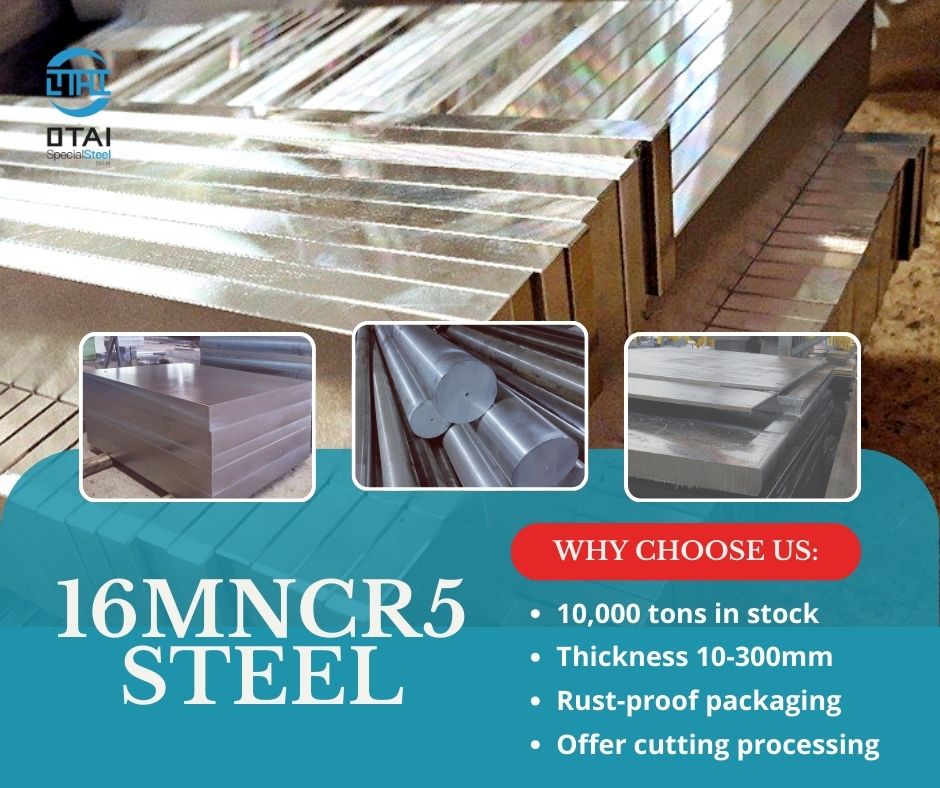
At Otai Special Steel, we specialize in providing high-quality 16MnCr5 steel and its equivalents. We offer precision cutting, heat treatment, and packaging services to meet the specific needs of your project. Whether you need gears, shafts, or custom parts, we provide solutions that enhance the performance and durability of your components.
Advantages of Working with Otai Special Steel:
-
Top-Quality Materials: We provide 16MnCr5 steel with consistent quality and mechanical properties.
-
Customization: We offer custom cutting, heat treatment, and machining tailored to your exact specifications.
-
Competitive Pricing: Our 16MnCr5 steel comes at competitive prices, offering excellent value without compromising quality.
-
Fast Delivery: With our extensive inventory, we guarantee fast and reliable delivery to meet your project deadlines.
❓ Frequently Asked Questions (FAQ)
Q1: What are the main equivalents of 16MnCr5 steel?
-
A1: Some of the main equivalents include AISI 5120, EN 19 (1.4511), 42CrMo4 (1.7225), AISI 4130, and SAE 8620 steel. These materials have similar mechanical properties and are often used as substitutes in specific applications.
Q2: How do I choose between 16MnCr5 steel and its equivalents?
-
A2: The choice between 16MnCr5 and its equivalents depends on factors such as strength, hardness, toughness, and cost. For example, 42CrMo4 offers better fatigue resistance, while AISI 4130 may be more suitable for aerospace applications where weight reduction is important.
Q3: Can 16MnCr5 steel be used for high-temperature applications?
-
A3: 16MnCr5 steel can perform in moderate temperature environments, but for extreme heat conditions, alternatives like 42CrMo4 or AISI 4340 may offer superior performance in high-temperature applications.