 16MnCr5 Heat Treatment: Processes, Effects, and Applications
16MnCr5 steel is a medium-carbon, low-alloy steel used in a variety of industries that require components to withstand high mechanical stress and wear. Known for its strength, toughness, and wear resistance, 16MnCr5 steel performs well in applications where durability and fatigue resistance are essential. Heat treatment plays a vital role in enhancing the mechanical properties of 16MnCr5 steel. In this article, we will examine the heat treatment processes, the effects on the material’s properties, and the common applications of 16MnCr5 steel.
🏗️ What is 16MnCr5 Steel?
16MnCr5 steel is an alloy steel that includes manganese and chromium to improve its mechanical properties, such as strength, toughness, and wear resistance. The number “16” in the name refers to the carbon content (around 0.16%). The manganese and chromium elements help improve hardenability, fatigue resistance, and wear resistance, which are crucial for parts exposed to high mechanical loads.
The composition of 16MnCr5 steel typically includes:
-
Carbon (C): 0.14% – 0.20%
-
Manganese (Mn): 0.60% – 0.90%
-
Chromium (Cr): 0.80% – 1.10%
-
Silicon (Si): 0.15% – 0.35%
-
Phosphorus (P): ≤ 0.025%
-
Sulfur (S): ≤ 0.025%
This composition gives 16MnCr5 steel a balance of strength, ductility, and resistance to wear, making it ideal for components that must withstand harsh conditions and repetitive stresses.
🔧 Heat Treatment Processes for 16MnCr5 Steel
Heat treatment allows you to modify the mechanical properties of 16MnCr5 steel to meet the specific requirements of various applications. Through heat treatment, you can enhance its strength, hardness, toughness, and wear resistance. Below are the most commonly used heat treatment processes for 16MnCr5 steel:
1. Carburizing
-
Carburizing is a surface-hardening process that adds carbon to the outer layer of 16MnCr5 steel. This process creates a hard surface while keeping the inner core tough and ductile. Carburizing improves the wear resistance and fatigue strength, making it ideal for parts like gears, shafts, and sprockets.
-
Process:
-
Heat the steel to a temperature of 900°C to 950°C.
-
Expose the material to a carbon-rich atmosphere, such as carbon monoxide.
-
Quench the steel to lock in the carbon at the surface.
-
Optionally, temper the steel to restore some of its ductility.
-
-
Benefits: Increased surface hardness and wear resistance while maintaining a tough core.
2. Quenching and Tempering
-
Quenching and tempering are often applied together to increase strength and hardness while maintaining ductility. Quenching involves rapidly cooling the steel to lock in its hard martensitic structure, and tempering restores the material’s toughness by reheating it at a lower temperature.
-
Process:
-
Heat the steel to around 850°C to 900°C.
-
Quench it in oil or water to form martensite.
-
Temper the steel at 400°C to 650°C to relieve stresses and improve toughness.
-
-
Benefits: Improved tensile strength, fatigue resistance, and impact toughness.
3. Normalizing
-
Normalizing is a heat treatment that refines the grain structure of 16MnCr5 steel to improve its toughness and uniformity.
-
Process:
-
Heat the steel to 850°C to 900°C.
-
Allow the steel to cool in air, resulting in a more uniform grain structure.
-
-
Benefits: Enhanced toughness, strength, and improved formability.
4. Annealing
-
Annealing is a heat treatment designed to soften 16MnCr5 steel by relieving internal stresses and improving machinability.
-
Process:
-
Heat the steel to 750°C to 800°C.
-
Cool it slowly to reduce internal stresses and soften the material.
-
-
Benefits: Reduced internal stresses and improved ductility and machinability.
🔨 Effects of Heat Treatment on 16MnCr5 Steel
The heat treatment processes enhance various mechanical properties of 16MnCr5 steel, tailoring it for specific applications. Here’s how each process affects its properties:
1. Hardness
-
Carburizing and quenching increase the surface hardness of 16MnCr5 steel, making it more resistant to wear and abrasion. This is especially useful for components such as gears and bearings that experience high friction.
2. Strength and Toughness
-
Quenching increases the strength but may also make the steel brittle. Tempering after quenching restores the material’s toughness, improving its ability to absorb shocks and resist impact.
3. Ductility
-
Normalizing and annealing improve the ductility of 16MnCr5 steel, making it easier to work with and shape. This is important when the material needs to withstand deformation without cracking or breaking.
4. Wear Resistance
-
Carburizing increases the wear resistance of 16MnCr5 steel, which makes it ideal for parts exposed to continuous friction and abrasive forces.
🏗️ Applications of 16MnCr5 Steel
Due to its excellent mechanical properties and versatile heat treatment options, 16MnCr5 steel is used in a wide variety of applications, particularly in industries that require components to endure high stress, impact, and wear.
1. Automotive Industry
-
16MnCr5 steel is commonly used in the automotive industry for manufacturing gears, axles, crankshafts, and suspension components. These components require the steel to withstand high mechanical loads while maintaining fatigue strength and impact resistance.
2. Industrial Machinery
-
16MnCr5 steel is used for bearings, shafts, sprockets, and pulleys in industrial machinery. The material’s wear resistance and toughness make it perfect for heavy-duty machinery exposed to constant friction.
3. Heavy Equipment
-
Parts in heavy equipment, such as those used in construction and mining, benefit from the high strength and toughness of 16MnCr5 steel. This steel can endure harsh working conditions with high mechanical stresses.
4. Gears and Shafts
-
16MnCr5 steel is particularly suitable for gears and shafts that experience high torque, dynamic loads, and frequent wear. The material’s combination of hardness and ductility makes it durable and reliable in demanding applications.
📊 Comparison of 16MnCr5 Steel with Other Materials
For a clearer understanding of how 16MnCr5 steel compares to other materials, here is a comparison of tensile strength, yield strength, and hardness:
| Material | Tensile Strength (MPa) | Yield Strength (MPa) | Hardness (HRC) | Applications |
|---|---|---|---|---|
| 16MnCr5 Steel | 600–900 | 450–650 | 55–62 | Automotive parts, gears, shafts, industrial machinery |
| AISI 5120 Steel | 600–850 | 400–650 | 28–50 | Automotive gears, axles, crankshafts |
| EN 19 (1.4511) | 850–1,100 | 450–650 | 30–40 | Engine components, industrial machinery |
| 42CrMo4 (1.7225) | 900–1,050 | 600–750 | 30–50 | Gears, axles, crankshafts |
| AISI 4130 Steel | 670–1,000 | 430–600 | 28–50 | Aerospace, military, automotive |
🏆 Why Choose Otai Special Steel for Your 16MnCr5 Steel Needs?
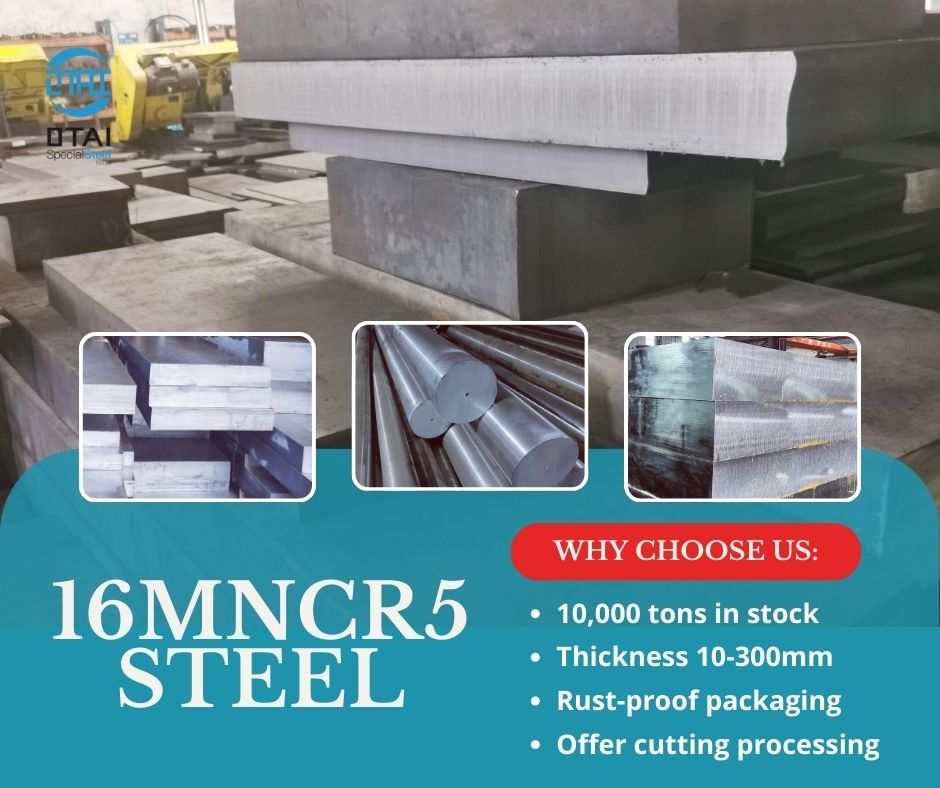
At Otai Special Steel, we offer high-quality 16MnCr5 steel that meets international standards. We provide precision cutting, heat treatment, and packaging services to ensure the material meets your project requirements. Whether you need gears, shafts, or machinery parts, we can help you get the right material for your application.
Advantages of Working with Otai Special Steel:
-
Top-Quality Materials: We offer 16MnCr5 steel that meets industry standards for strength, wear resistance, and toughness.
-
Customization: We provide custom cutting, heat treatment, and machining to meet your exact specifications.
-
Competitive Pricing: We offer high-performance steel at competitive prices, ensuring excellent value.
-
Fast Delivery: With our extensive inventory, we guarantee fast, reliable delivery to meet your deadlines.
❓ Frequently Asked Questions (FAQ)
Q1: What is 16MnCr5 steel used for?
-
A1: 16MnCr5 steel is used in automotive parts, gears, shafts, and industrial machinery components that require high strength, wear resistance, and fatigue resistance.
Q2: How does heat treatment affect 16MnCr5 steel?
-
A2: Heat treatments like carburizing, quenching, and tempering significantly improve the strength, hardness, and wear resistance of 16MnCr5 steel, making it suitable for heavy-duty applications.
Q3: Is 16MnCr5 steel weldable?
-
A3: Yes, 16MnCr5 steel is weldable, but it requires proper preheating and post-weld heat treatment to avoid cracking and ensure the best mechanical properties.