 16MnCr5 Material Name: International Designations, Standards, and Industrial Identity
When buyers search for 16MnCr5 material name, they usually face confusion in global sourcing. One country calls it 16MnCr5. Another market uses a completely different designation. Some suppliers reference European standards, while others use local equivalents.
If you import alloy steel for gears, shafts, or automotive components, you must clearly understand the naming system behind 16MnCr5. Otherwise, you risk purchasing the wrong grade.
This article explains:
-
What 16MnCr5 actually means
-
Its international equivalents
-
How standards define it
-
How to avoid mistakes when sourcing globally
🔍 What Does 16MnCr5 Mean?
The 16MnCr5 material name follows the European alloy steel designation system.
Breakdown of the name:
-
16 → Approximately 0.16% carbon
-
Mn → Manganese alloying element
-
Cr → Chromium alloying element
-
5 → Chromium content category within the EN system
In simple terms, 16MnCr5 is a low-carbon chromium alloy steel designed primarily for case hardening.
It offers:
-
Tough core strength
-
Excellent surface hardenability
-
Strong wear resistance after carburizing
📘 Standard Definition of 16MnCr5
The official European standard that defines this steel is:
EN 10084 classifies 16MnCr5 as a case hardening steel for mechanical components.
This standard controls:
-
Chemical composition
-
Mechanical properties
-
Delivery conditions
-
Heat treatment requirements
If a supplier cannot reference EN 10084, you should verify material compliance carefully.
📊 Chemical Composition of 16MnCr5
The composition defines the identity behind the 16MnCr5 material name.
| Element | Typical Range (%) |
|---|---|
| Carbon (C) | 0.14 – 0.19 |
| Manganese (Mn) | 1.00 – 1.30 |
| Chromium (Cr) | 0.80 – 1.10 |
| Silicon (Si) | ≤ 0.40 |
Low carbon ensures a tough core.
Chromium improves hardenability.
Manganese enhances strength and wear performance.
This composition makes 16MnCr5 ideal for carburized components.
🌍 International Equivalent Names
One major reason buyers search for 16MnCr5 material name involves international equivalence.
Below are commonly recognized equivalents:
| Standard | Equivalent Grade |
|---|---|
| Germany (DIN) | 16MnCr5 |
| Europe (EN) | 1.7131 |
| AISI / SAE | 5115 (approximate equivalent) |
| China (GB) | 20CrMnTi (similar application) |
| Japan (JIS) | SCM415 (application equivalent) |
Important note:
Equivalents may show similar applications but slightly different compositions. Always confirm chemical requirements before substitution.
🔥 Mechanical Properties After Case Hardening
The real performance of 16MnCr5 appears after carburizing and quenching.
Typical Case Hardening Results:
-
Surface hardness: 58–62 HRC
-
Core hardness: 30–45 HRC
-
Excellent fatigue resistance
-
Strong wear resistance
In soft condition (before carburizing):
| Property | Typical Value |
|---|---|
| Tensile Strength | 800–1000 MPa |
| Hardness | 170–220 HB |
This dual-structure capability makes 16MnCr5 highly versatile.
🏗️ Why Manufacturers Choose 16MnCr5
Engineers prefer this material because it allows:
-
Hard wear-resistant surface
-
Tough shock-resistant core
-
Excellent machinability before heat treatment
-
Stable dimensional performance
Typical applications include:
-
Automotive gears
-
Transmission shafts
-
Camshafts
-
Differential components
-
Heavy machinery parts
If you need high surface durability without brittle fracture risk, 16MnCr5 performs reliably.
⚠️ Common Mistakes When Identifying 16MnCr5
When sourcing internationally, buyers often make these errors:
-
Assuming AISI 4140 equals 16MnCr5 (it does not; 4140 is through-hardening steel).
-
Accepting “equivalent” without chemical verification.
-
Ignoring carburizing depth requirements.
-
Purchasing material without proper certification.
To avoid problems:
-
Request mill test certificate (MTC)
-
Confirm EN 10084 compliance
-
Verify chemical composition
-
Clarify heat treatment expectations
Understanding the 16MnCr5 material name prevents costly procurement mistakes.
🧰 Practical Selection Advice
Choose 16MnCr5 when:
-
Surface wear resistance is critical
-
Core toughness must remain high
-
Component experiences cyclic loading
-
Carburizing treatment is planned
Do not choose 16MnCr5 if:
-
You require uniform hardness throughout
-
You need very high through-thickness strength
In those cases, 4140 or 4340 may perform better.
🏅 Company Advantages – Otai Special Steel
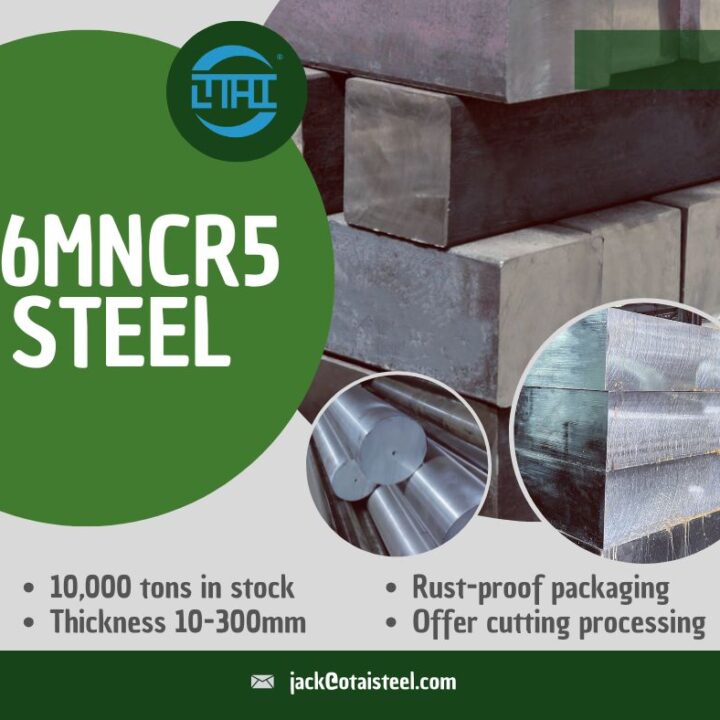
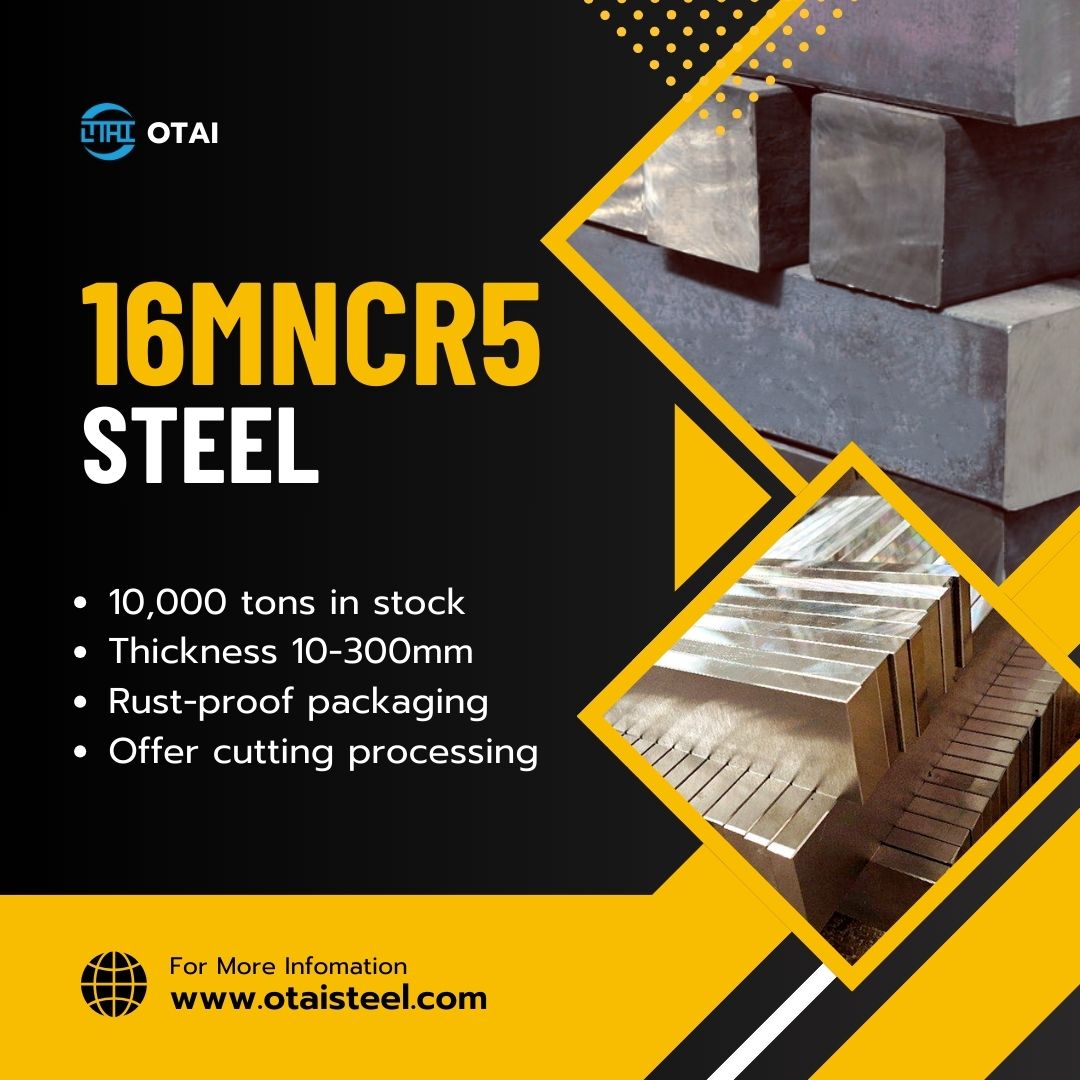
At Otai Special Steel, we supply certified 16MnCr5 with strict quality control.
We provide:
-
Large inventory availability
-
Thickness range from 6 mm to 300 mm
-
Custom cutting services
-
Ultrasonic testing (UT)
-
Chemical composition verification
-
Third-party inspection (SGS available)
-
Stable export experience worldwide
We help material suppliers, traders, and end users avoid grade confusion and ensure correct specification compliance.
❓ FAQ – 16MnCr5 Material Name
1. Is 16MnCr5 the same as 1.7131?
Yes. 1.7131 is the European numerical designation for 16MnCr5.
2. Can 16MnCr5 replace 4140?
No. 4140 is a through-hardening alloy steel, while 16MnCr5 is designed for case hardening.
3. What hardness can 16MnCr5 achieve after carburizing?
Typically 58–62 HRC on the surface.
4. What standard defines 16MnCr5?
EN 10084 defines its requirements.
5. Is 16MnCr5 suitable for heavy load gears?
Yes, especially when you require high surface wear resistance with a tough core.