 16MnCr5 Material Properties: Performance, Behavior, and Industrial Value
When engineers evaluate alloy steels for gears, shafts, and wear-resistant components, 16MnCr5 often stands out. Its balanced chemistry, excellent hardenability, and strong response to heat treatment give it a unique position among carburizing steels. Understanding 16MnCr5 material properties helps designers select the right material, optimize heat treatment, and extend component service life.
Below, we explore the chemical, mechanical, physical, and processing properties that define 16MnCr5 in real-world industrial use.
🔍 Overview of 16MnCr5 Steel
16MnCr5 is a low-alloy carburizing steel defined under EN 10084. Engineers typically select it for parts that require:
-
A hard, wear-resistant surface
-
A tough, shock-resistant core
-
Reliable performance under cyclic loads
Because of this combination, manufacturers widely use 16MnCr5 in automotive, industrial machinery, and transmission systems.
🧪 Chemical Composition and Its Influence
The alloying elements in 16MnCr5 directly control its hardenability, strength, and carburizing behavior.
Chemical Composition of 16MnCr5 (Typical Range)
| Element | Content (%) | Contribution to Material Properties |
|---|---|---|
| Carbon (C) | 0.14 – 0.19 | Enables carburizing and core toughness |
| Manganese (Mn) | 1.00 – 1.30 | Improves hardenability and strength |
| Chromium (Cr) | 0.80 – 1.10 | Enhances wear resistance and fatigue strength |
| Silicon (Si) | ≤ 0.40 | Improves strength and elasticity |
| Phosphorus (P) | ≤ 0.025 | Controlled to maintain toughness |
| Sulfur (S) | ≤ 0.035 | Improves machinability when controlled |
👉 Because of this chemistry, 16MnCr5 material properties respond very predictably to heat treatment.
⚙️ Mechanical Properties of 16MnCr5
The mechanical behavior of 16MnCr5 changes significantly with processing condition. Engineers often evaluate it in the normalized, quenched & tempered, or carburized state.
Typical Mechanical Properties (Core, Non-Carburized)
| Condition | Tensile Strength (MPa) | Yield Strength (MPa) | Elongation (%) |
|---|---|---|---|
| Normalized | 600 – 750 | 350 – 450 | 14 – 18 |
| Quenched & Tempered | 850 – 1000 | 600 – 750 | 10 – 14 |
These values highlight why 16MnCr5 supports load-bearing components while still resisting fracture.
🔥 Surface Hardness After Carburizing
One of the most valuable 16MnCr5 material properties is its ability to form a very hard surface layer.
Surface Hardness Capability
| Treatment | Surface Hardness |
|---|---|
| Carburized + Quenched | 58 – 62 HRC |
| Core Hardness | 30 – 40 HRC |
This hardness gradient allows components to resist wear while absorbing shock, which is essential for gears and transmission parts.
🧱 Physical Properties
Although mechanical strength often receives the most attention, physical properties also matter in design and simulation.
Physical Properties of 16MnCr5
| Property | Typical Value |
|---|---|
| Density | 7.85 g/cm³ |
| Elastic Modulus | ~210 GPa |
| Thermal Conductivity | ~42 W/m·K |
| Coefficient of Thermal Expansion | ~11.5 × 10⁻⁶ /K |
These stable values help engineers predict dimensional behavior during heat treatment and service.
🛠️ Machinability and Processing Behavior
In the annealed or normalized condition, 16MnCr5 machines easily with standard cutting tools. However, once carburized and hardened, machining requires carbide or CBN tooling.
Key processing advantages include:
-
Smooth turning and milling before carburizing
-
Good dimensional stability after heat treatment
-
Consistent response to batch processing
Therefore, manufacturers often machine parts close to final shape before surface hardening.
🔩 Weldability Considerations
16MnCr5 does not target welding applications. However, controlled welding remains possible.
Best practices include:
-
Preheating to reduce thermal stress
-
Low-hydrogen consumables
-
Post-weld stress relief when required
Without proper control, welding can negatively affect 16MnCr5 material properties, especially toughness.
🏭 Typical Industrial Applications
Thanks to its property balance, 16MnCr5 supports many demanding uses:
-
⚙️ Transmission and gearbox gears
-
🚗 Automotive shafts and pinions
-
🏗️ Industrial drive components
-
🛢️ Mechanical parts under cyclic load
-
🧰 Precision machined carburized parts
Each application benefits from the steel’s hard surface + tough core structure.
📊 Comparison with Similar Carburizing Steels
| Steel Grade | Key Difference |
|---|---|
| 20MnCr5 | Higher carbon, slightly harder core |
| 17CrNiMo6 | Higher strength, higher cost |
| AISI 5115 | Lower alloy content, reduced fatigue life |
This comparison shows why engineers often choose 16MnCr5 as a cost-performance balance.
🏅 Company Advantages – Why Choose Otai Special Steel?
At Otai Special Steel, we supply 16MnCr5 with consistent quality and full technical support:
-
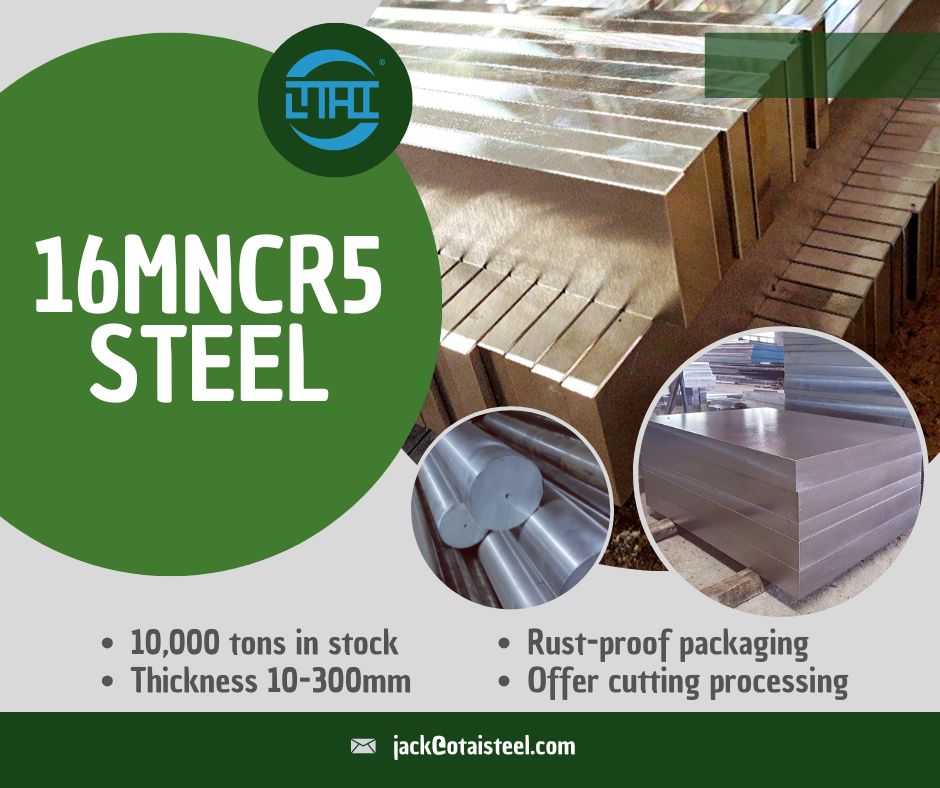
🔹 Over 10,000 tons of alloy steel inventory
-
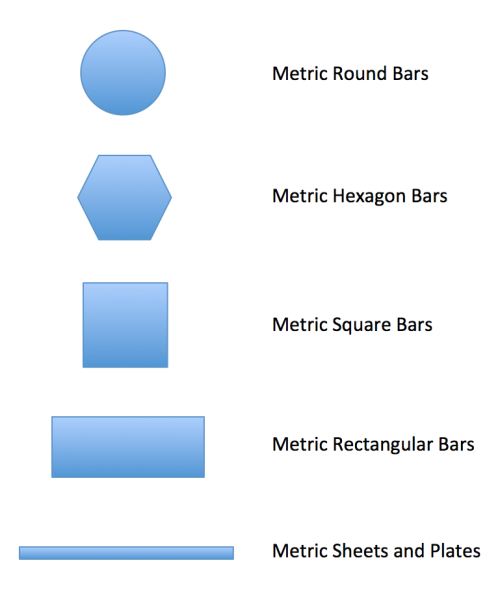
🔹 Supply forms: round bar, flat bar, plate, and forged blanks
-
🔹 Heat treatment services: annealing, normalizing, carburizing
-
🔹 Quality assurance: UT testing, chemical analysis, SGS inspection
-
🔹 Trusted supplier to Thyssenkrupp, Borealis, Schlumberger
We help customers fully realize 16MnCr5 material properties in real production environments.
❓ FAQ – 16MnCr5 Material Properties
Q1: Is 16MnCr5 a low carbon steel?
Yes. Its low carbon content allows deep carburizing while maintaining a tough core.
Q2: What hardness can 16MnCr5 reach?
After carburizing and quenching, surface hardness typically reaches 58–62 HRC.
Q3: Does 16MnCr5 resist fatigue well?
Yes. Chromium and manganese improve fatigue resistance, especially after surface hardening.
Q4: Can 16MnCr5 replace 4140 steel?
Not directly. 16MnCr5 targets carburized applications, while 4140 focuses on through-hardening.
Q5: Is 16MnCr5 suitable for heavy loads?
Yes. Its tough core and hardened surface handle high contact stress effectively.