 16MnCr5 Physical Properties: Key Features and Applications
16MnCr5 steel is a medium-carbon, low-alloy steel that is highly regarded for its strength, toughness, and wear resistance. It is commonly used in automotive, machinery, and aerospace industries for manufacturing gears, shafts, crankshafts, and other critical components. One of the most important factors determining the performance of 16MnCr5 steel in various applications is its physical properties, which influence how the material behaves under different environmental conditions.
In this article, we will explore the physical properties of 16MnCr5 steel, their implications on material selection, and how these properties impact the steel’s suitability for various industrial applications.
🏗️ What are Physical Properties?
Physical properties refer to the characteristics of a material that can be measured or observed without changing the substance’s composition. These properties help determine how a material will behave under various conditions such as temperature, pressure, and mechanical stress.
Common physical properties include:
-
Density
-
Thermal conductivity
-
Electrical conductivity
-
Melting point
-
Thermal expansion
-
Modulus of elasticity
-
Hardness
For 16MnCr5 steel, these physical properties are crucial for selecting the right material for high-performance components that must endure harsh conditions, including high wear, stress, and temperature variations.
🔧 Physical Properties of 16MnCr5 Steel
1. Density
-
The density of 16MnCr5 steel typically ranges around 7.85 g/cm³, which is consistent with most steels. This value is important because it helps determine the mass and weight of components made from this material, which is crucial for applications where weight plays a critical role, such as in automotive parts or aerospace components.
2. Melting Point
-
16MnCr5 steel has a melting point of approximately 1,400°C to 1,500°C (2,552°F to 2,732°F), depending on its exact alloy composition. The high melting point makes 16MnCr5 suitable for high-temperature applications where other materials might fail or lose their strength. For example, engine parts or machinery components made from 16MnCr5 can perform reliably under high thermal stress.
3. Thermal Conductivity
-
The thermal conductivity of 16MnCr5 steel is approximately 45 W/m·K. This property measures the material’s ability to conduct heat. Steel generally has moderate thermal conductivity, which means that it can distribute heat efficiently across a surface but also retains heat in certain applications. This makes it suitable for components like gears and shafts that require some degree of thermal management during operation.
4. Thermal Expansion
-
The coefficient of thermal expansion of 16MnCr5 steel is approximately 11.5 × 10⁻⁶ /°C (or 6.4 × 10⁻⁶ /°F). This means that 16MnCr5 will expand by about 11.5 micrometers for every meter of material length for every 1°C increase in temperature. It is essential to understand the thermal expansion of materials when designing components that experience temperature fluctuations, such as automotive parts or engine components.
5. Modulus of Elasticity
-
The modulus of elasticity (also called Young’s modulus) for 16MnCr5 steel is approximately 210 GPa (30,500,000 psi). This value indicates how stiff or flexible a material is. In general, a high modulus of elasticity means that the material is stiff and resists deformation under stress. The modulus of elasticity is a crucial property for components that experience high mechanical loads and require minimal deformation.
6. Hardness
-
The hardness of 16MnCr5 steel can vary based on its heat treatment, but it typically ranges from 200 HB (Brinell hardness) to 300 HB. The hardness of 16MnCr5 can be increased through processes such as quenching and tempering, which is essential for parts exposed to high wear conditions, such as gears and bearings.
7. Electrical Conductivity
-
As a ferrous alloy, 16MnCr5 steel has relatively low electrical conductivity compared to non-ferrous metals like copper or aluminum. Steel, including 16MnCr5, is generally not used in electrical applications where high conductivity is needed, but it performs well in mechanical applications where electrical conductivity is not a primary concern.
🔨 How Do the Physical Properties of 16MnCr5 Steel Impact Its Applications?
The physical properties of 16MnCr5 steel play a significant role in determining its suitability for various applications. These properties affect its strength, durability, and performance under different environmental conditions.
1. Automotive Industry
-
16MnCr5 steel is widely used in the automotive industry for manufacturing gears, axles, and crankshafts. The high melting point and thermal conductivity allow it to perform well under high-temperature conditions, while its density and modulus of elasticity make it ideal for parts that require both strength and toughness. The hardness ensures that the components can withstand significant wear.
2. Aerospace Industry
-
In aerospace applications, 16MnCr5 steel is used for landing gears, actuators, and fasteners. The high melting point ensures that components can withstand high-pressure and high-temperature environments, while the thermal expansion properties help prevent dimensional changes that could affect the performance of these critical components.
3. Industrial Machinery
-
Bearings, shafts, and gears in industrial machinery benefit from the wear resistance and hardness provided by 16MnCr5 steel. Its thermal conductivity helps manage the heat buildup during operation, ensuring that components remain stable and functional under continuous mechanical stress.
4. Heavy Equipment
-
Hydraulic components and gears used in heavy equipment rely on 16MnCr5 steel for its strength and toughness. The material’s density and thermal expansion properties ensure that parts can handle high-stress environments while maintaining dimensional stability during temperature fluctuations.
📊 Comparison of Physical Properties of 16MnCr5 Steel
| Property | 16MnCr5 Steel |
|---|---|
| Density | 7.85 g/cm³ |
| Melting Point | 1,400°C to 1,500°C |
| Thermal Conductivity | 45 W/m·K |
| Coefficient of Thermal Expansion | 11.5 × 10⁻⁶ /°C |
| Modulus of Elasticity | 210 GPa (30,500,000 psi) |
| Hardness | 200 HB to 300 HB (varies with treatment) |
| Electrical Conductivity | Low (as typical with steel) |
🏆 Why Choose Otai Special Steel for Your 16MnCr5 Steel Needs?
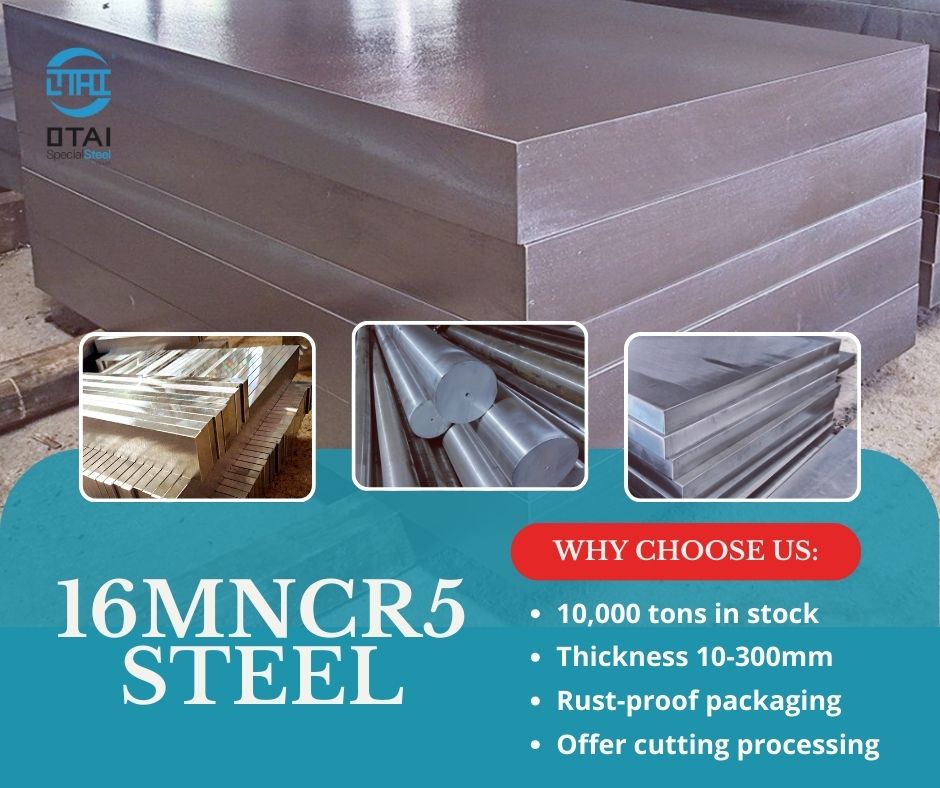
At Otai Special Steel, we supply high-quality 16MnCr5 steel that undergoes strict quality controls to ensure excellent physical properties. We offer custom cutting, heat treatment, and packaging services tailored to meet your exact requirements.
Advantages of Working with Otai Special Steel:
-
Premium Materials: Our 16MnCr5 steel undergoes rigorous testing to ensure high strength, toughness, and wear resistance for your critical applications.
-
Customization: We provide custom cutting, heat treatment, and machining services to meet your project’s exact specifications.
-
Competitive Pricing: Our high-performance steel comes at competitive prices, ensuring excellent value for your projects.
-
Fast Delivery: With a large inventory, we guarantee fast and reliable delivery to meet your project deadlines.
❓ Frequently Asked Questions (FAQ)
Q1: What is the typical density of 16MnCr5 steel?
-
A1: The typical density of 16MnCr5 steel is approximately 7.85 g/cm³, which is standard for most steels.
Q2: How does 16MnCr5 steel perform in high-temperature applications?
-
A2: 16MnCr5 steel has a high melting point (around 1,400°C to 1,500°C) and performs well in high-temperature environments, making it suitable for use in automotive and aerospace components.
Q3: What is the hardness range for 16MnCr5 steel?
-
A3: The hardness of 16MnCr5 steel ranges from 200 HB to 300 HB, depending on the heat treatment, ensuring excellent wear resistance in demanding applications.