 16MnCr5 Steel Heat-Treating: Key Processes and Benefits
16MnCr5 steel, a low-alloy manganese-chromium steel, is widely used in the production of components requiring good wear resistance, toughness, and fatigue strength. Its heat-treatment process plays a critical role in optimizing its mechanical properties, making it suitable for a wide range of industrial applications. In this article, we’ll explore the heat-treating process for 16MnCr5 steel, its benefits, and its key applications.
🧪 What is 16MnCr5 Steel?
16MnCr5 steel is a low-alloy steel containing manganese (Mn) and chromium (Cr), which enhance its hardness, strength, and wear resistance. The steel’s composition typically includes:
-
Carbon (C): 0.14% to 0.20%
-
Manganese (Mn): 0.70% to 1.00%
-
Chromium (Cr): 0.90% to 1.20%
These alloying elements provide 16MnCr5 steel with good hardness, fatigue resistance, and strength, especially after undergoing proper heat treatment. This steel is commonly used for parts like gears, shafts, axles, and other components requiring high wear resistance and toughness.
🔥 Heat-Treating Process of 16MnCr5 Steel
Heat treatment significantly affects the mechanical properties of 16MnCr5 steel. It enhances its hardness, strength, and resistance to wear while maintaining its toughness. The main heat-treatment processes for 16MnCr5 steel are quenching, tempering, and carburizing.
1. Carburizing
During carburizing, 16MnCr5 steel gets heated in a carbon-rich environment at about 900°C to 950°C. Carbon diffuses into the surface layer, hardening it to 58-62 HRC while the core stays soft and tough. This process makes the steel ideal for parts needing a hard outer layer and a tough core.
Benefits of Carburizing:
-
Increases wear resistance on the surface.
-
Improves fatigue resistance.
-
Maintains a tough core for better impact resistance.
Carburized 16MnCr5 steel is commonly used in the manufacture of gears, camshafts, and axles, where high surface hardness and resilience are crucial.
2. Quenching and Tempering
Quenching heats 16MnCr5 steel to around 850°C to 900°C and rapidly cools it in water or oil, boosting hardness but risking brittleness. Tempering reheats it to 200°C to 500°C and cools it gradually, reducing brittleness and boosting toughness while retaining high strength.
The quenching and tempering process results in 16MnCr5 steel with a hardness of 30-40 HRC. This makes it ideal for parts that require a balance of high strength, toughness, and wear resistance.
Benefits of Quenching and Tempering:
-
Provides good toughness.
-
Maintains a balance between strength and hardness.
-
Improves resistance to impact and fatigue.
16MnCr5 steel treated with quenching and tempering is often used in applications like automotive components, machine parts, and heavy-duty equipment.
3. Normalizing
Normalizing is a heat treatment process in which 16MnCr5 steel is heated to a temperature of about 850°C to 900°C and then allowed to cool in air. This process refines the steel’s grain structure and enhances uniformity. It results in a material with improved machinability and better toughness.
The hardness after normalizing typically falls in the range of 220 HB to 250 HB, making 16MnCr5 steel suitable for applications that require moderate hardness and good workability.
Benefits of Normalizing:
-
Improves machinability.
-
Refines the grain structure, enhancing toughness.
-
Ensures uniform mechanical properties.
Normalizing is often used for general-purpose machining where the steel does not require a high surface hardness but needs to be easily machined and tough.
🏗️ Applications of 16MnCr5 Steel after Heat Treatment
1. Gears and Shafts
2. Automotive Components
3. Machine Parts
4. Heavy Duty Equipment
For heavy-duty equipment that experiences significant stress and wear, 16MnCr5 steel treated with carburizing or quenching and tempering is an excellent choice. It ensures that parts such as pins, bushings, and spindles maintain their performance under challenging operating conditions.
📊 Comparison of Heat-Treated 16MnCr5 Steel
| Heat Treatment Process | Hardness | Key Benefits | Ideal Applications |
|---|---|---|---|
| Carburizing | 58-62 HRC | Increased surface hardness, improved wear resistance | Gears, Shafts, Camshafts |
| Quenching + Tempering | 30-40 HRC | Balanced strength and toughness | Automotive components, Machine parts |
| Normalizing | 220-250 HB | Improved machinability, uniform properties | General-purpose machining |
🏅 Company Advantages – Otai Special Steel
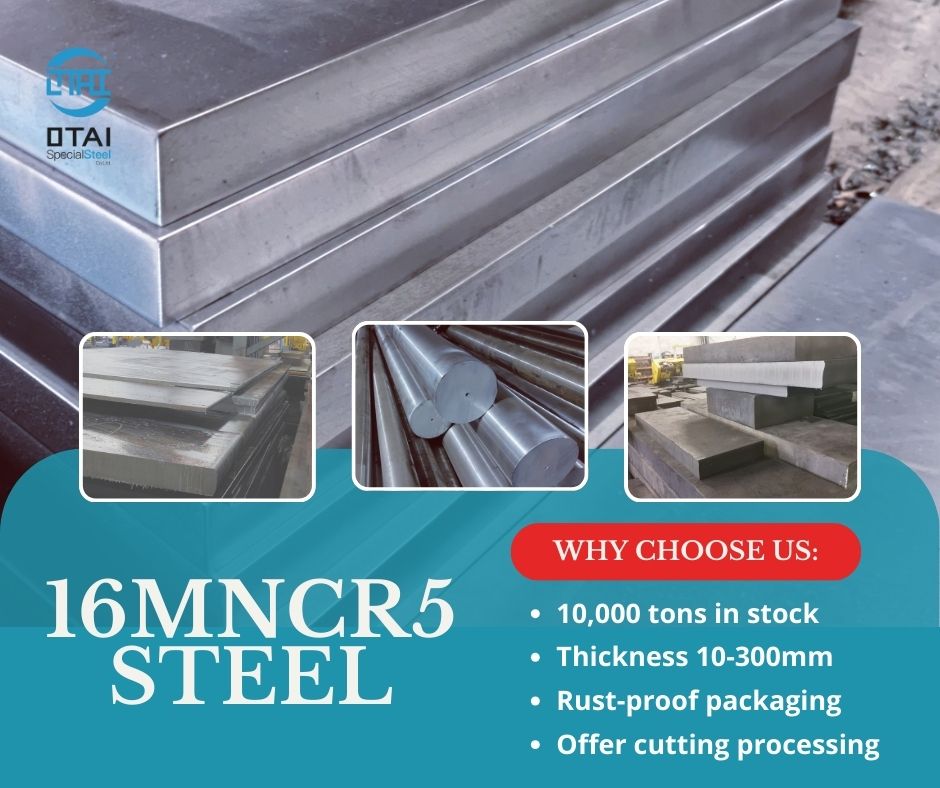
At Otai Special Steel, we specialize in providing 16MnCr5 steel with tailored heat treatment options to meet the specific requirements of your project. We offer custom cutting, precision machining, and material certification to ensure the highest quality and performance.
Why Choose Otai Special Steel?
-
Custom Heat Treatment: We provide 16MnCr5 steel with precise heat treatment to optimize its properties.
-
High-Quality Materials: We supply 16MnCr5 steel with consistent and reliable mechanical properties.
-
Fast Delivery: We maintain a large inventory for quick delivery.
-
Expert Support: Our engineers provide guidance to help you choose the best material for your application.
❓ Frequently Asked Questions (FAQ)
Q1: What is the typical hardness of 16MnCr5 steel after carburizing?
A1: After carburizing, 16MnCr5 steel can achieve a surface hardness of 58-62 HRC, providing high wear resistance for critical parts.
Q2: How does heat treatment affect 16MnCr5 steel?
A2: Heat treatment improves the hardness, strength, and resilience of 16MnCr5 steel. Processes like carburizing, quenching, and tempering allow engineers to customize the steel’s properties for different applications.