 16MnCr5 Steel Heat Treatment: Enhancing Performance and Durability
16MnCr5 steel is a popular low-alloy steel that contains manganese and chromium as its main alloying elements. It is used for components requiring high strength, good wear resistance, and toughness. However, achieving optimal mechanical properties for 16MnCr5 steel often requires the right heat treatment.
In this article, we explore the heat treatment process for 16MnCr5 steel, how it impacts the material’s characteristics, and the common applications that benefit from these treatments.
🧪 What is 16MnCr5 Steel?
16MnCr5 steel is a low-alloy carburizing steel, widely used in applications demanding high strength and fatigue resistance. Engineers often use it to produce gears, shafts, crankshafts, and bearings. The alloying elements chromium and manganese provide the steel with better hardness, wear resistance, and toughness.
The steel’s composition includes:
- 0.14% – 0.19% Carbon
- 1.00% – 1.30% Manganese
- 0.80% – 1.10% Chromium
- 0.15% – 0.25% Molybdenum
The correct heat treatment ensures that 16MnCr5 steel achieves the ideal combination of these properties.
🔥 The Importance of Heat Treatment for 16MnCr5 Steel
Heat treatment significantly alters 16MnCr5 steel’s mechanical properties. Through heat treatment, engineers can optimize hardness, strength, wear resistance, and fatigue resistance to meet specific requirements for different applications.
Key Benefits of Heat Treatment for 16MnCr5 Steel:
- Improved Surface Hardness: Heat treatment enhances the steel’s surface hardness, providing superior wear resistance.
- Optimized Toughness: It ensures the core remains tough, offering protection against cracking under dynamic loading.
- Increased Fatigue Resistance: Heat treatment refines the microstructure, improving the material’s fatigue strength.
By properly controlling heat treatment, manufacturers can customize 16MnCr5 steel for challenging industrial environments.
🔧 Heat Treatment Processes for 16MnCr5 Steel
The heat treatment process for 16MnCr5 steel includes several methods: normalizing, carburizing and quenching, and tempering. Each method targets specific mechanical properties.
1. Normalizing Process
Normalizing refines the grain structure and improves uniformity in 16MnCr5 steel. To normalize, heat the steel to a temperature range of 850°C to 900°C and air cool it.
Effects of Normalizing on 16MnCr5 Steel:
- Improved machinability: The steel becomes easier to machine after normalizing.
- Reduced internal stresses: This step reduces residual stresses in the steel.
- Uniform microstructure: A more uniform structure enhances strength distribution.
Normalizing is often used when uniform strength and improved machinability are essential.
2. Carburizing and Quenching
Carburizing involves heating 16MnCr5 steel to 900°C to 950°C in a carbon-rich atmosphere. The heat allows carbon to diffuse into the surface of the steel, creating a hardened outer layer. The steel is then quenched, typically in oil or water, to rapidly cool it, resulting in a hardened surface and a tough core.
Effects of Carburizing and Quenching on 16MnCr5 Steel:
| Property | Before Treatment | After Carburizing + Quenching |
|---|---|---|
| Surface Hardness | 170 – 220 HB | 56 – 62 HRC |
| Core Hardness | 150 HB | 30 – 40 HRC |
| Wear Resistance | Moderate | Excellent |
| Fatigue Resistance | Moderate | High |
The hardened surface significantly improves wear resistance, making this process ideal for parts that undergo high friction.
3. Quenching and Tempering
Quenching involves heating 16MnCr5 steel to 850°C to 900°C and rapidly cooling it. This process increases hardness but also creates brittleness. To reduce brittleness, the steel is then tempered by reheating it to a lower temperature (typically 400°C to 650°C) and gradually cooling it.
Effects of Quenching and Tempering on 16MnCr5 Steel:
- Increased toughness: Tempering restores toughness while maintaining strength.
- Reduced brittleness: This process prevents cracking under dynamic stress.
- Improved fatigue resistance: Tempering enhances the material’s ability to resist fatigue failure.
Quenching and tempering are ideal for components requiring a balance of strength, toughness, and fatigue resistance.
🏗️ Applications of 16MnCr5 Steel
Heat-treated 16MnCr5 steel is used across many industries that demand high strength and durability. Some common applications include:
- Automotive: Axles, gears, crankshafts, suspension parts
- Aerospace: Landing gear components, fasteners, wheels
- Oil & Gas: Drill rods, pumps, valves
- Heavy Equipment: Pins, bushings, machinery parts
These parts benefit from the high surface hardness and tough core properties created by the heat treatment processes.
📊 Comparison with Other Steels
| Property | 16MnCr5 Steel | 1045 Steel | 4340 Steel |
|---|---|---|---|
| Tensile Strength | 800 – 1000 MPa | 600 – 700 MPa | 1000 – 1200 MPa |
| Yield Strength | 600 – 750 MPa | 400 – 500 MPa | 900 – 1100 MPa |
| Wear Resistance | High | Moderate | Excellent |
| Fatigue Resistance | High | Moderate | Very High |
| Machinability | Good | Moderate | Moderate |
While 4340 steel offers higher tensile strength, 16MnCr5 steel provides a balanced combination of strength, toughness, and fatigue resistance, making it ideal for automotive and machinery components.
🏅 Company Advantages – Otai Special Steel
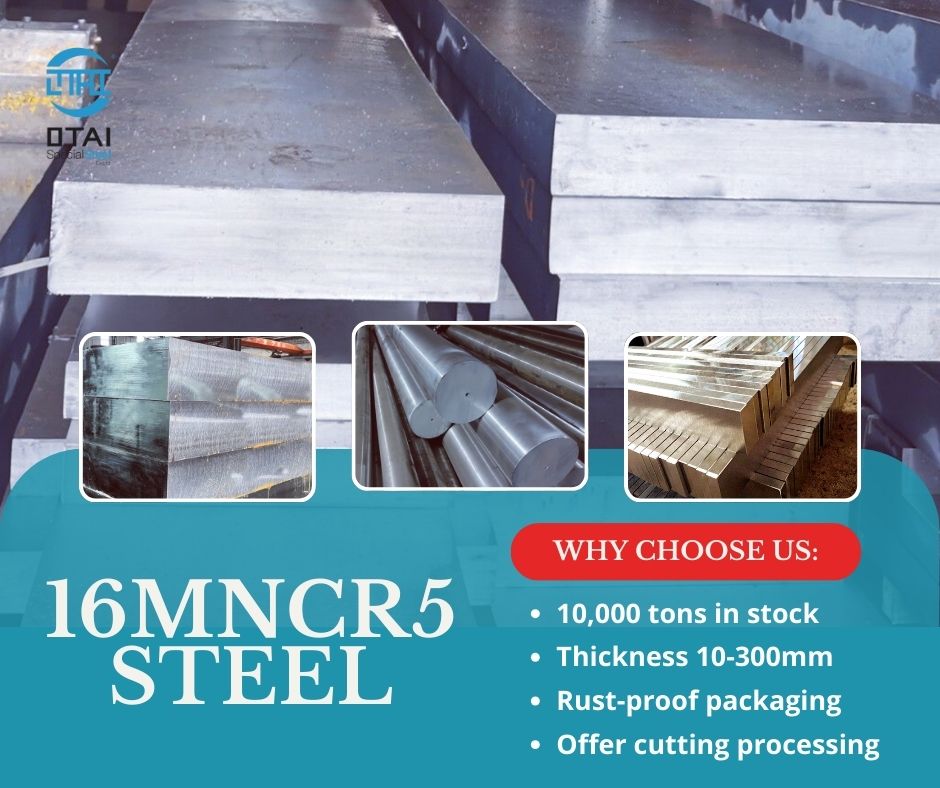
At Otai Special Steel, we specialize in providing 16MnCr5 steel with expert heat treatment services. Whether you need custom cutting, heat treatment, or material certification, we ensure that every order meets your requirements.
Why Choose Otai Special Steel?
- Premium Materials: We provide 16MnCr5 steel with consistent mechanical properties.
- Custom Solutions: We offer custom cutting, heat treatment, and machining services.
- Competitive Pricing: We offer cost-effective solutions without compromising on quality.
- Fast Delivery: We guarantee timely delivery, no matter the size or complexity of your order.
❓ Frequently Asked Questions (FAQ)
Q1: What is the best heat treatment for 16MnCr5 steel?
A1: The ideal heat treatment depends on the application. For high surface hardness, carburizing and quenching work best. For balanced properties, quenching and tempering offer excellent strength and toughness.
Q2: How does heat treatment affect 16MnCr5 steel’s fatigue resistance?
A2: Heat treatment, especially carburizing, enhances fatigue resistance by improving the surface hardness while maintaining the core’s toughness.
Q3: Can 16MnCr5 steel be welded after heat treatment?
A3: Yes, 16MnCr5 steel can be welded, but it is essential to preheat the material before welding to avoid cracking in the heat-affected zone.