 16MnCr5 vs 4140 – Choosing the Right Steel for Performance and Longevity
When engineers compare 16MnCr5 vs 4140, they usually look for a material that delivers the right balance of strength, wear resistance, hardenability, and cost. Both steels perform strongly in power-transmission components, gears, shafts, and high-stress parts, yet they differ in composition, behavior during heat treatment, and ideal application scenarios. In this article, I compare them in detail, focusing on 16MnCr5 vs 4140 steel differences in chemistry, properties, heat treatment, and real-world usage. I keep the discussion practical, application-driven, and supported by data tables.
🔍 What Each Steel Is Designed To Do
16MnCr5 belongs to the carburizing steel family. It excels when components need a hard, wear-resistant surface and a tough, ductile core. Manufacturers typically carburize gear teeth, pins, and bushings made from 16MnCr5 to create a hard case and impact-resistant interior.
4140 is a chromium-molybdenum alloy steel designed for through-hardening. It offers high strength, toughness, and fatigue resistance across the entire section without carburizing. You find it widely in heavy shafts, bolts, tool holders, and oilfield parts.
Understanding this difference already frames the comparison: 16MnCr5 favors case hardening; 4140 favors through hardening.
🧪 Chemical Composition Comparison (Table)
The chemistry directly drives the performance difference, so let’s look at 16MnCr5 vs 4140 chemical composition comparison.
| Steel Grade | C (%) | Mn (%) | Cr (%) | Mo (%) | Si (%) | Other |
|---|---|---|---|---|---|---|
| 16MnCr5 | 0.14–0.19 | 1.00–1.30 | 0.80–1.10 | — | ≤0.40 | Case-carburizing grade |
| 4140 | 0.38–0.43 | 0.75–1.00 | 0.80–1.10 | 0.15–0.25 | 0.15–0.35 | Cr–Mo alloy steel |
Key takeaways in active voice:
-
I see higher carbon content in 4140, which supports through hardening.
-
I see lower base carbon in 16MnCr5, which suits carburizing with deep case formation.
-
Chromium and molybdenum in 4140 increase hardenability and strength through the section.
⚙️ Mechanical Properties Comparison (Table)
Now let’s move to 16MnCr5 vs 4140 mechanical properties. Actual values vary with size and heat treatment, but the table below summarizes typical ranges.
| Property | 16MnCr5 (Carburized & Quenched Case) | 4140 (Quenched & Tempered) |
|---|---|---|
| Surface Hardness | 58–62 HRC | 28–45 HRC (Typical), up to ~50 HRC |
| Core Hardness | 28–38 HRC | Uniform through section |
| Tensile Strength | Up to ~1100–1400 MPa (Surface Case) | 850–1200 MPa (QT Condition) |
| Toughness | Tough core after carburizing | High, uniform |
| Wear Resistance | Excellent at surface | Very good overall |
I highlight one practical point: 16MnCr5 delivers extremely hard surfaces after carburizing, while 4140 delivers strong and tough bulk sections without special case treatment.
🔥 Heat Treatment Behavior and Selection Impact
Heat treatment plays a central role in this comparison. Engineers often search for 16MnCr5 vs 4140 heat treatment comparison, because selection usually starts from required hardness depth and profile.
-
16MnCr5 responds best to carburizing + quenching + tempering. I recommend it when you need a hard case depth of 0.8–2.0 mm with high wear resistance on the surface.
-
4140 responds best to quenching and tempering directly. I recommend it when you need high strength through the full section or large cross-sections with good toughness.
If you want to avoid carburizing furnaces, 4140 simplifies processing. If you require a very hard skin and ductile core, 16MnCr5 delivers superior surface performance.
⚙️ Which Is Better for Gears?
This question appears frequently: 16MnCr5 vs 4140 which is better for gears?
-
For high-load gears with sliding wear, 16MnCr5 usually wins because carburizing gives a 60+ HRC wear-resistant case.
-
For moderate gears or large shafts with integral gear sections, 4140 can perform very well in quenched and tempered condition.
So:
-
Precision gears → 16MnCr5
-
Combined strength + simpler heat treatment → 4140
🏗️ Applications in Real Industries
You will encounter 16MnCr5 vs 4140 applications in machinery in industries such as:
16MnCr5 Typical Uses
-
Automotive: Transmission gears, camshafts, crankshafts
-
Aerospace: Landing gear components, fasteners, structural parts
-
Heavy Machinery: Bearings, shafts, spindles
-
General Engineering: Machine tools, valves, hydraulic components
4140 Typical Uses
-
Automotive: Hydraulic shafts, piston rods, bolts, drill collars
-
Heavy-duty tools: Tool holders, dies, coupling parts
-
Oilfield: Oilfield components, downhole equipment
I recommend choosing based on case depth requirements, section size, and the dominant failure mode (wear vs fatigue).
🔧 Machinability, Weldability, and Hardenability
Both steels machine well in normalized or annealed condition. After hardening, machining becomes difficult, so I advise finishing all critical dimensions beforehand.
-
16MnCr5: Good machinability before carburizing; after case-hardening, grinding becomes the primary finishing method.
-
4140: Good machinability in pre-hard or annealed condition; many users prefer it in pre-hardened 28–32 HRC condition.
Regarding 16MnCr5 vs 4140 Hardenability and Wear Resistance:
-
4140 has excellent through-hardenability because of Cr-Mo alloy additions.
-
16MnCr5 has outstanding surface wear resistance after carburizing, while core retains toughness.
💰 Cost and Availability
Engineers also ask about 16MnCr5 vs 4140 cost and availability. Market prices vary by region, size, and heat treatment condition, but you can expect:
-
4140 to offer very good global availability, including pre-hardened and QT conditions.
-
16MnCr5 is widely available in Europe and Asia for automotive gear production.
If your project prioritizes easy sourcing and fast turnaround, 4140 often simplifies procurement. If the design demands carburized gears, 16MnCr5 matches the requirement directly.
🏅 Company Advantages – Otai Special Steel
When you choose between these two grades, reliable material quality matters as much as specification. Otai Special Steel supports buyers with:
-
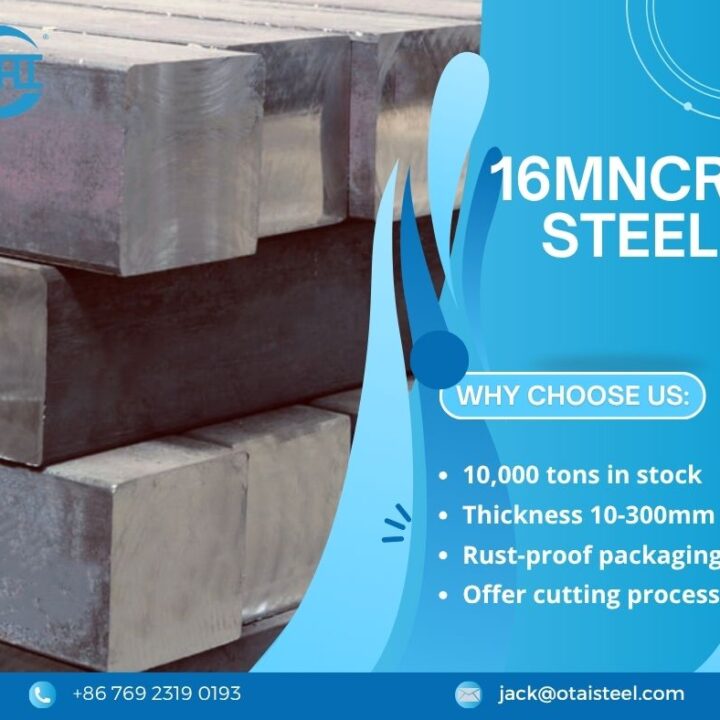
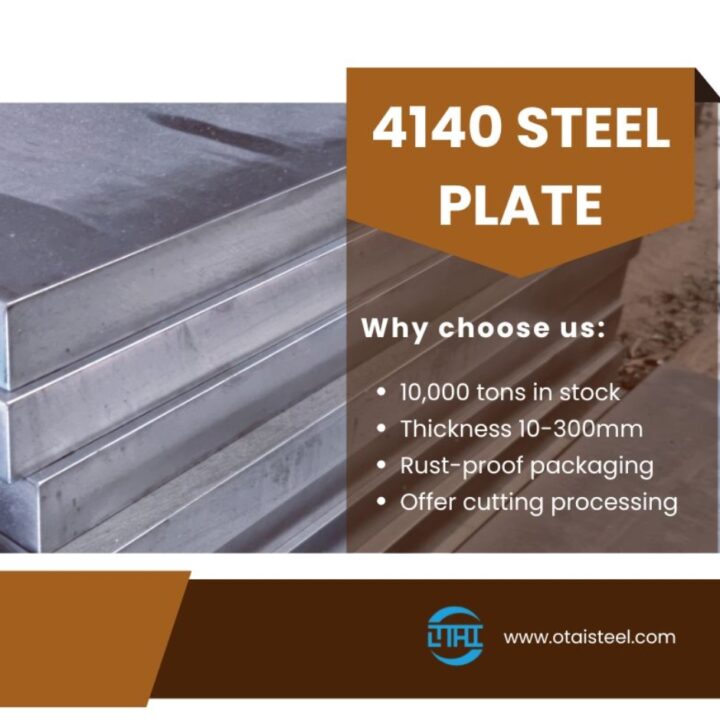
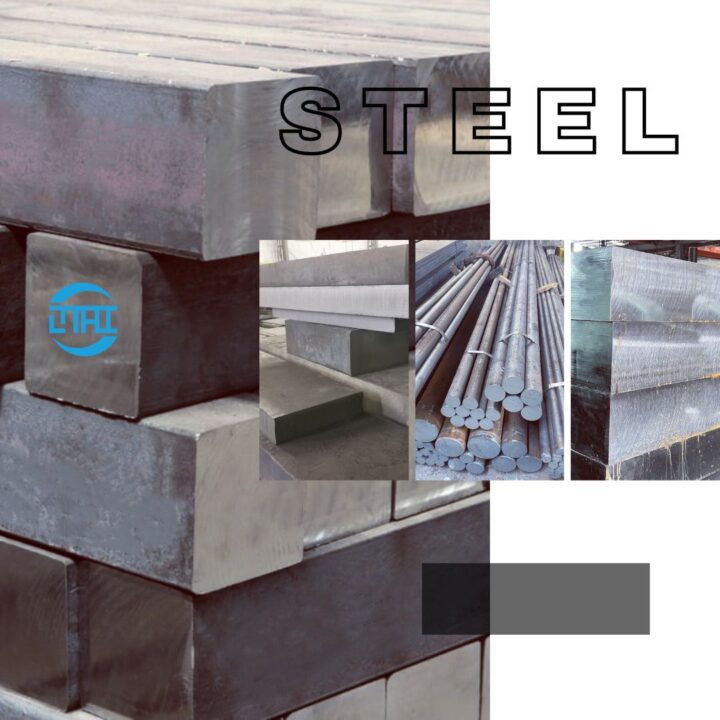
Large in-stock inventories of 4140 alloy steel plates, bars, and forgings
-
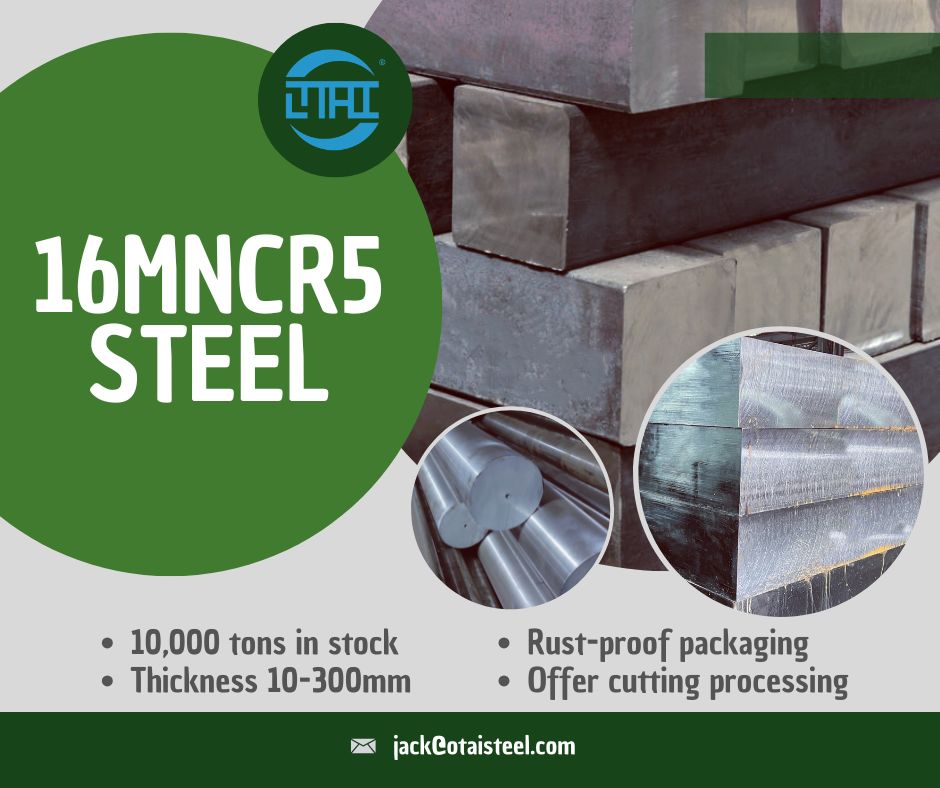
Stable supply of carburizing steels, including 16MnCr5 equivalents
-
Thickness range from 6 mm to 300 mm
-
Cutting, pre-machining, heat treatment, and packaging services
-
Ultrasonic testing (UT), chemical composition testing
-
Third-party inspection options such as SGS
-
Global export experience with end users, trading companies, and OEM manufacturers
We help you reduce sourcing risk, shorten lead time, and match the right grade to each application.
❓ FAQ – 16MnCr5 vs 4140
Q1: Can 4140 replace 16MnCr5 in all gear applications?
A1: No. 4140 performs very well in many gears, but high-wear, high-precision carburized gears benefit strongly from 16MnCr5.
Q2: Which steel offers higher surface hardness?
A2: After carburizing, 16MnCr5 reaches 58–62 HRC on the surface, usually higher than standard QT 4140.
Q3: Which one provides better through-section strength?
A3: 4140 offers more uniform through-section strength because of higher carbon and alloy content and excellent hardenability.
Q4: Is carburizing always necessary for 16MnCr5?
A4: You normally select 16MnCr5 because you plan to carburize it. Without carburizing, it does not deliver its best performance.
Q5: Which grade is easier to source globally?
A5: 4140 typically has wider global availability in multiple forms and conditions.