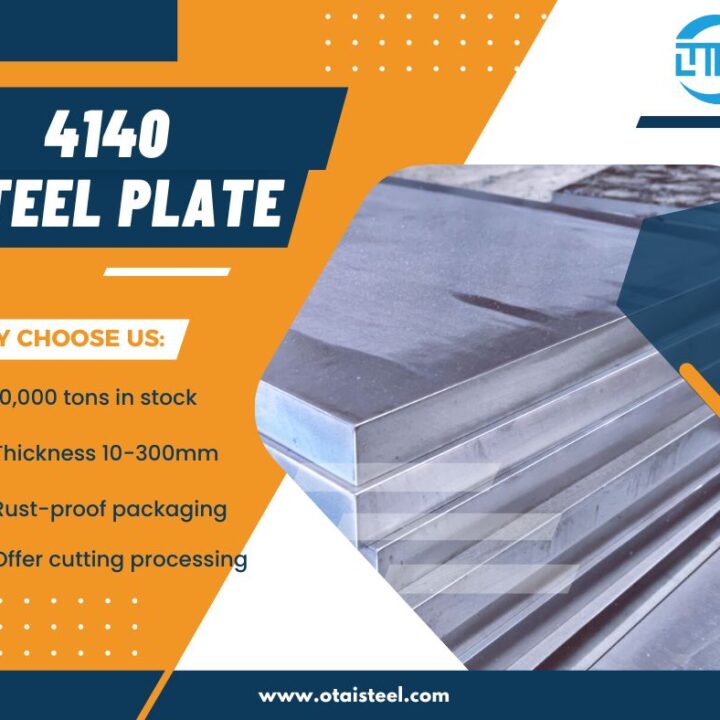
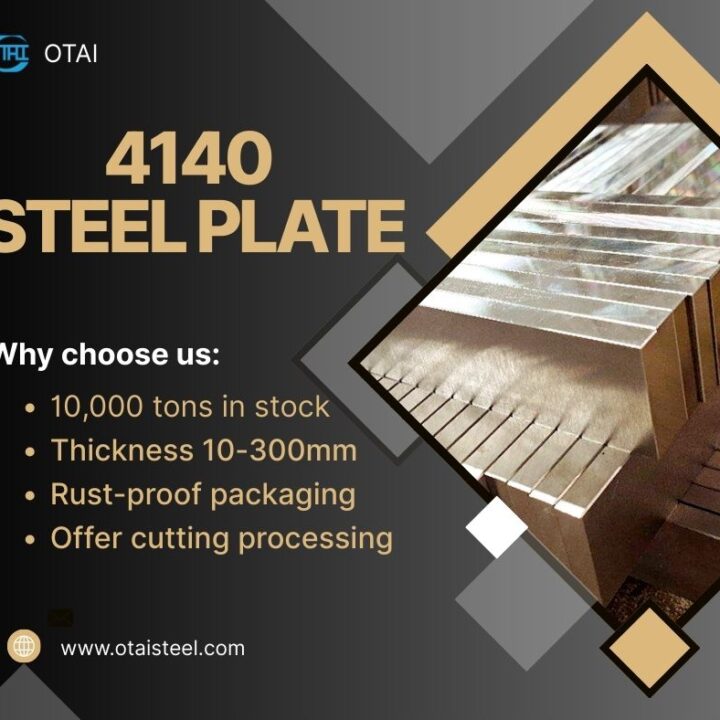
 Engineers, manufacturers, and procurement teams often search for a steel grade that combines strength, wear resistance, and predictable performance after heat treatment. In many cases, 4140 QT steel delivers exactly that balance. Because Quenched and Tempered (QT) treatment optimizes hardness and toughness, this grade works reliably in demanding mechanical applications.
In this article, we explore what 4140 QT steel means, how quenching and tempering change its properties, key mechanical data, practical engineering uses, and how to select the right condition for your projects.
🔎 What is 4140 QT Steel?
4140 QT steel refers to AISI 4140 alloy steel that undergoes quenching and tempering to achieve specific hardness and strength levels. The QT process increases the steel’s resistance to wear, impact, and fatigue loading.
The material belongs to chromium–molybdenum alloy steels and contains approximately:
-
0.40% carbon
-
0.8–1.1% chromium
-
0.15–0.25% molybdenum
These alloying elements support deep hardenability, so heat treatment produces uniform properties across thicker sections.
Engineers choose 4140 QT material when they need consistent performance rather than raw untreated material.
🧪 4140 QT Steel Chemical Composition
The following table shows the typical composition of 4140 grade:
| Element | Content (%) | Function |
|---|---|---|
| Carbon (C) | 0.38–0.43 | Improves hardness and tensile strength |
| Chromium (Cr) | 0.80–1.10 | Enhances wear and corrosion resistance |
| Molybdenum (Mo) | 0.15–0.25 | Increases toughness and creep resistance |
| Manganese (Mn) | 0.75–1.00 | Supports hardenability |
| Silicon (Si) | 0.15–0.35 | Strengthens matrix and shock resistance |
A balanced composition allows 4140 QT material to respond strongly to quenching and tempering.
🔥 What Does QT (Quenched & Tempered) Mean?
QT treatment includes two major stages:
1️⃣ Quenching
Heat the steel to austenitizing temperature, then cool it rapidly (oil or polymer). This step increases hardness dramatically.
2️⃣ Tempering
Reheat the quenched steel to a lower temperature. Tempering:
-
relieves internal stresses
-
improves toughness
-
adjusts hardness to the desired level
Because of QT treatment, 4140 qt steel achieves stable and reliable properties that designers can calculate and predict.
⚡ Mechanical Properties of 4140 QT Steel
Mechanical performance varies with final hardness level. A typical comparison appears below:
| Condition | Tensile Strength (MPa) | Yield Strength (MPa) | Hardness (HRC) |
|---|---|---|---|
| Annealed | ~655 | ~415 | 18–22 |
| Normalized | ~965 | ~655 | 28–32 |
| Quenched & Tempered (QT) | 1080–1600 | 900–1300 | 28–55 |
Therefore, engineers can select hardness based on application demands rather than compromise between strength and toughness.
🛠️ 4140 QT Steel Key Characteristics
When properly heat treated, 4140 qt steel offers several important characteristics:
-
high tensile and yield strength
-
excellent fatigue resistance
-
strong wear resistance
-
good dimensional stability
-
reliable performance under dynamic loading
-
strong core toughness
-
suitability for surface treatments such as nitriding or induction hardening
Because of these benefits, many industries standardize this material for safety-critical parts.
🏗️ Applications of 4140 QT Steel in Industry
Different industries rely on 4140 qt steel because it tolerates load and shock reliably.
🚗 Automotive and transportation
-
transmission shafts
-
axle components
-
crankshafts
-
steering knuckles
✈ Aerospace and defense
-
landing gear components
-
structural pins
-
actuators
🛢 Oil and gas sector
-
drill collars
-
tool joints
-
high-pressure tubing
⚙️ Industrial machinery
-
gears
-
spindles
-
dies and molds
-
hydraulic cylinder rods
Furthermore, engineers prefer 4140 quenched and tempered steel when they require predictable service life and fatigue resistance.
🔧 Machinability and Heat Treatment Behavior
In pre-hardened condition, machining requires rigid setups and carbide tooling. However, annealed 4140 machines easily before final treatment.
Practical engineering tips:
-
keep cutting speeds lower at higher hardness
-
use coolant to manage heat
-
apply carbide inserts for hardened surfaces
-
rough-machine first, then QT for final properties
Moreover, manufacturers often nitridize 4140 QT steel surfaces to gain additional wear resistance without sacrificing core toughness.
📐 Available Forms and Sizes
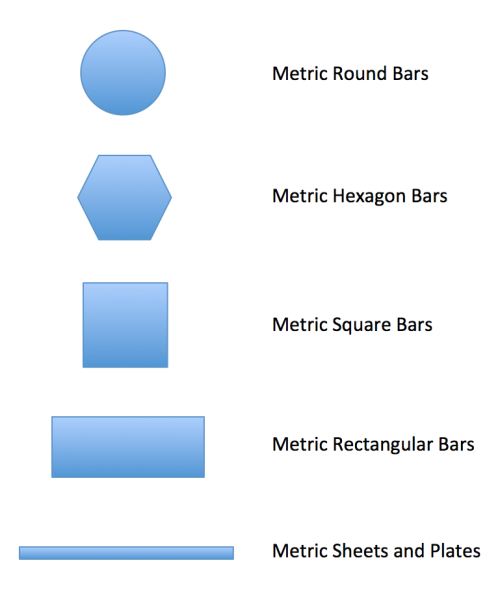
Manufacturers supply 4140 qt steel in several product shapes:
| Product Form | Typical Size Range | Common Use |
|---|---|---|
| Round bar | 10–600 mm diameter | shafts, gears |
| Flat bar | 6–300 mm thickness | dies, plates |
| Tube | OD 10–600 mm | hydraulic cylinders |
| Forgings | customized | heavy duty components |
Because supply covers broad dimensional ranges, engineers can design both small precision parts and massive structural components using the same material family.
🛡️ Benefits of Using 4140 QT Steel
You gain several advantages when you specify 4140 qt steel:
-
predictable strength after heat treatment
-
long service life under cyclic loads
-
strong resistance to abrasive wear
-
flexibility in final hardness selection
-
compatibility with surface engineering methods
-
excellent cost-to-performance ratio
For these reasons, the material remains popular in global engineering markets.
🏅 Company Advantages – Why Source 4140 QT Steel from Otai Special Steel?
When purchasing 4140 QT steel, supplier capability matters as much as material grade. At Otai Special Steel, you benefit from:
-
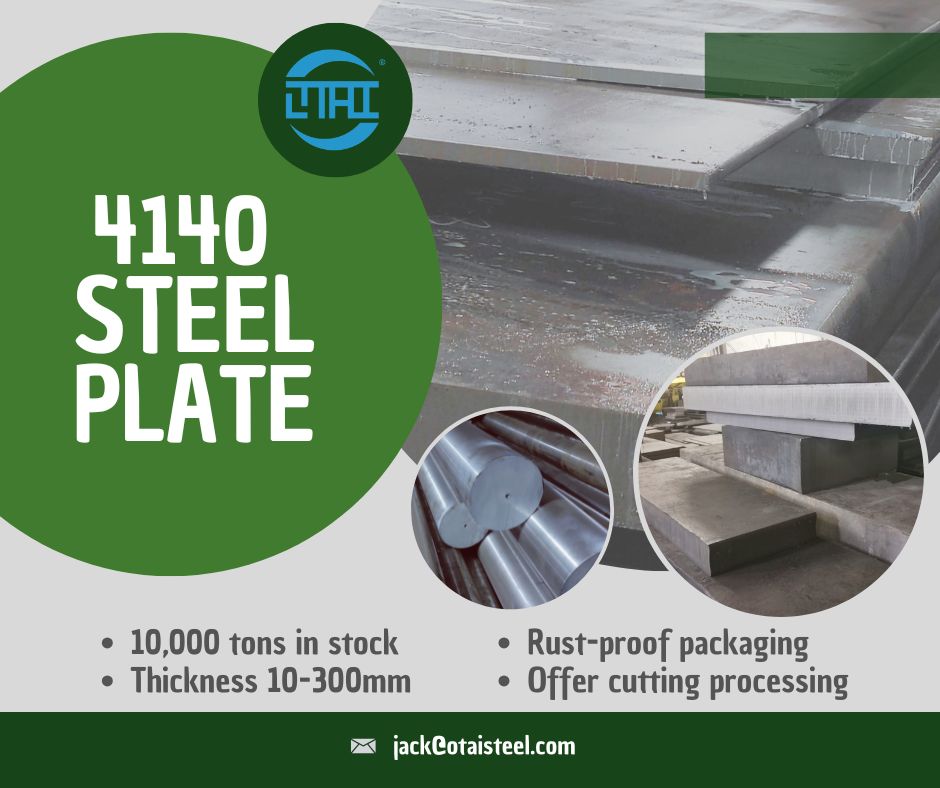
📦 Large inventory – over 10,000 tons of alloy steel bars, plates, and tubes
-
🛠 Processing services – cutting, rough and finish machining, quenching & tempering
-
🧪 Quality control – UT testing, chemical analysis, hardness inspection
-
🌍 Global trust – long-term cooperation with Thyssenkrupp, Borealis, Schlumberger
-
📐 Customized hardness – supply of pre-hardened 4140 steel and 4140 quenched and tempered steel at specified HRC levels
We support both end users and trading companies with stable supply and technical consultation.
❓ FAQ
Q1: What does QT mean in 4140 QT steel?
QT stands for quenched and tempered, the process that increases strength and adjusts hardness.
Q2: What hardness range can 4140 QT steel achieve?
Typical hardness ranges from 28–55 HRC, depending on tempering temperature.
Q3: Can I weld 4140 QT steel?
Yes, but always use preheating and post-weld stress relief to avoid cracking.
Q4: Is 4140 QT steel expensive?
It usually costs more than plain carbon steel but less than tool steel, offering a strong cost-performance ratio.
Q5: What is the difference between annealed 4140 and 4140 QT?
Annealed 4140 machines easily but has lower strength; 4140 qt steel delivers much higher mechanical properties.