 4140 Steel Specs: Detailed Guide
When it comes to selecting materials for engineering, manufacturing, or industrial applications, 4140 steel stands out for its balanced combination of strength, toughness, and versatility. But to fully understand how it can fit into your project, you need to know the exact 4140 steel specs — covering its chemical composition, mechanical properties, heat treatment potential, and dimensional standards. This guide will break down the details so you can make informed sourcing and processing decisions.
🔍 What Does “Specs” Mean for 4140 Steel?
When engineers or buyers talk about 4140 steel specifications, they are referring to a combination of chemical, mechanical, and dimensional data. These specifications ensure the steel meets certain performance criteria for manufacturing gears, shafts, bolts, molds, and other high-stress components.
Specifications can come from different organizations, such as:
-
ASTM (American Society for Testing and Materials)
-
SAE (Society of Automotive Engineers)
-
AISI (American Iron and Steel Institute)
-
DIN (German Standards)
-
JIS (Japanese Standards)
Knowing these standards helps you find equivalent grades across countries and ensures that your supplier’s product matches your technical needs.
🧪 Chemical Composition of 4140 Steel
The chemical makeup of 4140 alloy steel determines its mechanical behavior, heat treatability, and corrosion resistance. The typical composition is:
| Element | Percentage (%) |
|---|---|
| Carbon (C) | 0.38 – 0.43 |
| Manganese (Mn) | 0.75 – 1.00 |
| Chromium (Cr) | 0.80 – 1.10 |
| Molybdenum (Mo) | 0.15 – 0.25 |
| Silicon (Si) | 0.15 – 0.35 |
| Sulfur (S) | ≤ 0.040 |
| Phosphorus (P) | ≤ 0.035 |
These alloying elements give 4140 steel its signature high strength, wear resistance, and good machinability after heat treatment.
⚙️ Mechanical Properties of 4140 Steel
Mechanical properties depend on the steel’s heat treatment condition, but typical 4140 steel specs in normalized or quenched and tempered states are:
| Property | Value Range |
|---|---|
| Tensile Strength (MPa) | 850 – 1000 |
| Yield Strength (MPa) | 655 – 850 |
| Elongation (%) | 20 – 25 |
| Reduction of Area (%) | 50 – 60 |
| Brinell Hardness (HB) | 197 – 235 |
| Impact Energy (J) | 40 – 55 |
These figures make 4140 suitable for heavy-duty parts that face both static and dynamic loads.
🔥 Heat Treatment Specifications
Heat treatment plays a critical role in optimizing 4140 steel mechanical specs. Common processes include:
-
Annealing
Heated to 800–850°C, then cooled slowly to refine grain structure and improve machinability. -
Normalizing
Heated to 870–900°C, air-cooled to improve toughness. -
Quenching & Tempering (Q&T)
Quenched in oil or water from ~840°C, then tempered between 540–680°C to achieve desired hardness and toughness. -
Nitriding
Improves surface wear resistance without changing the core properties.
📏 Dimensional & Form Availability
4140 steel is available in multiple forms:
-
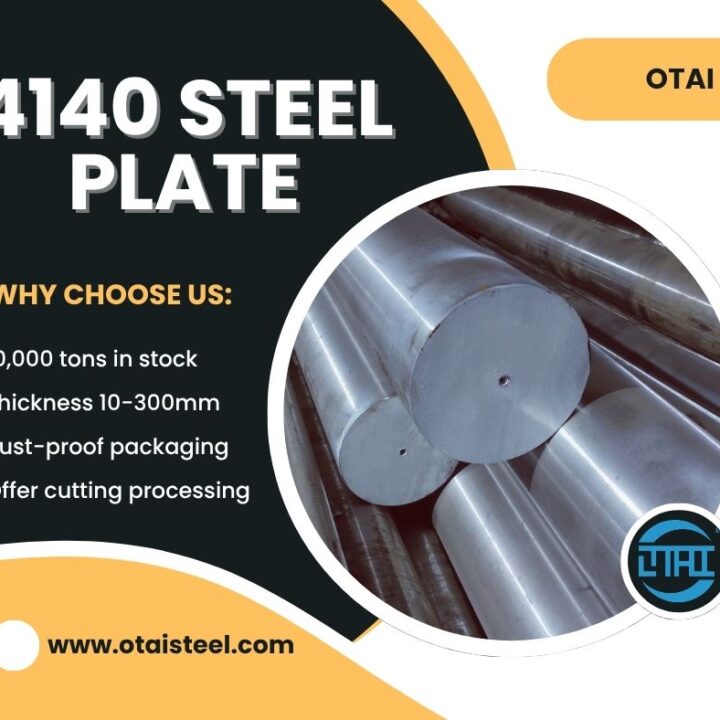
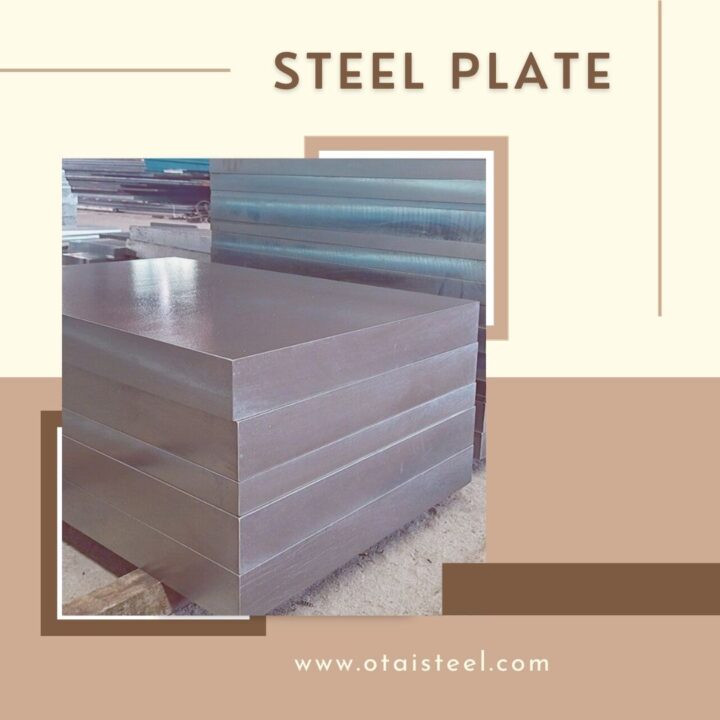
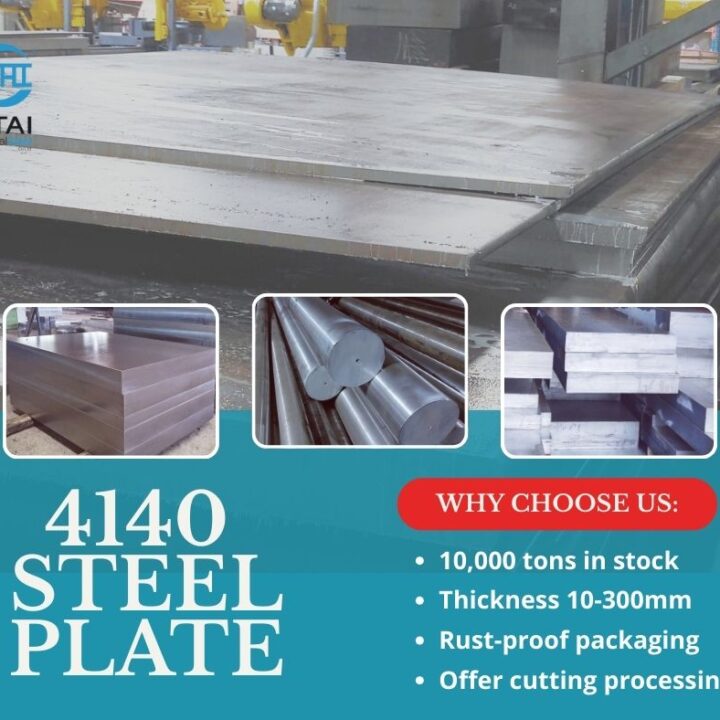
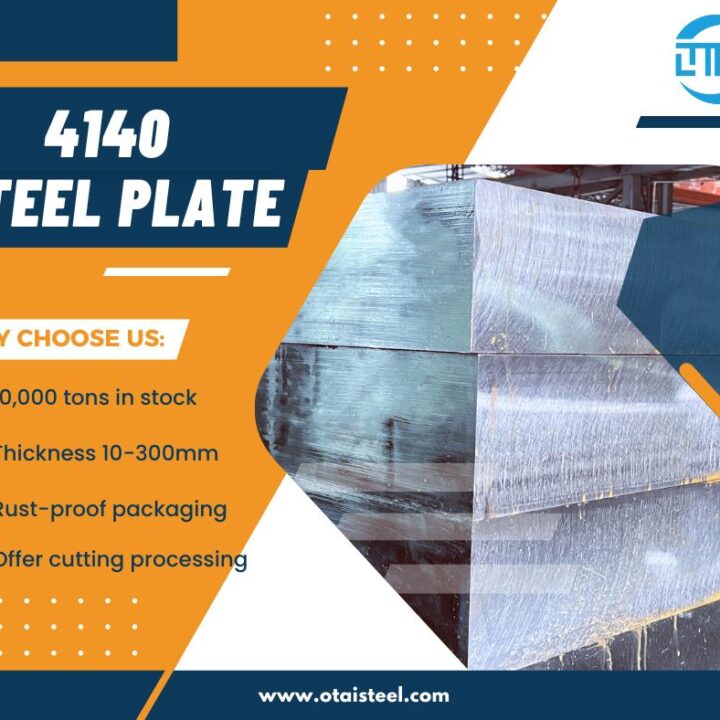
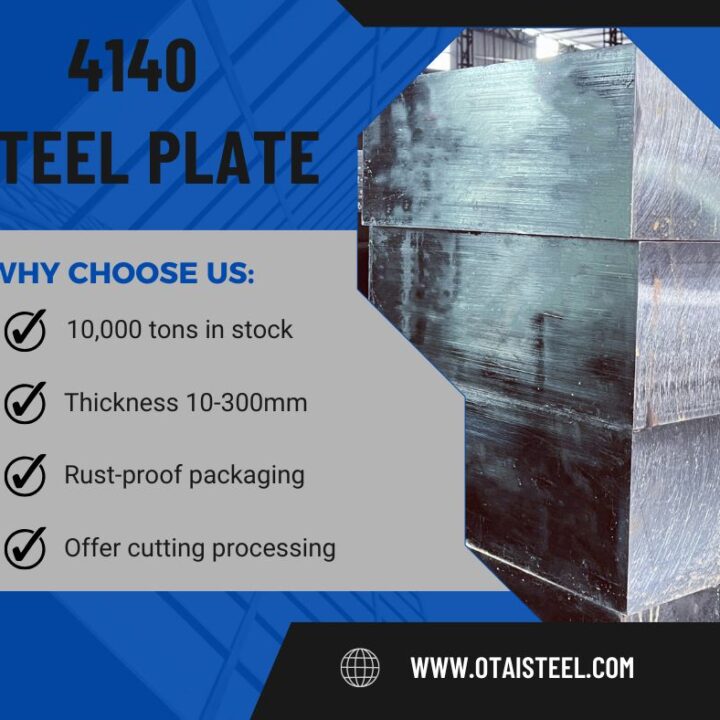
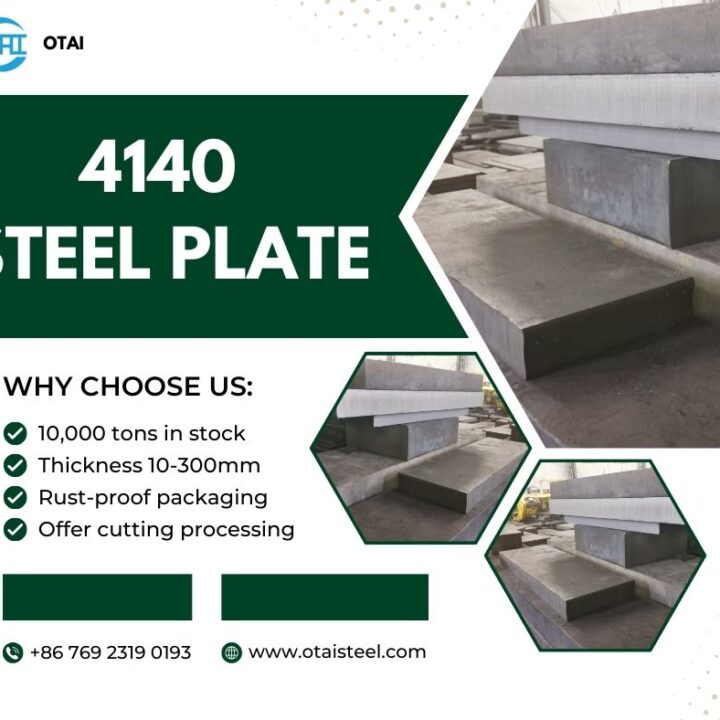
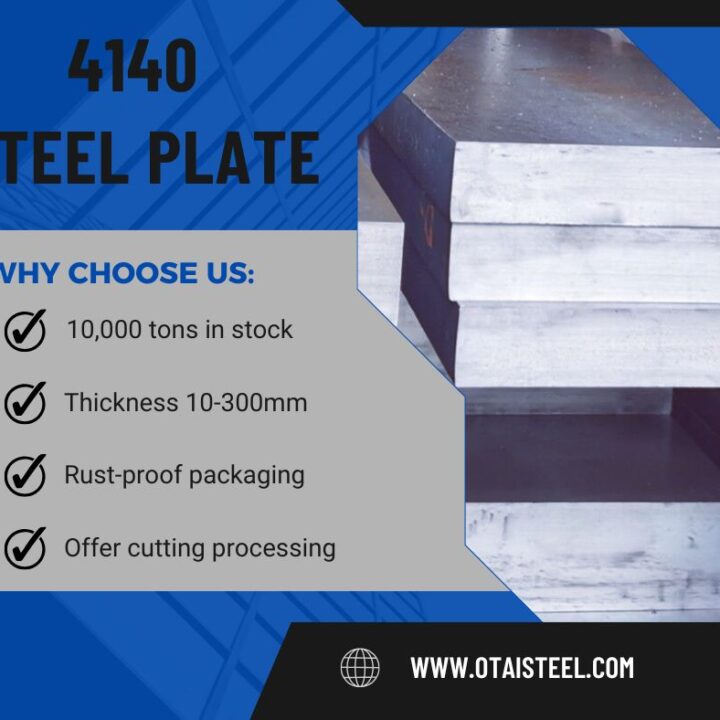
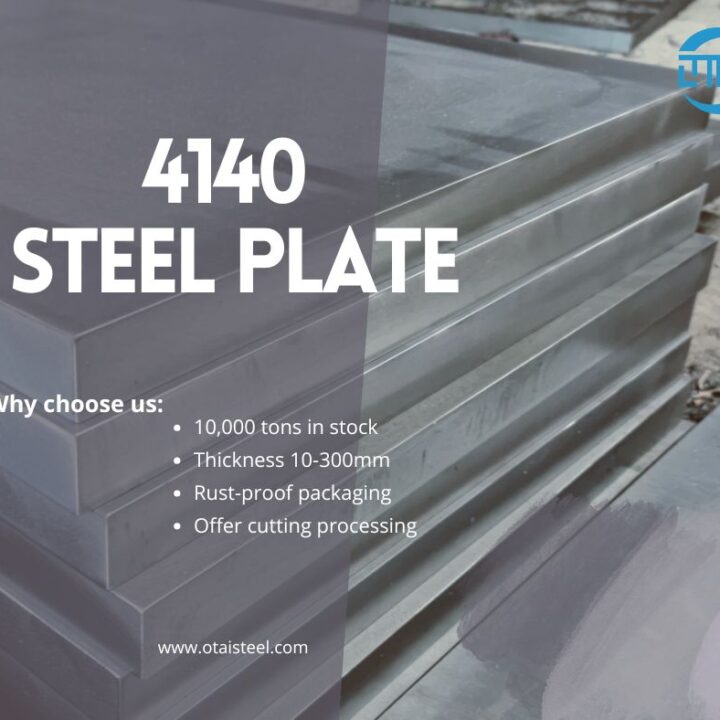
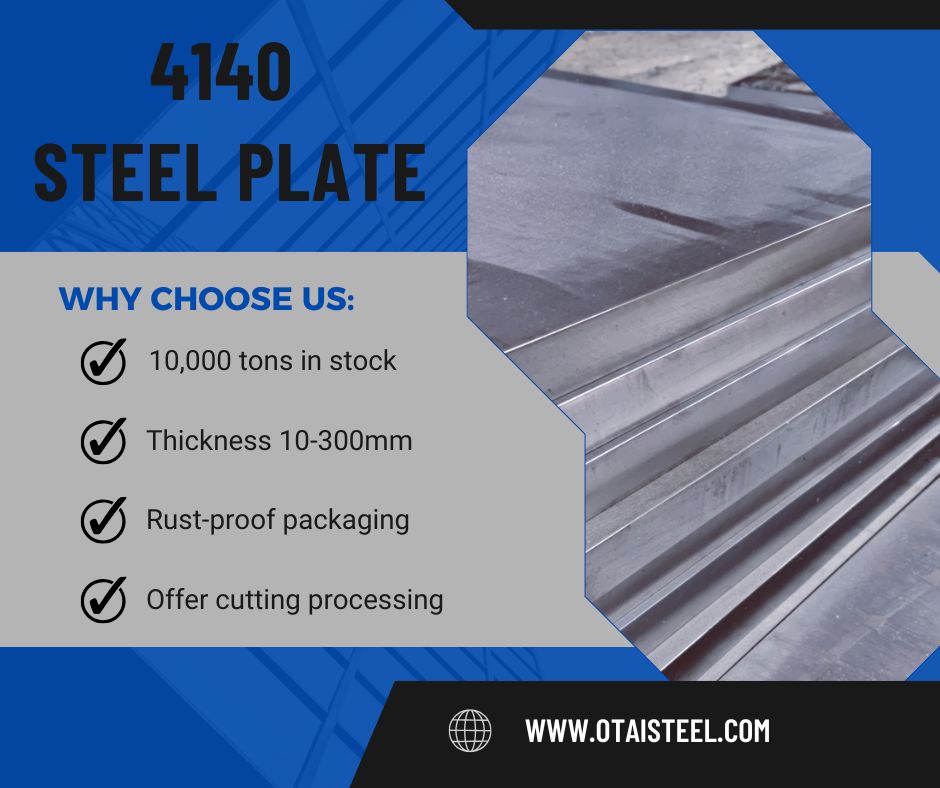
Hot rolled plates: 6mm to 300mm thickness
-
Round bars: 10mm to 500mm diameter
-
Flat bars, blocks, and custom cut shapes
Dimensional tolerances follow standards like ASTM A29 or EN 10083, ensuring uniformity across batches.
🌍 International Equivalents
When sourcing globally, it’s helpful to know alternative designations for 4140 steel:
| Country/Standard | Equivalent Grade |
|---|---|
| ASTM / AISI | 4140 |
| SAE | 4140 |
| DIN | 42CrMo4 |
| JIS | SCM440 |
| GB (China) | 42CrMo |
This helps avoid mismatches in properties when importing or exporting.
🛠 Typical Applications Based on Specs
Because of its balanced properties, 4140 steel is commonly used in:
-
Automotive crankshafts, axles, and gears
-
Oil and gas drilling tools
-
Industrial machinery shafts
-
Heavy-duty bolts and fasteners
-
Tooling components like dies and molds
🧩 Why Understanding 4140 Steel Specs Matters
Knowing the 4140 steel specifications ensures:
-
You select the right heat treatment for your load requirements
-
You match dimensional tolerances for precise fitting
-
You verify international equivalents to avoid substitution errors
-
You reduce risk of premature failure in high-stress environments
In short, detailed knowledge of 4140 specs saves money, improves safety, and ensures better product performance.
💼 Company Advantages
At Otai Special Steel, we supply 4140 alloy steel in a wide range of dimensions and meet multiple international standards (ASTM, DIN, JIS, GB).
Our advantages include:
-
Over 10,000 tons in stock year-round
-
Cutting, heat treatment, and machining services
-
100% ultrasonic testing for internal quality
-
Competitive pricing and fast delivery worldwide
-
Experience serving top brands like Thyssenkrupp and Schlumberger
❓ FAQ
Q1: Is 4140 steel weldable?
Yes, but preheating and post-weld heat treatment are recommended to avoid cracking.
Q2: Can 4140 steel be surface-hardened?
Yes, processes like nitriding or induction hardening are commonly applied.
Q3: What’s the difference between 4140 and 4340 steel specs?
4340 contains higher nickel content, offering better toughness, especially at low temperatures.