 4140 Steel Type: Properties, Uses, and Key Advantages
4140 steel is a highly versatile alloy steel known for its strength, toughness, and hardness. As part of the chrome-molybdenum (Cr-Mo) family, it is widely used across a variety of industries. Known for offering a reliable balance of properties, 4140 steel finds applications in machinery, automotive, and oil & gas industries. This article explores the types of 4140 steel, its composition, uses, and the advantages it offers for high-performance applications.
🧰 What is 4140 Steel?
4140 steel is a low-alloy, medium-carbon steel that contains chromium (Cr) and molybdenum (Mo) as its primary alloying elements. The chromium enhances its hardness, wear resistance, and corrosion resistance, while molybdenum boosts its strength, hardness at high temperatures, and toughness.
This combination of alloying elements provides 4140 steel with an ideal balance of strength, durability, and resilience under harsh conditions.
⚙️ Types of 4140 Steel
The term 4140 steel encompasses several grades, each characterized by different processing methods and heat treatments. The most common types of 4140 steel include:
1. 4140 Normalized Steel
-
4140 normalized steel undergoes heating to a specific temperature followed by cooling in air. This process refines the grain structure, enhancing the material’s overall strength and toughness.
-
Applications: 4140 normalized steel is suitable for general manufacturing, automotive parts, and tools that require high tensile strength and toughness.
2. 4140 Annealed Steel
-
4140 annealed steel is softened through the annealing process, making it easier to machine and form. This type is ideal for parts that need extensive machining before heat treatment.
-
Applications: Commonly used in gears, shafts, and crankshafts, 4140 annealed steel is perfect for components that will undergo further processing.
3. 4140 Quenched and Tempered Steel
-
4140 quenched and tempered steel undergoes a heat treatment where the steel is heated to a high temperature, then rapidly cooled (quenched) and tempered to achieve the desired hardness. This process provides a balance of hardness, strength, and toughness.
-
Applications: Used for components like tools, heavy-duty machinery, and oilfield equipment, this type of 4140 steel performs well under demanding conditions.
🔨 Chemical Composition of 4140 Steel
The chemical composition of 4140 steel plays a significant role in determining its properties. Here’s a breakdown of its key elements:
| Element | Percentage (%) |
|---|---|
| Carbon (C) | 0.38–0.43 |
| Manganese (Mn) | 0.75–1.00 |
| Chromium (Cr) | 0.80–1.10 |
| Molybdenum (Mo) | 0.15–0.25 |
| Silicon (Si) | 0.20–0.35 |
| Phosphorus (P) | ≤0.035 |
| Sulfur (S) | ≤0.040 |
| Iron (Fe) | Balance |
These elements work together to give 4140 steel its desirable strength, durability, and resilience.
⚙️ Key Properties of 4140 Steel
The composition of 4140 steel provides several critical properties, making it suitable for a wide range of applications.
1. High Strength
-
4140 steel offers impressive tensile strength (ranging from 655–1,000 MPa), making it perfect for components subjected to heavy loads and mechanical stress.
2. Hardness
-
With proper heat treatment, 4140 steel can achieve hardness levels between 28–50 HRC, offering great wear resistance and performance in demanding conditions.
3. Toughness and Ductility
-
Even in highly stressed environments, 4140 steel maintains excellent toughness and ductility, preventing brittle failure and ensuring longevity.
4. Fatigue Resistance
-
4140 steel resists fatigue from repetitive stress, making it a top choice for components like gears and shafts exposed to cyclic loading.
🏗️ Applications of 4140 Steel
Due to its strength and versatility, 4140 steel has found applications in several industries. Here’s a look at its primary uses:
1. Automotive Components
-
4140 steel is essential in manufacturing high-performance automotive parts such as crankshafts, axles, gears, and drive shafts. Its high tensile strength and fatigue resistance make it ideal for automotive applications.
2. Industrial Machinery
-
4140 steel is often used in machinery for parts such as shafts, gears, cylinders, and bearings, where strength and wear resistance are critical.
3. Oil & Gas Equipment
-
In the oil and gas industry, 4140 steel is used for drill pipes, couplings, and valves, all of which must withstand extreme pressures and harsh environments.
4. Tooling Applications
-
4140 steel is widely used in the manufacturing of molds, dies, and cutting tools, where its hardness and wear resistance are particularly beneficial.
📊 Comparison of 4140 Steel with Other Steels
Let’s compare 4140 steel with other commonly used materials in terms of tensile strength and hardness:
| Material | Tensile Strength (MPa) | Hardness (HRC) | Applications |
|---|---|---|---|
| 4140 Steel | 655–1,000 | 28–50 | Automotive, machinery, tooling, oilfield |
| 4340 Steel | 1,050–1,200 | 30–40 | Aerospace, military applications |
| 1045 Steel | 570–700 | 18–28 | General engineering, shafts |
| 8620 Steel | 600–850 | 20–30 | Gears, automotive parts |
| AISI 52100 | 1,000–1,200 | 60–65 | Bearings, high-performance mechanical parts |
4140 steel sits comfortably in the middle of the spectrum, providing a solid balance between strength and hardness.
🏆 Why Choose Otai Special Steel for 4140 Steel?
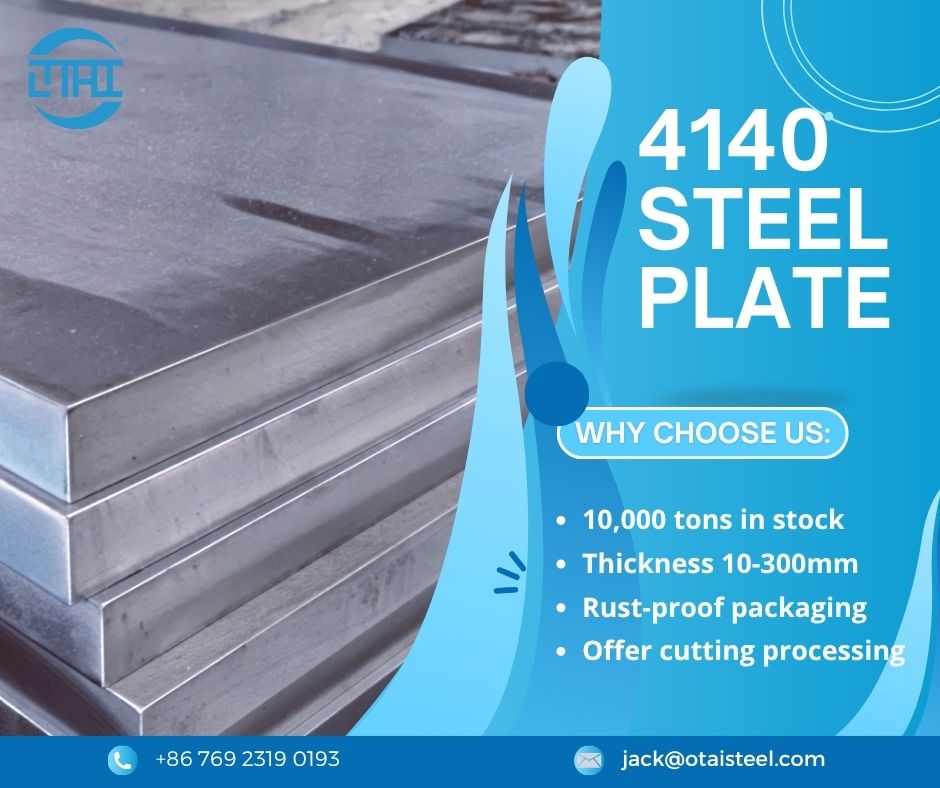
At Otai Special Steel, we offer top-quality 4140 steel that meets international standards. Our strong partnerships with the best steel mills allow us to offer customized cutting, heat treatment, and packaging services tailored to your exact needs.
Advantages of Working with Otai Special Steel:
-
High-Quality Materials: We rigorously test all our 4140 steel to meet chemical and mechanical property standards.
-
Customization: We provide custom cutting and heat treatment to meet your specific project requirements.
-
Competitive Pricing: Our 4140 steel comes at a competitive price, offering you cost-effective solutions without compromising quality.
-
Timely Delivery: With our vast inventory, we ensure quick delivery to meet your deadlines.
❓ Frequently Asked Questions (FAQ)
Q1: What is the tensile strength of 4140 steel?
-
A1: The tensile strength of 4140 steel ranges from 655–1,000 MPa, depending on heat treatment.
Q2: How does 4140 steel perform in automotive applications?
-
A2: 4140 steel is ideal for automotive parts such as crankshafts and axles due to its excellent strength and fatigue resistance.