 16MnCr5 vs 20MnCr5: Key Differences in Composition and Strength
In the field of engineering materials, carburizing steels play a critical role in manufacturing high-performance mechanical components. Two widely used case-hardening steels are 16MnCr5 and 20MnCr5. Engineers and procurement specialists often compare these grades to determine which material better suits their design requirements. Understanding 16mncr5 vs 20mncr5 helps manufacturers select the right steel for gears, shafts, and other load-bearing components.
Both steels belong to the chromium-manganese carburizing steel family and share many similarities in composition and applications. However, differences in carbon content and mechanical performance create distinct advantages depending on the intended use. In this article, we explore the difference between 16MnCr5 and 20MnCr5 steel, examine their chemical composition, compare their mechanical properties, and discuss typical industrial applications.
🔍 Overview of 16MnCr5 and 20MnCr5 Steel
16MnCr5 and 20MnCr5 are low-alloy carburizing steels designed for surface hardening processes such as carburizing and quenching. These steels provide a hardened surface layer combined with a tough core, making them ideal for parts subjected to heavy loads and wear.
The primary difference lies in carbon content. 20MnCr5 contains slightly higher carbon levels than 16MnCr5, which influences its strength and hardness after heat treatment.
Both steels comply with European standard EN 10084 and are commonly used in automotive and mechanical engineering industries.
⚙️ Chemical Composition Comparison
The 16MnCr5 vs 20MnCr5 chemical composition comparison reveals how slight variations in carbon content influence mechanical behavior.
| Element | 16MnCr5 (%) | 20MnCr5 (%) |
|---|---|---|
| Carbon (C) | 0.14 – 0.19 | 0.17 – 0.22 |
| Manganese (Mn) | 1.00 – 1.30 | 1.10 – 1.40 |
| Chromium (Cr) | 0.80 – 1.10 | 1.00 – 1.30 |
| Silicon (Si) | ≤0.40 | ≤0.40 |
| Phosphorus (P) | ≤0.025 | ≤0.025 |
| Sulfur (S) | ≤0.035 | ≤0.035 |
Because 20MnCr5 contains more carbon and chromium, it typically achieves slightly higher hardness and strength after carburizing treatment.
This difference forms the basis of the 16MnCr5 vs 20MnCr5 carburizing steel comparison.
📊 Mechanical Properties Comparison
Mechanical properties play a key role when engineers evaluate 16MnCr5 vs 20MnCr5 mechanical properties for industrial applications.
| Property | 16MnCr5 | 20MnCr5 |
|---|---|---|
| Ultimate Tensile Strength | 800 – 1000 MPa | 900 – 1100 MPa |
| Yield Strength | 550 – 750 MPa | 650 – 800 MPa |
| Core Hardness | 160 – 220 HB | 180 – 240 HB |
| Surface Hardness (carburized) | 58 – 62 HRC | 58 – 63 HRC |
The slightly higher carbon content allows 20MnCr5 to achieve greater tensile strength and hardness. However, both steels maintain excellent toughness and fatigue resistance.
When performing a 16MnCr5 vs 20MnCr5 hardness comparison, the carburized surface hardness remains similar, but 20MnCr5 often provides a stronger core structure.
🔥 Heat Treatment Characteristics
Both steels respond well to carburizing heat treatment processes. The typical procedure includes carburizing, quenching, and tempering.
| Heat Treatment Process | Temperature Range | Purpose |
|---|---|---|
| Carburizing | 880 – 950°C | Increase surface carbon |
| Quenching | 820 – 860°C | Achieve high hardness |
| Tempering | 150 – 200°C | Improve toughness |
Because of its slightly higher carbon content, 20MnCr5 may develop higher core hardness after quenching. However, 16MnCr5 often offers better machinability before heat treatment.
📈 Strength and Performance Comparison
When engineers compare which is better 16MnCr5 or 20MnCr5, the answer depends on the specific performance requirements.
16MnCr5 advantages:
- Better machinability before heat treatment
- Slightly improved toughness
- Lower risk of distortion during heat treatment
20MnCr5 advantages:
- Higher tensile strength
- Higher core hardness
- Better load-bearing capability
Both steels provide excellent fatigue resistance and wear resistance when properly carburized.
🏭 Industrial Applications
Manufacturers use both steels extensively in power transmission systems and mechanical equipment.
Typical 16MnCr5 vs 20MnCr5 applications include:
- Automotive transmission gears
- Differential gears
- Industrial gearbox components
- Camshafts
- Heavy machinery shafts
- Bearing components
16MnCr5 often appears in medium-duty gears and components requiring good machinability. In contrast, 20MnCr5 is commonly used in high-load gear systems where higher strength is necessary.
⚖️ Selection Guidelines for Engineers
Choosing between these two steels depends on the balance between machinability, strength, and service conditions.
| Selection Factor | Recommended Steel |
|---|---|
| Easier machining | 16MnCr5 |
| Higher load capacity | 20MnCr5 |
| Reduced distortion risk | 16MnCr5 |
| Higher core hardness | 20MnCr5 |
Understanding the difference between 16MnCr5 and 20MnCr5 steel allows engineers to make better material decisions for mechanical design.
🌟 Company Advantages
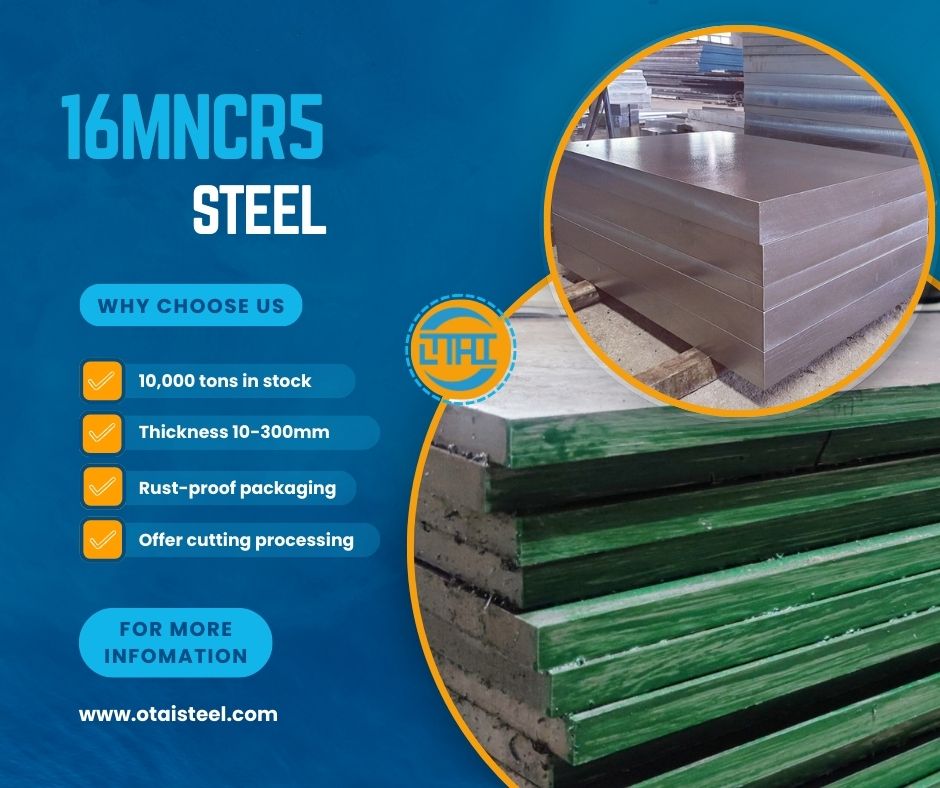
At Otai Special Steel, we supply high-quality alloy steels including 16MnCr5 and 20MnCr5 for global manufacturers.
Our advantages include:
- Over 10,000 tons of alloy steel inventory available year-round
- Thickness range from 6 mm to 300 mm
- Precision custom cutting and processing services
- Strict ultrasonic testing (UT) quality inspection
- Complete chemical composition verification
- Long-term cooperation with international companies such as Thyssenkrupp and Schlumberger
These capabilities ensure reliable steel materials for demanding engineering applications.
❓ FAQ
1. What is the main difference between 16MnCr5 and 20MnCr5?
The main difference lies in carbon content. 20MnCr5 contains slightly more carbon, which increases its tensile strength and core hardness after heat treatment.
2. Which steel is stronger, 16MnCr5 or 20MnCr5?
20MnCr5 generally offers higher strength and hardness due to its higher carbon content.
3. Are both steels suitable for carburizing?
Yes. Both 16MnCr5 and 20MnCr5 are carburizing steels designed for surface hardening processes used in gears and wear-resistant components.
4. When should engineers choose 16MnCr5 instead of 20MnCr5?
Engineers often choose 16MnCr5 when better machinability, improved toughness, or reduced heat-treatment distortion is required.