 16MnCr5 vs 42CrMo4: Differences in Strength and Industrial Use
Selecting the correct steel grade plays a critical role in mechanical design and manufacturing performance. Engineers frequently compare case-hardening steels with high-strength alloy steels to determine which material better suits a specific application. One common comparison involves 16mncr5 vs 42crmo4, two widely used steels in the automotive, machinery, and heavy equipment industries.
Although both steels contain chromium as an alloying element, they belong to different categories and serve different engineering purposes. 16MnCr5 is primarily a carburizing steel designed for surface hardening, while 42CrMo4 is a quenched and tempered alloy steel known for its high strength and fatigue resistance.
This article explores the difference between 16MnCr5 and 42CrMo4 steel, comparing their chemical composition, mechanical properties, hardness levels, and industrial applications.
🔍 Overview of 16MnCr5 and 42CrMo4 Steel
Both steels belong to the family of alloy steels, but they differ significantly in design purpose and heat treatment behavior.
16MnCr5 is a low-carbon carburizing steel commonly used for parts requiring a hard wear-resistant surface and a tough core. Engineers frequently select this material for gears, shafts, and transmission components.
In contrast, 42CrMo4 is a medium-carbon chromium-molybdenum alloy steel designed for high strength after quenching and tempering. It is widely used for heavy-duty components subjected to high loads and fatigue stresses.
Understanding the carburizing steel vs alloy steel comparison helps engineers determine which steel grade delivers the required mechanical performance.
⚙️ Chemical Composition Comparison
The 16MnCr5 vs 42CrMo4 chemical composition comparison shows the main metallurgical differences between these steels.
| Element | 16MnCr5 (%) | 42CrMo4 (%) |
|---|---|---|
| Carbon (C) | 0.14 – 0.19 | 0.38 – 0.45 |
| Manganese (Mn) | 1.00 – 1.30 | 0.60 – 0.90 |
| Chromium (Cr) | 0.80 – 1.10 | 0.90 – 1.20 |
| Molybdenum (Mo) | — | 0.15 – 0.30 |
| Silicon (Si) | ≤0.40 | ≤0.40 |
| Phosphorus (P) | ≤0.025 | ≤0.025 |
| Sulfur (S) | ≤0.035 | ≤0.035 |
The most noticeable difference lies in carbon content. 42CrMo4 contains significantly more carbon and also includes molybdenum, which improves strength, toughness, and resistance to high-temperature stress.
These elements explain the difference between 16MnCr5 and 42CrMo4 steel in terms of mechanical performance.
📊 Mechanical Properties Comparison
Mechanical properties represent one of the most important aspects when evaluating 16MnCr5 vs 42CrMo4 mechanical properties.
| Property | 16MnCr5 | 42CrMo4 |
|---|---|---|
| Ultimate Tensile Strength | 800 – 1000 MPa | 900 – 1200 MPa |
| Yield Strength | 550 – 750 MPa | 700 – 900 MPa |
| Core Hardness | 160 – 220 HB | 28 – 32 HRC |
| Surface Hardness (carburized) | 58 – 62 HRC | Typically not carburized |
Because of its higher carbon content and molybdenum addition, 42CrMo4 generally provides greater overall strength and fatigue resistance.
When engineers analyze which is stronger 16MnCr5 or 42CrMo4, the answer usually favors 42CrMo4 in terms of bulk strength. However, carburized 16MnCr5 provides superior surface wear resistance.
🔥 Heat Treatment Characteristics
Heat treatment methods differ significantly for these steels.
16MnCr5 Heat Treatment
| Process | Temperature Range | Purpose |
|---|---|---|
| Carburizing | 880 – 950°C | Enrich surface carbon |
| Quenching | 820 – 860°C | Increase hardness |
| Tempering | 150 – 200°C | Improve toughness |
This process creates a hardened surface layer while maintaining a tough and ductile core.
42CrMo4 Heat Treatment
| Process | Temperature Range | Purpose |
|---|---|---|
| Quenching | 820 – 870°C | Achieve high hardness |
| Tempering | 500 – 650°C | Balance strength and toughness |
Unlike carburizing steels, 42CrMo4 develops strength throughout the entire cross-section.
📈 Hardness and Wear Resistance
A 16MnCr5 vs 42CrMo4 hardness comparison highlights the functional difference between these materials.
Carburized 16MnCr5 achieves extremely high surface hardness, often exceeding 60 HRC. This property makes it ideal for components exposed to friction and wear.
42CrMo4, on the other hand, typically reaches hardness levels between 28 and 35 HRC after heat treatment. Although lower in surface hardness, it provides superior structural strength and fatigue resistance.
This difference illustrates why engineers select carburizing steels for wear surfaces and quenched-and-tempered steels for load-bearing structures.
🏭 Industrial Applications
Both steels appear in many industrial sectors, but their applications differ according to their mechanical characteristics.
Typical 16MnCr5 vs 42CrMo4 applications include:
16MnCr5 Applications
- Automotive gears
- Transmission components
- Differential gears
- Bearing parts
- Industrial gearboxes
42CrMo4 Applications
- Heavy-duty shafts
- Crankshafts
- Oil and gas drilling components
- High-strength bolts
- Hydraulic cylinders
16MnCr5 excels in parts that require wear-resistant surfaces, while 42CrMo4 performs better in components that must withstand high structural loads.
⚖️ Material Selection Guidelines
Engineers often compare these materials when choosing the most suitable steel for mechanical components.
| Selection Requirement | Recommended Steel |
|---|---|
| High surface wear resistance | 16MnCr5 |
| High structural strength | 42CrMo4 |
| Gear and transmission components | 16MnCr5 |
| Heavy load-bearing shafts | 42CrMo4 |
Understanding the difference between 16MnCr5 and 42CrMo4 steel allows engineers to optimize performance, durability, and production efficiency.
🌟 Company Advantages
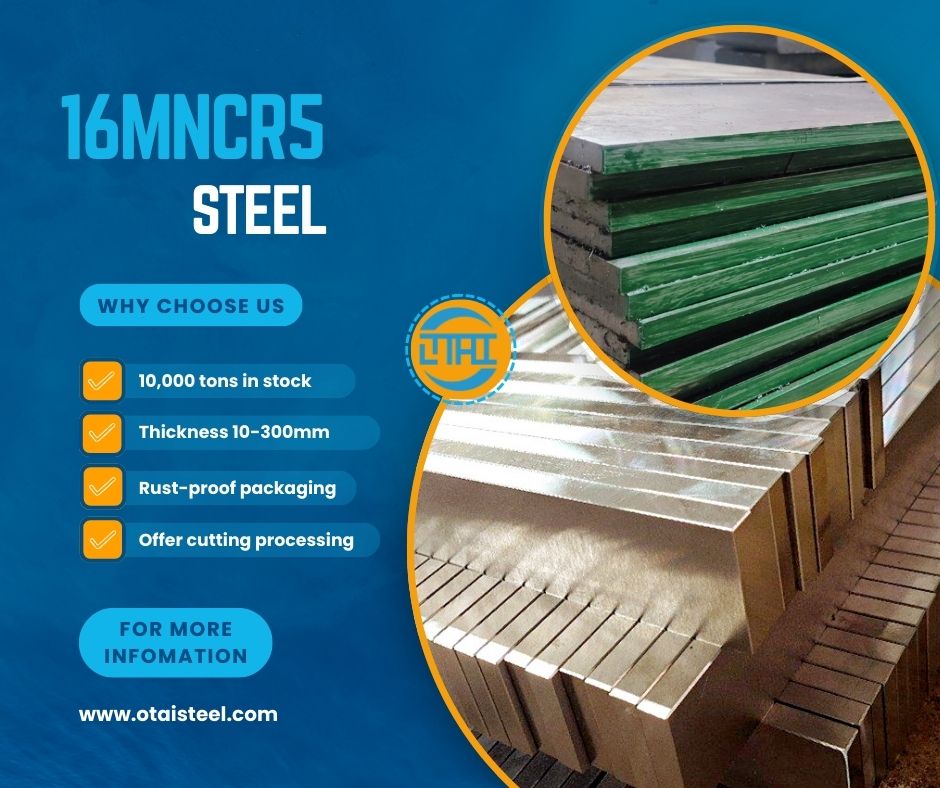
At Otai Special Steel, we supply high-quality alloy steels including 16MnCr5 and 42CrMo4 to global manufacturers.
Our advantages include:
- Over 10,000 tons of alloy steel inventory available year-round
- Thickness range from 6 mm to 300 mm
- Precision custom cutting and processing services
- Strict ultrasonic testing (UT) quality inspection
- Complete chemical composition verification
- Long-term cooperation with international companies such as Thyssenkrupp and Schlumberger
These capabilities allow us to deliver reliable materials for demanding engineering applications.
❓ FAQ
1. What is the main difference between 16MnCr5 and 42CrMo4 steel?
The primary difference lies in their purpose and composition. 16MnCr5 is a carburizing steel designed for surface hardening, while 42CrMo4 is a quenched and tempered alloy steel designed for high strength.
2. Which steel is stronger, 16MnCr5 or 42CrMo4?
42CrMo4 generally provides higher tensile strength and better fatigue resistance due to its higher carbon content and molybdenum addition.
3. Is 42CrMo4 suitable for carburizing?
42CrMo4 is typically not used for carburizing because it already contains higher carbon content and develops strength through quenching and tempering.
4. When should engineers choose 16MnCr5 instead of 42CrMo4?
Engineers usually choose 16MnCr5 for gears and wear-resistant components that require a hardened surface with a tough core.