Alloy Steel 16MnCr5 – Performance, Structure, and Engineering Value
When engineers evaluate materials for gears, shafts, and dynamically loaded components, alloy steel 16MnCr5 often emerges as a highly practical solution. Instead of maximizing strength alone, this steel grade focuses on balanced mechanical behavior, combining surface hardness with core toughness. As a result, it performs reliably in long-term service under cyclic loads.
Unlike plain carbon steels, alloy steel 16MnCr5 uses controlled alloying with manganese and chromium to improve hardenability, fatigue resistance, and wear performance. Therefore, it plays a central role in automotive, industrial transmission, and heavy machinery applications.
This article explores alloy steel 16MnCr5 from an engineering perspective, covering its composition logic, mechanical behavior, heat treatment response, and real-world applications.
1. What Is Alloy Steel 16MnCr5?
Alloy steel 16MnCr5 is a low-carbon chromium-manganese alloy steel defined under EN 10084. Engineers primarily classify it as a case-hardening steel, meaning it develops a hard surface after carburizing while maintaining a tough and ductile core.
Unlike through-hardened steels, 16MnCr5 does not rely on bulk hardness. Instead, it uses carbon diffusion and phase transformation to achieve dual-performance behavior. Consequently, designers can reduce failure risk in impact-loaded or fatigue-sensitive components.
2. Chemical Composition and Alloying Strategy
The chemical composition of alloy steel 16MnCr5 explains its predictable mechanical response and heat treatment stability.
Typical Chemical Composition (wt.%)
| Element | Content Range |
|---|---|
| Carbon (C) | 0.14 – 0.19 |
| Manganese (Mn) | 1.00 – 1.30 |
| Chromium (Cr) | 0.80 – 1.10 |
| Silicon (Si) | ≤ 0.40 |
| Phosphorus (P) | ≤ 0.025 |
| Sulfur (S) | ≤ 0.035 |
Each alloying element serves a clear function:
-
Manganese improves hardenability and core strength
-
Chromium enhances wear resistance and fatigue performance
-
Low carbon content preserves toughness after carburizing
As a result, alloy steel 16MnCr5 responds uniformly to industrial heat treatment processes.
3. Mechanical Properties of Alloy Steel 16MnCr5
Mechanical performance defines the real value of any engineering steel. In alloy steel 16MnCr5, these properties vary depending on condition and heat treatment.
Mechanical Properties (Normalized / Soft Condition)
| Property | Typical Value |
|---|---|
| Tensile strength | 650 – 800 MPa |
| Yield strength | 380 – 500 MPa |
| Elongation (A5) | 12 – 16% |
| Impact toughness (+20 °C) | ≥ 40 J |
| Brinell hardness | 170 – 220 HB |
These values already exceed many plain carbon steels. However, the true advantage appears after carburizing and quenching.
4. Effect of Carburizing on Mechanical Performance
Carburizing transforms alloy steel 16MnCr5 into a dual-structure material. The surface converts into high-carbon martensite, while the core retains a low-carbon bainitic or tempered martensitic structure.
After Carburizing + Quenching + Tempering
| Zone | Typical Property |
|---|---|
| Surface hardness | 58 – 62 HRC |
| Effective case depth | 0.8 – 1.5 mm |
| Core tensile strength | 800 – 950 MPa |
| Core toughness | High |
| Wear resistance | Excellent |
Therefore, alloy steel 16MnCr5 resists surface wear while absorbing internal stress. This balance significantly improves fatigue life compared with through-hardened steels.
5. Fatigue Strength and Load Behavior
Fatigue failure often limits component life more than static overload. Alloy steel 16MnCr5 addresses this challenge in three ways:
-
Hardened surface delays crack initiation
-
Tough core slows crack propagation
-
Residual compressive stress improves fatigue endurance
As a result, gears and shafts made from 16MnCr5 often outperform higher-strength steels in real service conditions.
Moreover, designers can optimize case depth and core hardness based on expected load cycles, which increases design flexibility.
6. Comparison with Similar Alloy Steels
To understand where alloy steel 16MnCr5 fits best, comparison with related grades helps.
Comparison with Similar Steels
| Steel Grade | Heat Treatment Style | Strength Focus | Typical Use |
|---|---|---|---|
| 16MnCr5 | Case-hardened | Fatigue + wear | Gears, shafts |
| 20MnCr5 | Case-hardened | Higher load | Heavy gears |
| 42CrMo4 | Through-hardened | Max strength | High-stress shafts |
| C45 | Normalized / Q&T | Cost-driven | General parts |
Unlike 42CrMo4, alloy steel 16MnCr5 sacrifices peak strength to gain durability and fatigue reliability. Therefore, it suits rotating components better than purely strength-driven designs.
7. Machinability and Manufacturing Considerations
Before carburizing, alloy steel 16MnCr5 machines easily in the soft condition. This characteristic reduces tool wear and improves dimensional accuracy.
Key advantages include:
-
Stable chip formation
-
Low risk of machining cracks
-
Good surface finish before heat treatment
After carburizing, grinding and finishing operations refine gear profiles and bearing surfaces. Therefore, manufacturers often integrate 16MnCr5 smoothly into high-volume production lines.
8. Typical Applications of Alloy Steel 16MnCr5
Thanks to its balanced properties, alloy steel 16MnCr5 appears in many industries:
-
Automotive transmission gears
-
Differential pinions
-
Industrial gearboxes
-
Conveyor drive systems
-
Agricultural machinery components
In each case, engineers prioritize fatigue resistance, wear life, and predictable performance rather than maximum hardness alone.
Company Advantages – Otai Special Steel
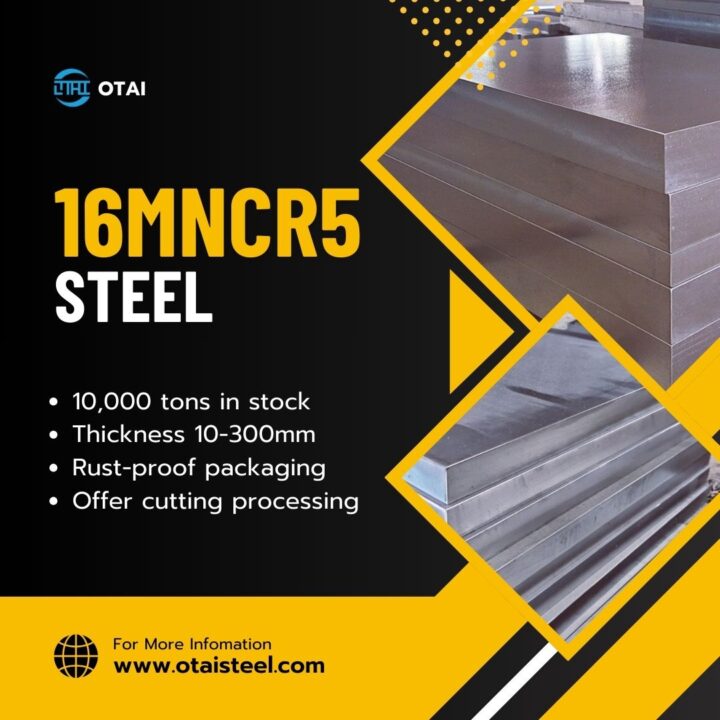
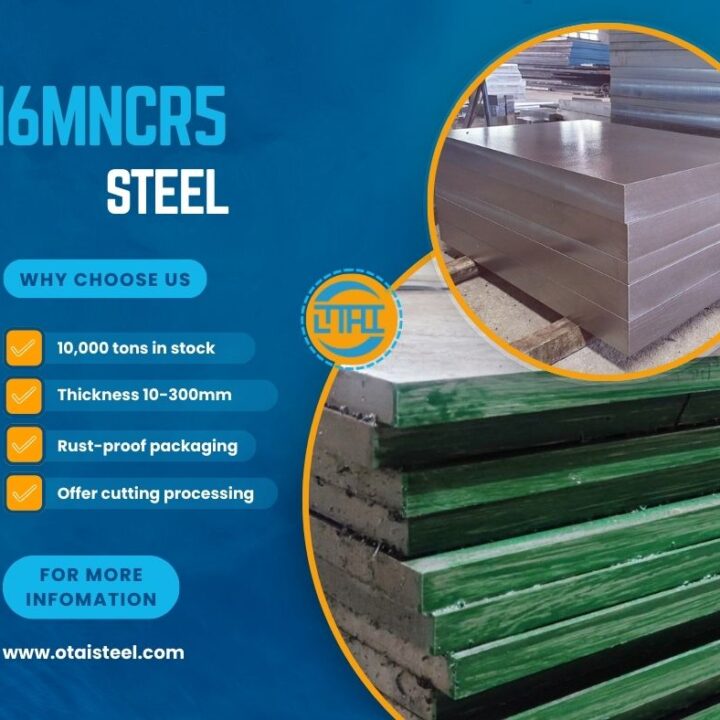
Otai Special Steel supplies alloy steel 16MnCr5 with stable quality and consistent mechanical performance.
Our strengths include:
-
Large inventory of EN 10084 alloy steels
-
Thicknesses and sizes for bars, plates, and forgings
-
Custom cutting and heat-treatment coordination
-
UT testing, chemical analysis, and third-party inspection
-
Long-term supply experience for global OEMs and distributors
We focus on helping customers match steel properties to real service conditions, not just datasheet values.
FAQ
Q1: Is 16MnCr5 steel suitable for high-speed gears?
Yes. Its carburized surface resists wear, while the tough core handles cyclic stress effectively.
Q2: Can 16MnCr5 replace 20MnCr5?
In moderate load conditions, yes. For heavier loads, 20MnCr5 may offer higher core strength.
Q3: Does alloy steel 16MnCr5 require strict heat treatment control?
Yes. Proper carburizing depth and tempering temperature directly affect fatigue life and toughness.