 Closest ASTM Equivalent to 16MnCr5 steel
When buyers source 16MnCr5 ASTM equivalent steel, they usually face one practical question: Which ASTM grade truly matches 16MnCr5 in performance, not just in name?
This comparison matters because many global projects mix European drawings with American standards, especially in automotive, gear manufacturing, and industrial machinery.
This article explains how 16MnCr5 compares to ASTM grades, what engineers should watch out for, and how buyers avoid costly material mismatches.
🔍 What Is 16MnCr5 Steel?
16MnCr5 is a low-alloy case-hardening steel defined under the EN 10084 standard. Manufacturers value it for its excellent core toughness, surface hardness after carburizing, and stable machining behavior.
Key characteristics that buyers care about:
-
Strong core after heat treatment
-
High surface hardness after carburizing
-
Good machinability in delivery condition
-
Reliable performance in gears and shafts
Because ASTM standards do not use the same naming system, buyers must rely on chemical composition and application intent, not just grade numbers.
🧪 Chemical Composition of 16MnCr5 (Reference)
Understanding chemistry helps buyers identify the closest ASTM alternative.
📊 Typical Chemical Composition of 16MnCr5
| Element | Content (%) |
|---|---|
| Carbon (C) | 0.14 – 0.19 |
| Manganese (Mn) | 1.00 – 1.30 |
| Chromium (Cr) | 0.80 – 1.10 |
| Silicon (Si) | ≤ 0.40 |
| Phosphorus (P) | ≤ 0.025 |
| Sulfur (S) | ≤ 0.035 |
This composition clearly positions 16MnCr5 as a carburizing-grade steel, not a through-hardening alloy like 4140.
⚖️ Closest ASTM Equivalent to 16MnCr5
ASTM does not provide a one-to-one equivalent for 16MnCr5. However, engineers widely recognize ASTM A29 / A322 5115 steel as the closest practical alternative.
✅ Commonly Accepted ASTM Equivalent
-
ASTM 5115
-
SAE 5115
These grades share similar carbon levels and alloy intent, especially for case-hardened components.
🔄 16MnCr5 vs ASTM 5115: Practical Comparison
📊 Side-by-Side Comparison
| Aspect | 16MnCr5 (EN 10084) | ASTM / SAE 5115 |
|---|---|---|
| Standard | European (EN) | American (ASTM / SAE) |
| Carbon Content | 0.14 – 0.19% | 0.13 – 0.18% |
| Chromium | 0.8 – 1.1% | ~0.8 – 1.1% |
| Heat Treatment | Carburizing | Carburizing |
| Core Toughness | Excellent | Excellent |
| Typical Use | Gears, shafts | Gears, shafts |
👉 In real production, these two grades behave very similarly after carburizing and quenching.
🔥 Heat Treatment Behavior Buyers Should Understand
Both 16MnCr5 and its ASTM equivalent rely on surface hardening, not full-section hardness.
Typical process flow:
-
Carburizing: 880–940 °C
-
Quenching: Oil quench
-
Tempering: Low-temperature temper
After treatment:
-
Surface hardness: 58–62 HRC
-
Core hardness: 30–40 HRC
This balance explains why manufacturers prefer these steels for gears under cyclic load.
⚠️ Common Buyer Mistakes When Choosing ASTM Equivalents
Many sourcing problems happen because buyers rely on grade names instead of performance intent.
🚫 Typical Errors
-
Replacing 16MnCr5 with 4140 (wrong hardening behavior)
-
Ignoring carburizing requirements
-
Overlooking core toughness after heat treatment
-
Assuming all “Cr steels” behave the same
👉 16MnCr5 ≠ 4140, even though both contain chromium.
🏗️ Typical Applications Using ASTM Equivalents
When buyers select the correct ASTM equivalent, performance remains consistent across standards.
Common applications include:
-
Automotive transmission gears
-
Pinions and sprockets
-
Splined shafts
-
Industrial gearbox components
-
Wear-resistant mechanical parts
These parts benefit from hard surfaces and tough cores, not maximum bulk hardness.
🏅 Company Advantages – Why Otai Special Steel Is a Reliable Choice
At Otai Special Steel, we help buyers match European and American standards based on application, not guesswork.
-
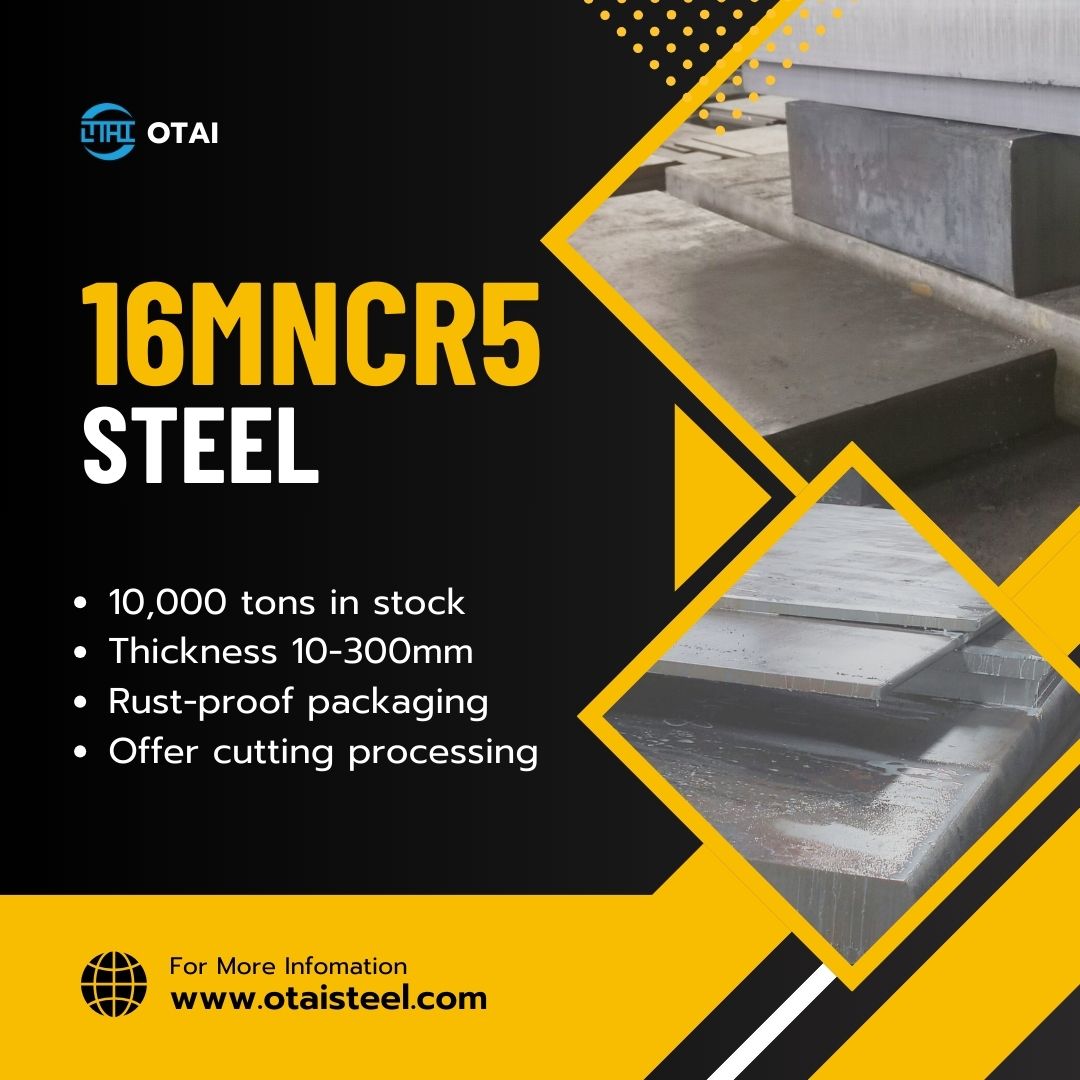
Large Stock: 16MnCr5 plates and bars up to 300 mm
-
Grade Matching Support: EN, ASTM, SAE comparison guidance
-
Heat Treatment Options: Annealed, normalized, carburizing-ready
-
Quality Control: UT testing, chemical analysis, full traceability
-
Project Stability: Consistent supply for repeat orders
We focus on performance equivalency, not just paperwork equivalency.
❓ Frequently Asked Questions (FAQ)
Q1: What is the ASTM equivalent of 16MnCr5?
ASTM / SAE 5115 is the closest and most commonly accepted equivalent.
Q2: Can ASTM 4140 replace 16MnCr5?
No. 4140 is a through-hardening steel and does not suit carburized applications.
Q3: Do 16MnCr5 and ASTM 5115 have the same heat treatment process?
Yes. Both use carburizing, quenching, and tempering.
Q4: Is chemical composition more important than grade name?
Yes. Performance depends on chemistry and heat treatment, not labels.
Q5: Can Otai supply ASTM-equivalent material?
Yes. We support both EN and ASTM specifications with full documentation.