 Case Hardening 16MnCr5: The Key to High-Performance Parts in Demanding Environments
When engineers and manufacturers need materials that deliver high surface hardness and toughness simultaneously, case hardening of 16MnCr5 proves to be an effective solution. This steel, which is commonly used for components like gears, shafts, and bearing parts, benefits from the unique properties of carburizing, a heat treatment process that enhances its wear resistance while maintaining a ductile core.
This article explores the case hardening process of 16MnCr5, how it improves mechanical properties, and why it is a preferred choice in industries where surface durability and core toughness are critical.
🔍 What Is Case Hardening of 16MnCr5?
Case hardening refers to a heat treatment process where the surface of a steel component becomes much harder than its core. In the case of 16MnCr5, a low-carbon steel, carburizing is used to infuse carbon into the surface, followed by quenching and tempering to achieve the desired hardness profile.
The main advantage of case hardening is that the outer layer becomes very hard, while the core remains tough and resistant to fracture, making it ideal for components subjected to high surface wear but requiring impact resistance and fatigue strength in the core.
🧪 Chemical Composition of 16MnCr5 and How It Supports Case Hardening
Before discussing case hardening, it’s important to understand the basic chemistry of 16MnCr5, which influences how it responds to carburizing.
📊 Typical Chemical Composition of 16MnCr5
| Element | Content (%) | Contribution to Case Hardening |
|---|---|---|
| Carbon (C) | 0.14 – 0.19 | Low carbon, ideal for carburizing |
| Manganese (Mn) | 1.00 – 1.30 | Improves hardenability and toughness |
| Chromium (Cr) | 0.80 – 1.10 | Enhances wear resistance and carburizing depth |
| Silicon (Si) | ≤ 0.40 | Helps maintain a strong matrix |
| Phosphorus (P) | ≤ 0.025 | Kept low to avoid brittleness |
| Sulfur (S) | ≤ 0.035 | Controlled for machinability |
This composition provides 16MnCr5 with excellent carburizing response, allowing for a deep, uniform case with excellent hardness without compromising the core’s toughness.
⚙️ Case Hardening Process of 16MnCr5: Step by Step
The process of case hardening 16MnCr5 involves several stages. Each step must be carefully controlled to achieve the right combination of surface hardness and core toughness.
🔥 Steps of the Case Hardening Process
-
Carburizing:
The component exposes itself to a carbon-rich environment at temperatures between 880–930 °C. Carbon atoms diffuse into the steel’s surface, raising the carbon content in the outer layer. -
Soaking:
The steel stays at the carburizing temperature for a set time, ensuring enough carbon diffuses into the surface. -
Quenching:
After carburizing, we rapidly cool the component, typically in oil or polymer, to lock in the high hardness in the surface layer. -
Tempering:
The component then undergoes a lower temperature heat treatment to relieve internal stresses and improve the toughness of the core without affecting the surface hardness.
📊 Hardness and Case Depth of 16MnCr5 After Case Hardening
One of the key advantages of 16MnCr5 case hardening lies in its predictability and control of hardness and case depth.
📏 Typical Hardness Profile After Case Hardening
| Layer | Hardness (HRC) | Typical Use |
|---|---|---|
| Surface (Case) | 58 – 62 HRC | Wear resistance, fatigue resistance |
| Transition Layer | Gradual decrease | Supports the tough core |
| Core | 28 – 35 HRC | Toughness, impact resistance |
The case depth—the thickness of the hardened layer—typically ranges from 0.5 mm to 1.2 mm depending on the component size and carburizing time. This ensures the part can handle high wear while maintaining its structural integrity.
🏗️ Applications of Case Hardened 16MnCr5
Thanks to the unique balance of hard surface and tough core, 16MnCr5 case hardened steel is used in several demanding applications, especially in the automotive, industrial machinery, and aerospace sectors.
🏭 Common Applications:
-
Gears and pinions: High wear resistance for gear teeth.
-
Transmission shafts: Requires toughness inside, hardness outside.
-
Crankshafts: Surface must resist wear, while core must absorb shock.
-
Industrial machinery components: Bearings, cam followers, and other load-bearing parts.
-
Agricultural equipment: Parts that undergo constant abrasion, such as drive components.
In these applications, surface failure is unacceptable, and case hardening ensures that parts last longer in high-stress environments.
🔧 Machining Case Hardened 16MnCr5
16MnCr5 steel is typically machined before case hardening when it’s in its softer annealed state. After hardening, the material becomes much more challenging to machine due to its high surface hardness.
🧰 Tips for Machining:
-
Before Case Hardening: Machining is easier in the annealed state.
-
After Case Hardening: Use grinding, honing, or special cutting tools to finish hardened surfaces.
-
Post-Hardening Adjustments: Allow for some stock removal during machining to compensate for any minor distortions from the quenching process.
🏅 Company Advantages – Why Choose Otai Special Steel?
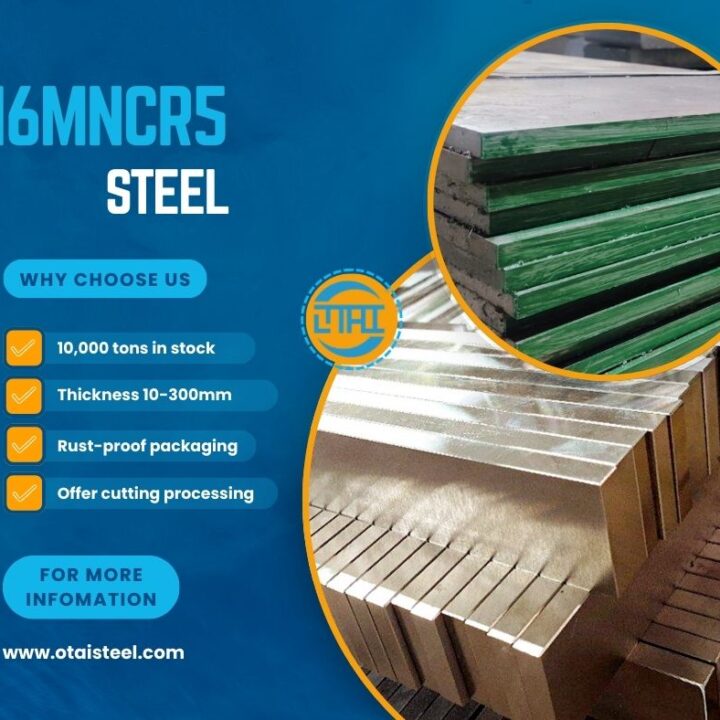
At Otai Special Steel, we provide 16MnCr5 steel with consistent quality and precise case hardening control.
-
Large Stock: A wide selection of 16MnCr5 steel plates, bars, and forgings.
-
Reliable Heat Treatment: Controlled carburizing and tempering processes for uniform surface hardness.
-
Custom Processing: Cutting, heat treatment, and machining services tailored to your needs.
-
Quality Control: UT testing, chemical analysis, and full traceability.
-
Global Reach: Trusted by automotive, machinery, and heavy equipment manufacturers.
We help you select the right material for each application—maximizing performance and cost-efficiency.
❓ FAQ – Case Hardening 16MnCr5
Q1: What is the case depth of 16MnCr5?
The typical case depth of 16MnCr5 is between 0.5 mm and 1.2 mm, depending on the application and heat treatment conditions.
Q2: Can I use 16MnCr5 for deep carburizing?
Yes, 16MnCr5 is ideal for deep carburizing applications, particularly for parts like gears and shafts.
Q3: How does case hardening affect the impact resistance of 16MnCr5?
While the surface becomes very hard, the core remains tough, maintaining high impact resistance and fatigue strength.
Q4: What industries use case-hardened 16MnCr5?
It is used across automotive, industrial, and aerospace industries for parts that need high wear resistance and core toughness.
Q5: Can Otai provide case-hardened 16MnCr5 to my specifications?
Yes, we can provide customized case hardening for your specific components, ensuring they meet your hardness and toughness requirements.