 Steel Grade 4140 Equivalent: Exploring Similar Steels and Their Applications
When selecting materials for industrial applications, it’s essential to understand the different types of steel and their equivalencies. 4140 steel is a versatile, medium-carbon alloy steel commonly used in manufacturing components that require high strength, durability, and resistance to wear. However, many other steels share similar properties and can be used as alternatives in specific applications. In this article, we will explore the equivalents of 4140 steel, including their properties and applications.
🏗️ What is 4140 Steel?
4140 steel is an alloy steel that contains chromium and molybdenum as its primary alloying elements. These elements enhance the steel’s hardness, strength, and ability to resist wear, making 4140 steel highly suitable for applications such as gears, shafts, and machine parts. The alloy typically contains the following:
-
Carbon (C): 0.38–0.43%
-
Manganese (Mn): 0.75–1.00%
-
Chromium (Cr): 0.80–1.10%
-
Molybdenum (Mo): 0.15–0.25%
This combination results in excellent mechanical properties such as high tensile strength, good hardenability, and resistance to impact, making 4140 steel a popular choice in the automotive, aerospace, and oil and gas industries.
🔧 Equivalents of 4140 Steel
Several other steel grades are similar to 4140 steel in terms of composition and mechanical properties. These steels are often used as substitutes depending on the specific requirements of a project. Below are some common equivalents to 4140 steel and their key characteristics:
1. AISI 4142 Steel
-
AISI 4142 steel is almost identical to 4140 steel, with slightly higher carbon content (around 0.40%). This steel also contains chromium and molybdenum, resulting in similar mechanical properties. The main difference is the slightly improved hardenability of 4142 compared to 4140.
-
Applications: Like 4140, 4142 steel is used in the manufacturing of gears, shafts, and crankshafts in industries that require high strength and wear resistance.
2. AISI 4150 Steel
-
AISI 4150 is another close equivalent to 4140 steel. The key difference is that 4150 contains slightly higher carbon content (0.45%), providing better wear resistance and improved hardness.
-
Applications: 4150 steel is commonly used in automotive and military applications, particularly for firearms, gun barrels, and high-performance machinery.
3. EN 19 (DIN 1.4511)
-
EN 19 is a high-quality alloy steel that is widely used as an equivalent to 4140 steel. It contains similar alloying elements, including chromium and molybdenum, and offers excellent strength and toughness.
-
Applications: EN 19 is used in the production of gears, shafts, engine components, and diesel engine parts due to its high strength and ability to withstand wear.
4. 42CrMo4 (DIN 1.7225)
-
42CrMo4 is a German steel equivalent to 4140 with similar mechanical properties. It offers excellent hardenability, strength, and resistance to fatigue, making it suitable for heavy-duty components.
-
Applications: 42CrMo4 is commonly used in automotive and machine tool manufacturing where components need to endure high-stress environments, such as gears, axles, and crankshafts.
5. SAE 4130 Steel
-
SAE 4130 is a chromium-molybdenum steel that is frequently compared to 4140 steel due to its similar chemical composition. The carbon content in 4130 is slightly lower than 4140, which can result in slightly lower hardness but increased ductility and toughness.
-
Applications: 4130 steel is often used in aircraft structures, chassis, and military applications, where the balance of strength and weight is crucial.
6. AISI 4340 Steel
-
AISI 4340 is a high-strength, low-alloy steel containing nickel, chromium, and molybdenum. It has higher toughness and strength than 4140, but it is also more expensive. It is often used in highly demanding applications.
-
Applications: 4340 steel is used for aircraft components, gears, and heavy-duty machinery where extreme tensile strength and fatigue resistance are required.
🔍 Comparison of Mechanical Properties
Here’s a quick comparison of the mechanical properties of 4140 steel and its key equivalents:
| Steel Grade | Tensile Strength (MPa) | Yield Strength (MPa) | Hardness (HRC) | Applications |
|---|---|---|---|---|
| 4140 Steel | 655–1,000 | 415–650 | 28–50 | Automotive, industrial machinery, tools |
| 4142 Steel | 675–1,050 | 450–675 | 28–50 | Gears, shafts, crankshafts |
| 4150 Steel | 850–1,200 | 450–700 | 32–50 | Firearms, automotive, aerospace |
| EN 19 (1.4511) | 850–1,100 | 450–650 | 30–40 | Engine components, machine parts |
| 42CrMo4 (1.7225) | 900–1,050 | 600–750 | 30–50 | Gears, axles, crankshafts |
| SAE 4130 | 670–1,000 | 430–600 | 28–50 | Aircraft, military, structural components |
| 4340 Steel | 1,000–1,200 | 850–1,050 | 40–60 | Aerospace, military, heavy machinery |
🏆 Why Choose Otai Special Steel for Your Steel Needs?
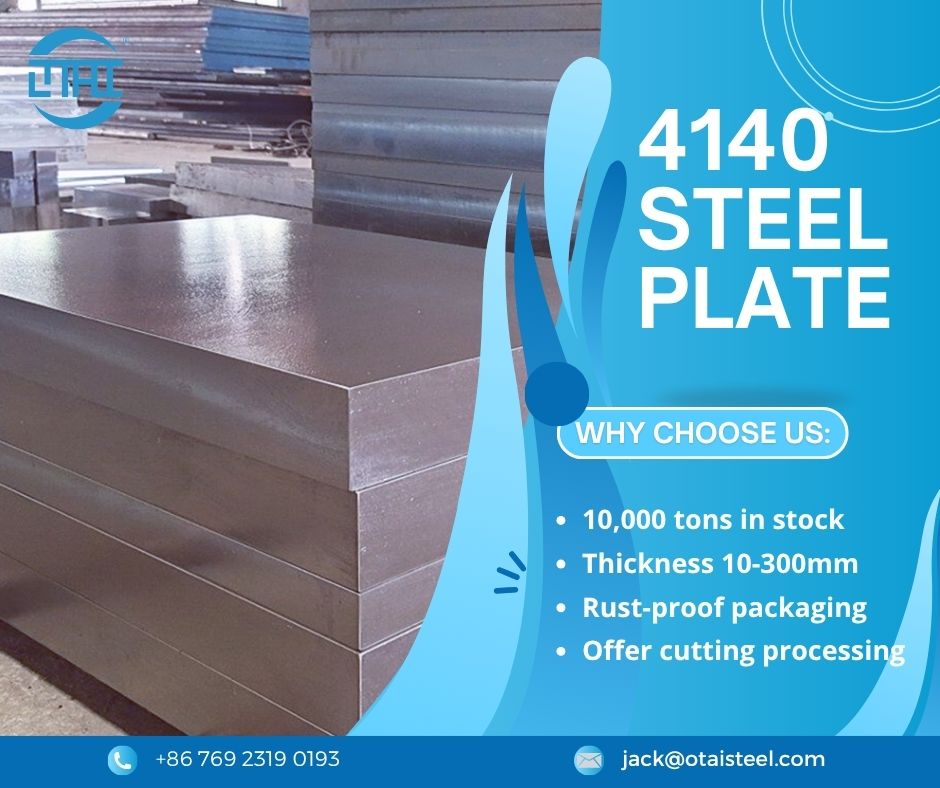
At Otai Special Steel, we specialize in providing high-quality alloy steels, including 4140 steel and its equivalents. Our expertise in sourcing, cutting, heat treatment, and packaging ensures that you receive precisely what you need for your project, with reliable delivery and competitive pricing.
Advantages of Working with Otai Special Steel:
-
Top-Quality Materials: We provide only the highest-quality 4140 steel and its equivalents with consistent mechanical properties.
-
Customization: We offer custom cutting, heat treatments, and machining to meet your exact project requirements.
-
Cost-Effective Solutions: Our pricing ensures that you get high-performance steel at competitive rates without compromising quality.
-
Fast Delivery: With an extensive inventory and efficient logistics, we guarantee prompt delivery for all your steel requirements.
❓ Frequently Asked Questions (FAQ)
Q1: What are the primary equivalents of 4140 steel?
-
A1: Some of the main equivalents of 4140 steel include 4142 steel, 4150 steel, EN 19, 42CrMo4, and SAE 4130 steel. These materials share similar mechanical properties and are used in similar applications.
Q2: How do I choose between 4140 steel and its equivalents?
-
A2: The choice between 4140 steel and its equivalents depends on factors such as strength, ductility, hardness, and cost. For example, 4340 steel offers superior strength and is ideal for more demanding applications, while SAE 4130 is better for applications requiring lighter weight and more ductility.
Q3: Can I use 4140 steel in high-temperature environments?
-
A3: 4140 steel is suitable for applications that involve high temperatures, but its performance at very high temperatures may be limited compared to steels like 4340. For extreme temperatures, consider materials specifically designed for high-heat environments.